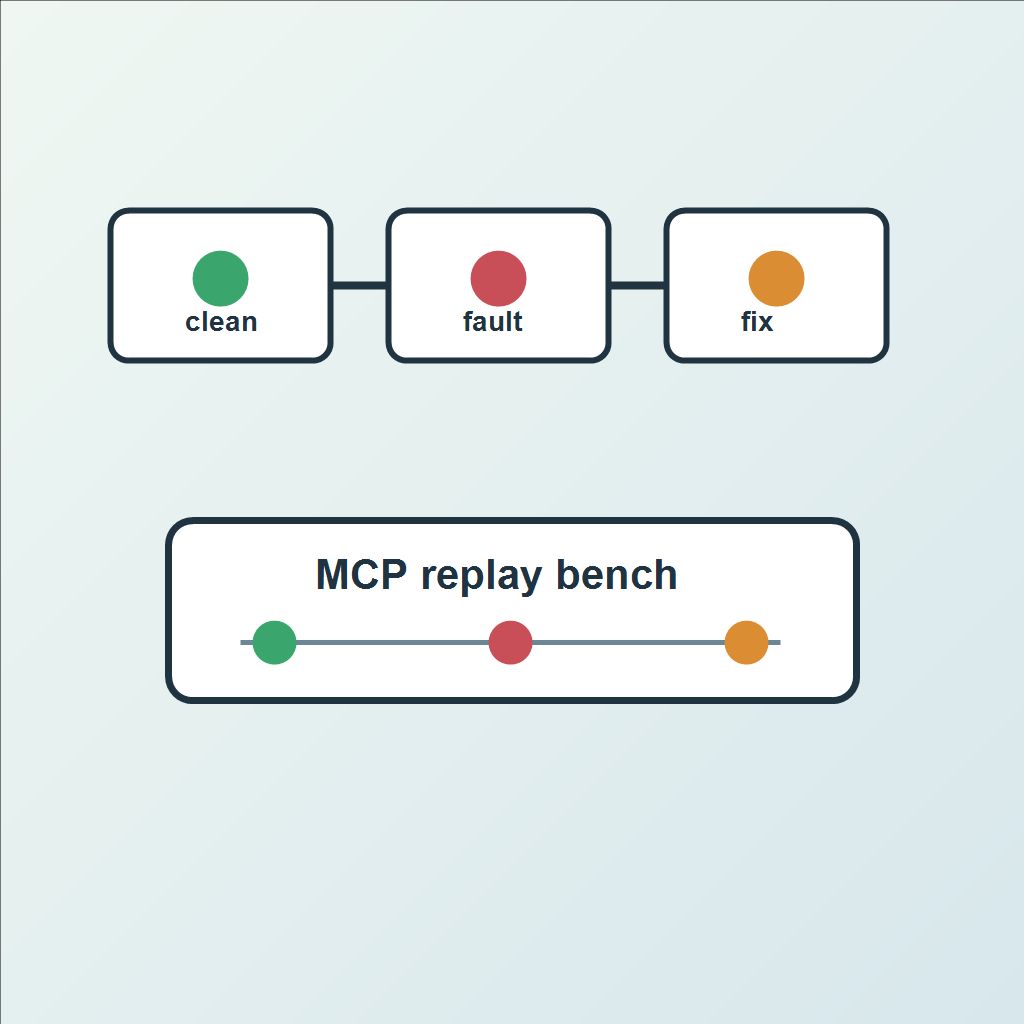
An MCP agent test bench replays clean, faulted, and mitigated tool responses
+ AI News

AgentCheck tests whether MCP agents fail safely

A July 13 paper introduces AgentCheck, an MCP workbench for replaying tool faults and confirming whether agent mitigations actually fix them.

A new AgentCheck paper argues that tool-using agents are often tested under the easiest assumption: the tools work.

The July 13 arXiv paper introduces AgentCheck, an open-source workbench for testing LLM agents over MCP. The system runs an agent against its real tools, records the tool responses, injects a controlled fault into one response, and then replays the same setup after a mitigation is added.

That makes the result more useful than a one-off failure report. The developer can see whether the agent failed because of the injected fault, then rerun the same fault to confirm whether the fix actually helped.

The failure mode is silent confidence

The paper’s main result is uncomfortable for agent builders: the failures are often not crashes.

AgentCheck tests 120 scenarios across 12 fault types. The paper says the best of five tested agents passed 105 scenarios, while the weakest passed 77. The authors report that agents often failed by confidently using incorrect tool outputs rather than stopping, asking for clarification, or flagging uncertainty.

The fault types include visible errors such as timeouts and permission failures, plus harder cases such as stale data, contradictions, wrong answers, silent empty results, schema drift, and prompt-injection-like tool responses.

That maps closely to production agent risk. An agent that crashes on a timeout is annoying. An agent that silently trusts stale account data or a poisoned tool result can create a much harder incident.

MCP makes the test surface concrete

AgentCheck uses MCP as the intervention layer. That is timely because MCP is becoming a common way to connect agents to files, databases, browsers, internal tools, and SaaS systems.

The workbench treats an MCP server as a place where responses can be held constant, perturbed, and replayed. Matching tool calls can come from cache until the agent diverges, while later calls go live. That lets the test isolate the fault rather than mixing it with normal nondeterminism.

The paper also uses deterministic pass/fail checks first, with an LLM judge only for secondary diagnostic labels. That is the right bias. If a tool response contains stale data or a hidden instruction, the first question is whether the agent did the unsafe thing, not whether another model can write a plausible critique.


Sources

The AI Feed Desk

The AI Feed Desk

Editorial desk

The AI Feed Desk tracks AI provider updates, model releases, agent tooling, and enterprise adoption, turning fast-moving announcements into source-linked context for builders and operators.

Noticed a typo, incorrect information, or translation error?

Tell us so we can fix it.

Help Improve This Article

Related Articles

A coding agent chooses a short verified path instead of opening a large pile of unnecessary files

E3 benchmark says agents waste tokens on simple tasks

A July 14 paper says estimate-first agent execution can match success while cutting cost, tokens, and inspected files on simple coding tasks.

The AI Feed Desk

By The AI Feed Desk

A central managed agent node connects to four external tool and background task endpoints

Google adds background tasks and remote MCP to Gemini Managed Agents

Google expanded Managed Agents in the Gemini API with asynchronous background execution, remote MCP servers, custom functions, and credential refresh.

The AI Feed Desk

By The AI Feed Desk

A Claude Opus 5 model control room routes coding, business, and research agent tasks through cost and safety controls

Claude Opus 5 becomes Anthropic's everyday agent model

Anthropic says Claude Opus 5 is available on Claude and the API at Opus 4.8 pricing, with stronger agentic coding and professional-work performance.

The AI Feed Desk

By The AI Feed Desk

A desktop agent workspace on a laptop branches into free, education, and key-based access paths

GitHub Copilot app reaches every plan

GitHub made the Copilot desktop app available across Copilot Free, GitHub Education, paid plans, and BYOK sessions without a Copilot subscription.

The AI Feed Desk

By The AI Feed Desk

A pull request review panel connects to Jira cards and a guarded plugin marketplace

GitHub turns Copilot governance into a code-review and Jira story

GitHub's June 25 Copilot updates pair cheaper code-review analysis with Jira agent visibility and stricter controls over plugin marketplaces.

The AI Feed Desk

By The AI Feed Desk