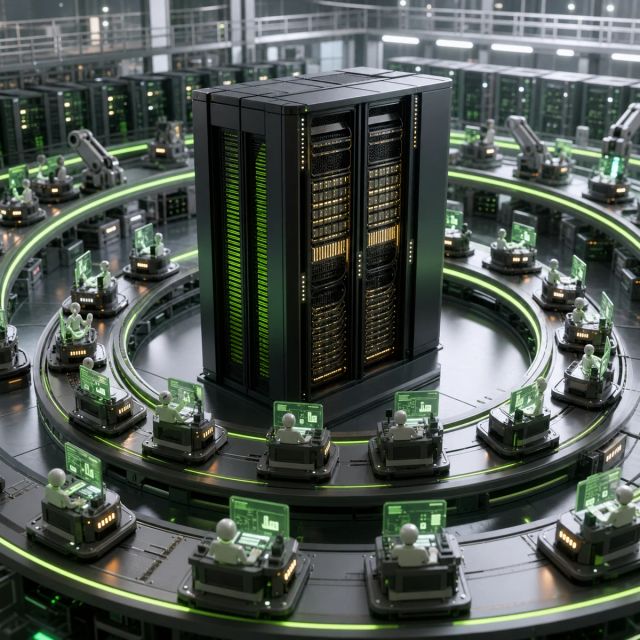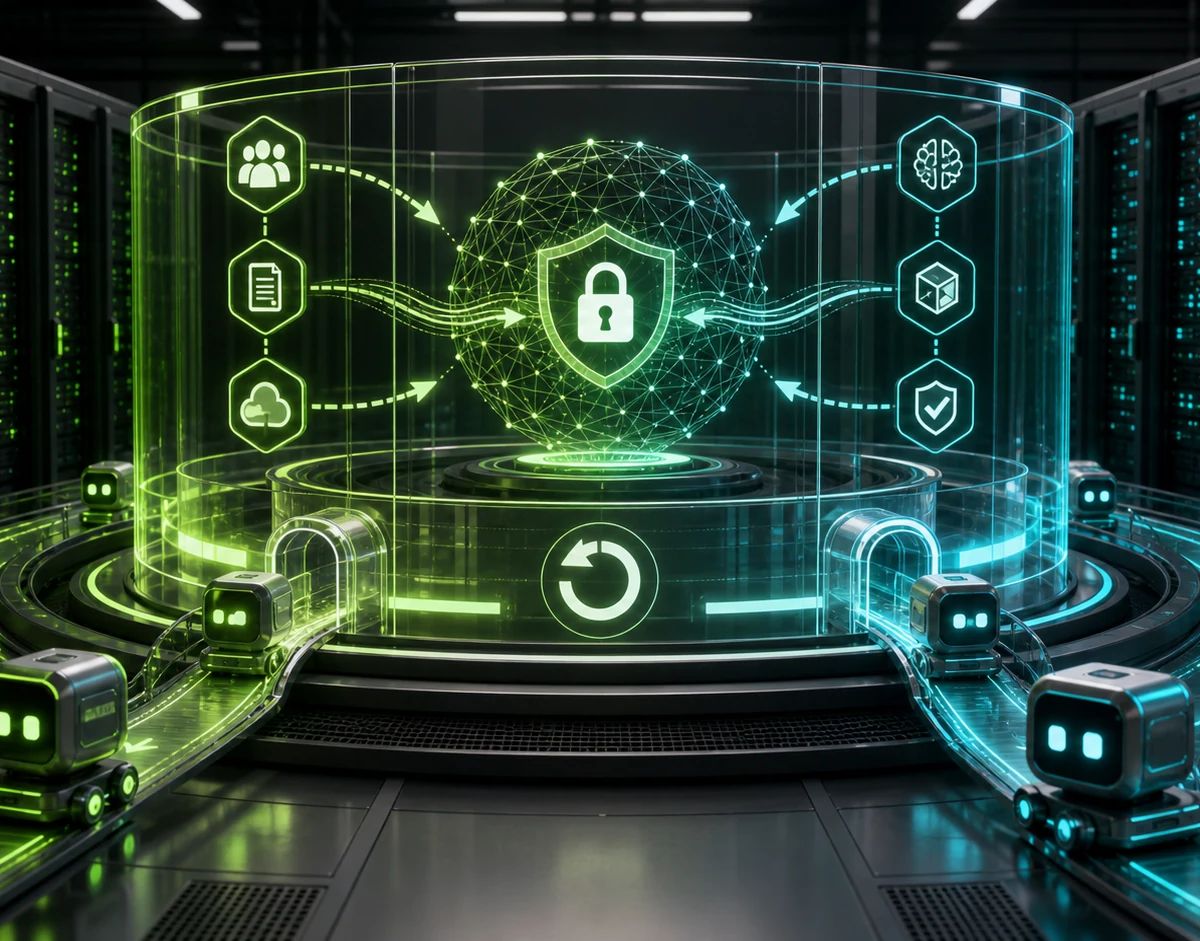
NVIDIA and HPE are expanding HPE AI Factory with NVIDIA around agent infrastructure, not just more accelerator capacity. The new package adds NVIDIA Vera CPU support for HPE Private Cloud AI, NVIDIA Agent Toolkit, local agent registration, HPE Zerto rollback capabilities, confidential computing, and deeper NVIDIA networking integration across HPE AI Factory offerings.
That is the interesting shift. Enterprises do not only need faster agents. They need agents that can be approved, monitored, rolled back, and run near sensitive data. The HPE and NVIDIA update reads like a control-plane story for that problem.
NVIDIA says the HPE ProLiant Compute DL394 Gen12 with NVIDIA Vera CPU will be available in 2027 with HPE Private Cloud AI. Vera is positioned as a CPU built for the agent loop: tool calls, orchestration, and real-time data processing. The New York Stock Exchange, with Redpanda and HPE, is described as an early enterprise customer exploring Vera CPU with that server.
Agent governance is becoming infrastructure
The more useful part of the announcement is the agent operating layer. NVIDIA Agent Toolkit, including Nemotron open models, OpenShell secure runtime, and NemoClaw blueprints, will be available with HPE Private Cloud AI. NVIDIA says the toolkit is meant to help enterprises monitor agent behavior, enforce governance policies, and safely build and run long-running multi-agent systems.
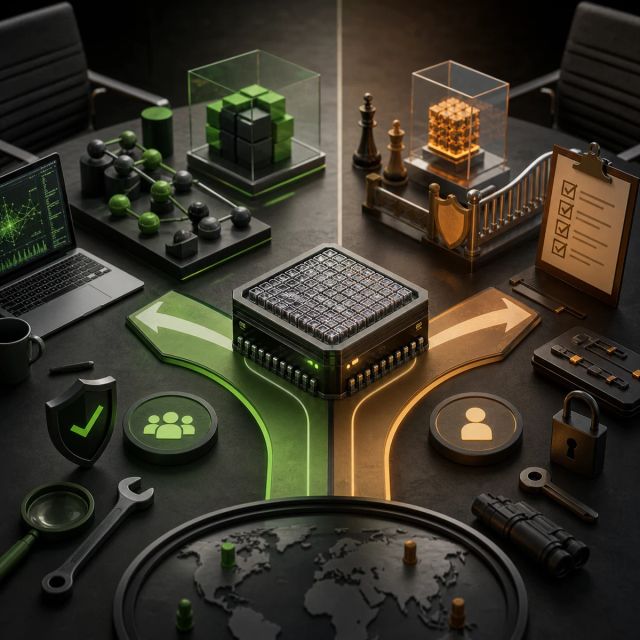
HPE Private Cloud AI is also adding secure local agent registration. Customers can approve AI models, skills, and tools against centralized governance and security policies before they run. That is a practical requirement for companies that cannot let any employee wire an autonomous agent to internal systems without review.
The rollback point is even more concrete. NVIDIA says new HPE Zerto Software capabilities can detect rogue agent actions and use continuous data protection to rewind to a clean state. That does not eliminate the risk of bad actions, but it shows where enterprise agent platforms are headed: assume some automation will misfire, then build recovery into the stack.
Confidential computing fits the private-cloud pitch
NVIDIA also says confidential computing is now available across the HPE AI Factory through HPE Services, including HPE AI Factory at Scale, HPE Sovereign AI Factory, and HPE Private Cloud AI. The company frames it around protecting models and private data during execution through cryptographic attestation and encryption.
That matters because agent systems touch exactly the kind of data enterprises are nervous about exposing: customer records, internal documents, code, operational systems, and proprietary models. A private-cloud AI pitch without execution-time protection is incomplete for banks, exchanges, governments, healthcare systems, and other regulated buyers.
Confidential computing is not magic. It does not prove an agent made the right choice or that a workflow is well designed. It helps answer a narrower question: can sensitive code and data be protected while the AI workload is running? For on-premises and sovereign deployments, that narrower question is often a buying requirement.
The GPU story is still underneath
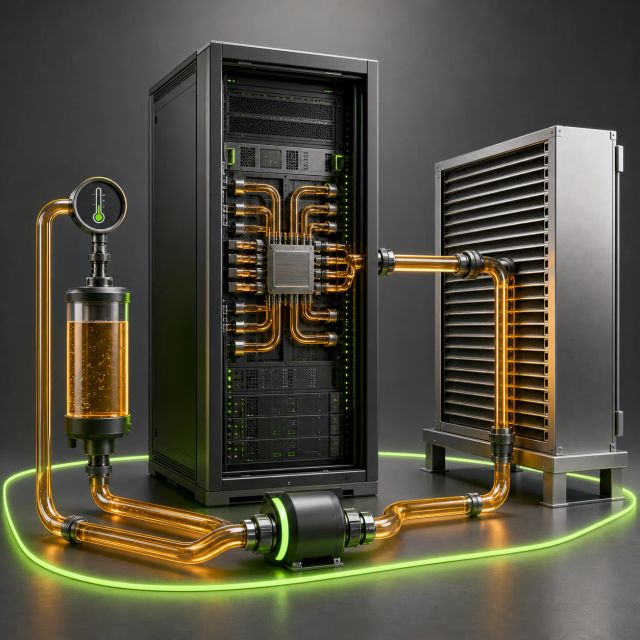
The announcement still has plenty of hardware. NVIDIA says Vera Rubin NVL72 systems from HPE will ship with NVIDIA Vera BlueField-4 DPUs, ConnectX-9 SuperNICs, Spectrum-X Ethernet, and Spectrum-6 switching. It also says Spectrum-6 delivers 1.6x higher networking performance for AI communication compared with off-the-shelf Ethernet.
That hardware matters because agents are not free-floating software. Long-running multi-agent systems call tools, retrieve data, run inference, and move context around a network. The more the workload depends on latency and orchestration, the more the CPU, DPU, networking, storage, and governance layers become part of the AI product.
The practical takeaway is that NVIDIA wants enterprise AI factories to be judged as full systems, not accelerator purchases. HPE wants the same thing for private cloud: a governed package that can run agents near the data and connect to services, storage, security, and recovery.