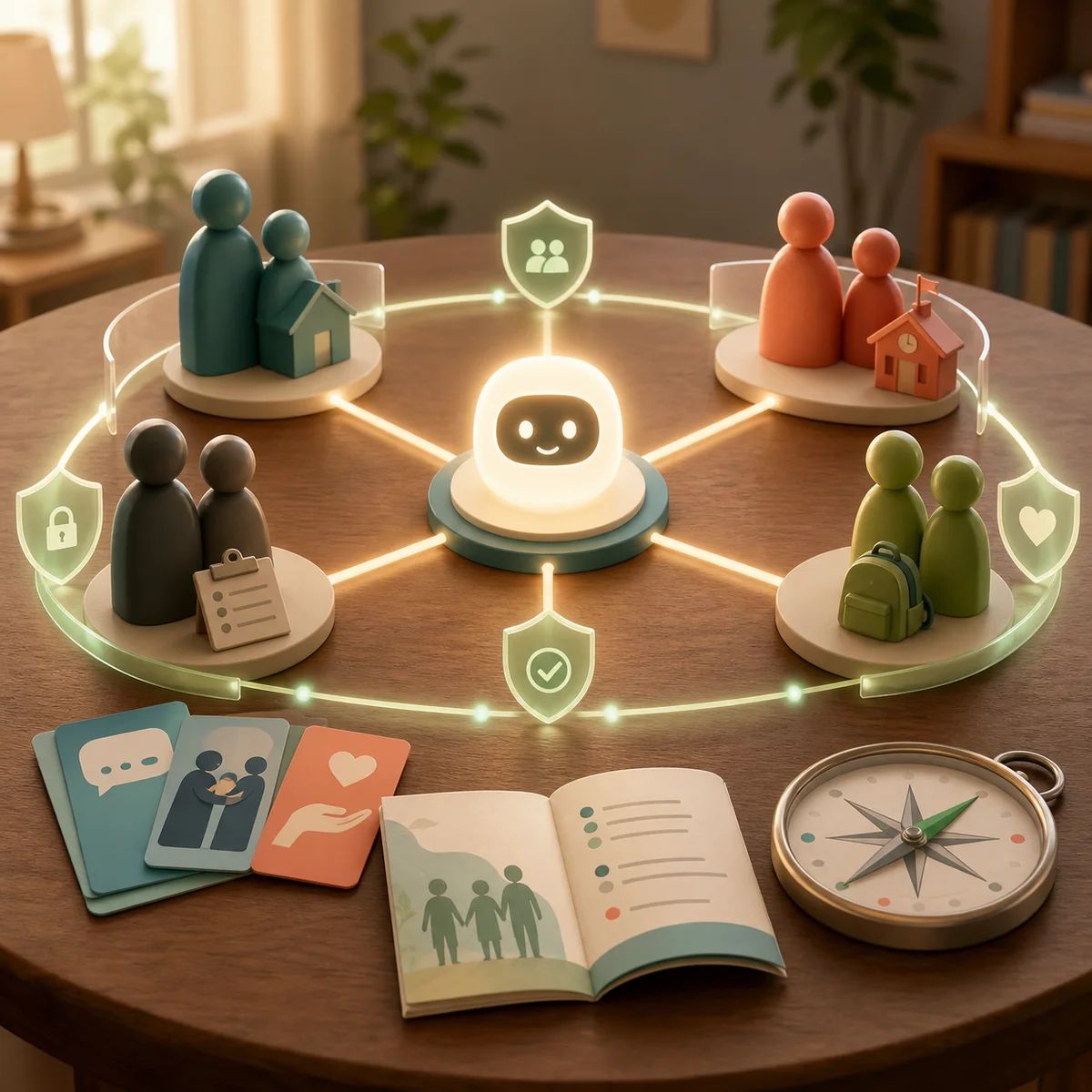
A support table connects families, clinicians, schools, and teens around an AI guidance beacon
+ OpenAI News

OpenAI and APA partner on youth mental health and AI

OpenAI and the American Psychological Association announced a three-year partnership to develop guidance, resources, and safeguards for responsible AI use supporting youth mental health.

OpenAI and the American Psychological Association are launching a three-year partnership around youth mental health and AI.

OpenAI’s August 6 RSS entry says the partnership will develop guidance, resources, and safeguards for responsible AI use supporting youth mental health. The linked OpenAI article URL was live but returned a 403 to plain shell fetch in this run, so this article keeps OpenAI-specific claims to the RSS-confirmed facts and uses APA materials for the clinical context.

The partnership lands in a sensitive area. Young people already use chatbots for emotional questions, and general-purpose AI systems can sound supportive without being clinicians, crisis counselors, or accountable care providers.

The issue is not whether teens ask AI for help

APA has already framed adolescent AI use as a well-being issue, not only a technology adoption question. Its advisory on artificial intelligence and adolescent well-being calls for AI systems designed for adolescents to protect mental and emotional health.

APA has also warned that AI is not a safe or effective replacement for a qualified mental health provider. That distinction should shape how to read the OpenAI partnership. A responsible product stance is not “make the chatbot therapeutic.” It is define what the system should do, when it should slow down, when it should route to human or crisis resources, and how it should avoid presenting itself as care.

For OpenAI, the product challenge is that youth mental health questions can appear inside ordinary ChatGPT use. A student may ask for school help, friendship advice, body-image support, self-harm content, relationship guidance, or a late-night emotional conversation without labeling it as a clinical interaction.

Guidance has to become product behavior

The strongest version of this partnership would translate psychological expertise into concrete product decisions: age-appropriate defaults, escalation rules, crisis-resource routing, parent and educator resources, risk evaluation, user research, and clear boundaries around what the model is not.

The weak version would be a resource library that sits beside the product while the product itself remains unchanged. The next checkpoint is whether OpenAI and APA publish guidance specific enough for independent researchers, schools, clinicians, and parents to judge.

Sources

The AI Feed Desk

The AI Feed Desk

Editorial desk

The AI Feed Desk tracks AI provider updates, model releases, agent tooling, and enterprise adoption, turning fast-moving announcements into source-linked context for builders and operators.

Noticed a typo, incorrect information, or translation error?

Tell us so we can fix it.

Help Improve This Article

Related Articles

An abstract health chat panel surrounded by physician review cards, safety markers, and a stethoscope on a clean desk

GPT-5.5 Instant makes health a default ChatGPT test

OpenAI says GPT-5.5 Instant improves ChatGPT health responses for free users, with physician rubrics, HealthBench evaluations, and production factuality monitoring.

The AI Feed Desk

By The AI Feed Desk

A bright solar model core is held behind a transparent safety gate

OpenAI previews GPT-5.6 Sol behind a limited-access safety gate

OpenAI's official feed says GPT-5.6 Sol improves coding, science, and cybersecurity capability, but the public body was blocked to plain fetch, so the responsible read starts with access and verification.

The AI Feed Desk

By The AI Feed Desk

A private health dashboard connects medical records, wearable data, and a ChatGPT conversation on a secure clinical desk

OpenAI brings medical records and Apple Health into ChatGPT

OpenAI says eligible U.S. users can now connect medical records and Apple Health to ChatGPT for more personalized health insights.

The AI Feed Desk

By The AI Feed Desk

An enterprise coding workstation sorts generic AI assistant tiles into retained and outgoing tool groups

Disney drops GitHub Copilot in U.S. coding-tool shake-up

Business Insider reports that Disney will drop GitHub Copilot and several other U.S. coding tools while preparing to adopt OpenAI Codex.

The AI Feed Desk

By The AI Feed Desk

A scientific computing lab compares agent-written code against datasets, tests, and validation reports

OpenAI says coding agents help scientific software when validation is strong

OpenAI published a field report on eight agent-assisted scientific-computing projects, showing gains in maintenance and rewrites while keeping validation as the boundary.

The AI Feed Desk

By The AI Feed Desk