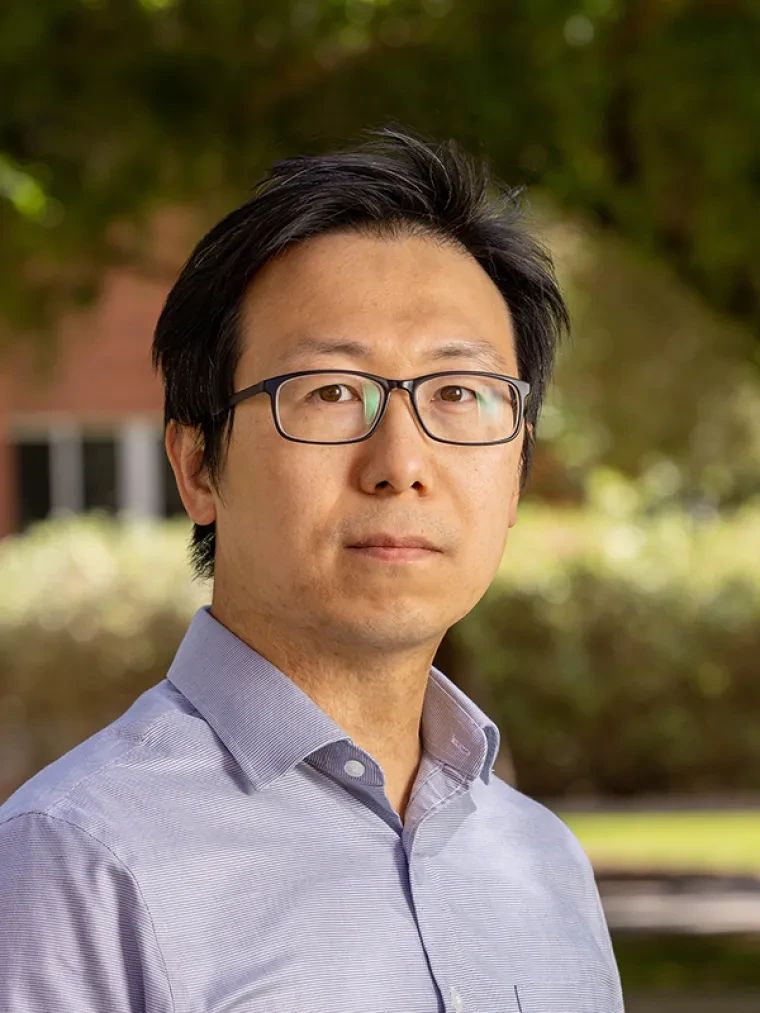
OpenAI published a June 11, 2026 case study on Chi-kwan Chan, a University of Arizona and Steward Observatory astrophysicist, using Codex to work on black-hole simulations. The work is not framed as Codex discovering physics on its own. It is framed as a coding agent helping Chan generate candidate numerical methods, implement them, and test them against known solutions.
The bottleneck is particle motion
Chan studies black holes with simulations and observations. OpenAI’s post says he is part of the Event Horizon Telescope collaboration, the group that published the first image of a black hole in 2019 and is now working toward the first video of a supermassive black hole, focused on the one at the center of the M87 galaxy.
The simulation problem is specific. Around a black hole, some plasma is so hot and diffuse that electrons and ions rarely collide. Instead, they spiral around magnetic field lines. To model that behavior directly, a simulation may need to track trillions of particles and calculate tiny turns at extremely small timesteps.
That can leave even large supercomputers spending most of their time on the smallest motions instead of the larger plasma behavior scientists want to study.
Codex expands the search space
Chan’s idea is to change how the simulation tracks particle motion so the computer does not have to follow every tiny spiral directly. OpenAI says exploring those mathematical possibilities by hand would take an enormous amount of time, so Chan uses Codex to help derive candidate algorithms and test them against known solutions.
That is the practical value of the tool in this story. A scientist still has to know what a valid method looks like. Codex can make it cheaper to try more approaches.
The failure mode is also explicit. OpenAI quotes Chan saying many generated approaches are not correct, and that most scientific ideas fail. The useful condition is that the algorithms are testable. A wrong candidate can be thrown away. A working one can open a path that was too slow to explore manually.
Verification is the boundary
The strongest line in the post is about acceptance. Chan says his group does not accept an idea because it came from Einstein, from a student, or from an AI model; it accepts the idea only after repeated testing.
That distinction matters for scientific AI. A coding model can create plausible math, plausible code, and plausible explanations. Plausible is not enough. The claim has to survive tests against known solutions and physical interpretation.
The same boundary applies to teams outside science. If an agent proposes a migration plan, a trading signal, a drug-screening workflow, or a new optimization, the review system is the product. Without tests, logs, and domain checks, faster idea generation just means faster uncertainty.