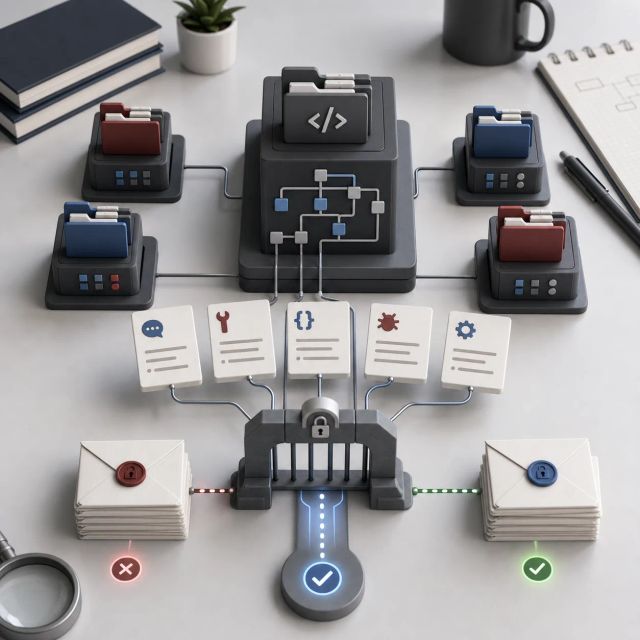
A coding benchmark grid is inspected with several task blocks cracked or flagged
+ Large Language Models News

OpenAI retracts SWE-Bench Pro recommendation after benchmark audit

OpenAI audited SWE-Bench Pro and now estimates that roughly 30% of its tasks are broken, weakening a key coding-agent evaluation.

OpenAI says SWE-Bench Pro has enough broken tasks that model developers should treat its results carefully and stop relying on OpenAI’s earlier recommendation to adopt it.

The July 8 audit reviewed SWE-Bench Pro, a coding-agent benchmark designed to improve on SWE-bench Verified with longer-horizon and more realistic software tasks. OpenAI says frontier models improved from 23.3% to 80.3% pass rate on the benchmark’s 731-task public split in eight months, which made the benchmark look like a strong signal for coding-agent progress.

The audit changes that read. OpenAI’s datapoint analysis pipeline flagged 200 broken tasks, or 27.4% of the public split. A separate human annotation campaign identified 249 broken tasks, or 34.1%. OpenAI’s current estimate is that roughly 30% of SWE-Bench Pro tasks are broken.

The failures are benchmark design failures, not just model misses

OpenAI groups the problems into four main categories: overly strict tests, underspecified prompts, low-coverage tests, and misleading prompts.

Those failures matter because repository-level coding benchmarks often hide the tests used for grading. If a prompt leaves out a requirement enforced by hidden tests, a model can produce a reasonable fix and still fail. If a test is too narrow, a model can pass while leaving the real feature incomplete.

That turns a benchmark leaderboard into a mixed measurement. Some scores reflect model capability. Some reflect whether the benchmark’s prompt, tests, and reference fix form a fair task.

OpenAI also says the audit used agents to inspect task metadata, model attempts, and failure traces before human review. That is a notable second-order point: stronger coding agents are now being used to audit the evaluations that measure coding agents.

Coding-agent buyers should ask what the tests prove

The practical lesson is not that all coding-agent benchmarks are useless. It is that benchmark names are no longer enough.

Teams comparing coding agents should ask how tasks were sourced, whether prompts were written for evaluation or copied from messy development history, how hidden tests were checked, and whether failures were audited by humans with repository context.

For internal pilots, the safer pattern is smaller but inspectable task sets: real issues from the team’s own repositories, explicit acceptance criteria, visible review rubrics, and hidden regression tests only after the prompt is checked for fairness.


Sources

The AI Feed Desk

The AI Feed Desk

Editorial desk

The AI Feed Desk tracks AI provider updates, model releases, agent tooling, and enterprise adoption, turning fast-moving announcements into source-linked context for builders and operators.

Noticed a typo, incorrect information, or translation error?

Tell us so we can fix it.

Help Improve This Article

Related Articles

An AI-generated pull request passes through a software review gate with quality checkpoints

Cognition's FrontierCode asks whether AI code would survive review

FrontierCode evaluates coding agents on mergeability, code quality, scope, tests, and maintainer judgment instead of only functional correctness.

The AI Feed Desk

By The AI Feed Desk

A repository map with abstract native-language request cards passes through a sealed testing gate

RuBench tests coding agents on native Russian repository tasks

RuBench adds 25 repository-level coding-agent tasks written natively in Russian, with withheld regression tests and product-agent runs.

The AI Feed Desk

By The AI Feed Desk

A computational biology bench with simulated genomic data paths branching into reviewed analysis decisions

OpenAI's GeneBench-Pro makes biology benchmarks about judgment

GeneBench-Pro tests whether AI agents can handle ambiguous computational-biology analysis, not just clean benchmark questions.

The AI Feed Desk

By The AI Feed Desk

A business briefcase opens into documents, messages, and evaluation scorecards

AA-Briefcase tests agents on messy business work

Artificial Analysis' AA-Briefcase benchmark evaluates models on multi-week knowledge-work projects with documents, email, Slack data, deliverables, and graded analysis quality.

The AI Feed Desk

By The AI Feed Desk

An unfinished legal brief sits beside a rubric grid with many partial checks but only one small completed seal

Harvey LAB-AA shows legal agents still miss most complete deliverables

Artificial Analysis launched Harvey LAB-AA, a legal-agent benchmark where the top model fully passes only 14.2% of real-world legal tasks.

The AI Feed Desk

By The AI Feed Desk