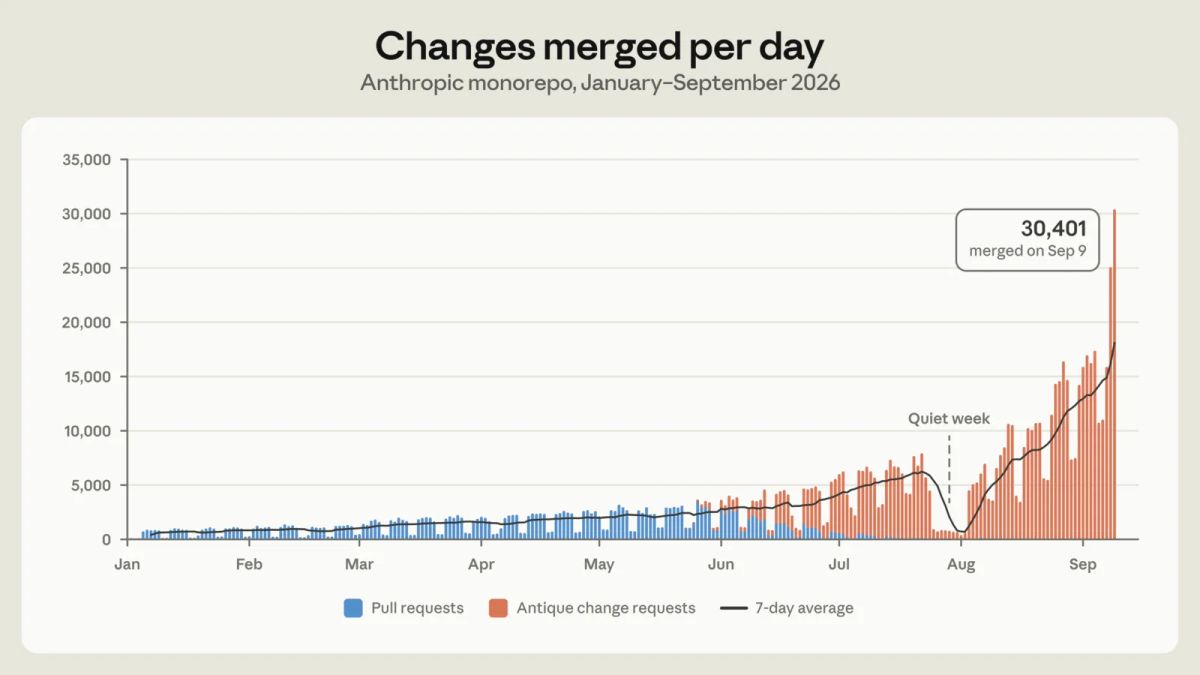
Anthropic replaced Git in its monorepo with an in-house source control system called Scion after daily code merges rose from about 2,500 in May to more than 30,000 in September. In an October 13 engineering post, the company says Claude’s code output made source control, builds and continuous integration its development bottlenecks.
Seven engineers built Scion, a code review tool called Antique and related systems, then completed the migration in five months. The case study describes what happens when agents generate enough work to overwhelm the infrastructure that stores and tests it.
Why agents changed the design
Anthropic says its main branch history approached 100 GB and a compressed working copy exceeded 25 GB. Continuous integration alone required about 25 million code checkouts each day, before agent sandboxes and research jobs.
The company had already used shallow clones, sparse checkouts, repository snapshots and several hundred internal Git mirrors. As merges accelerated, snapshots became stale faster and partial repositories made history queries harder to maintain.
Scion assumes clients can reach a server. That fits Anthropic’s mostly online agents and jobs. The server creates commits, performs merges and answers history queries. Clients keep a limited local cache and request the files they need.
A job that only needs a diff or information about a commit can ask an API without checking out code. Jobs that need files can request selected directories or materialize files as they read them. Caches on each compute node let jobs reuse downloaded objects, with regional caches above them.
Anthropic reports a 200-fold reduction in CPU and memory requirements for its source control infrastructure compared with its previous Git mirrors. It says CI and research checkouts became roughly 100 times faster, taking seconds rather than minutes, and CI recovered 25% of its CPU capacity. Those are company-reported results for its own workload.
The migration changed testing and review too
Anthropic says hundreds or thousands of changes can merge while tests run. It has invested in post-merge and pre-deployment testing after struggling to apply a global repository lock to its merge queue. Concurrent changes can conflict, and the company says Claude typically fixes those conflicts faster than people identify them.
Engineers still review every change request to Scion, but focus on intent rather than reading every line. They also enforce design constraints. The post describes agents scanning commit logs when they should have queried the review tool, and adding excessive validation after automated reviews raised hypothetical concerns.
Anthropic says adopting Scion would require migrating code review, search and CI alongside source control. It describes the system as suited to enormous monorepos and acknowledges that its internal token budget exceeds what other businesses would reasonably spend.