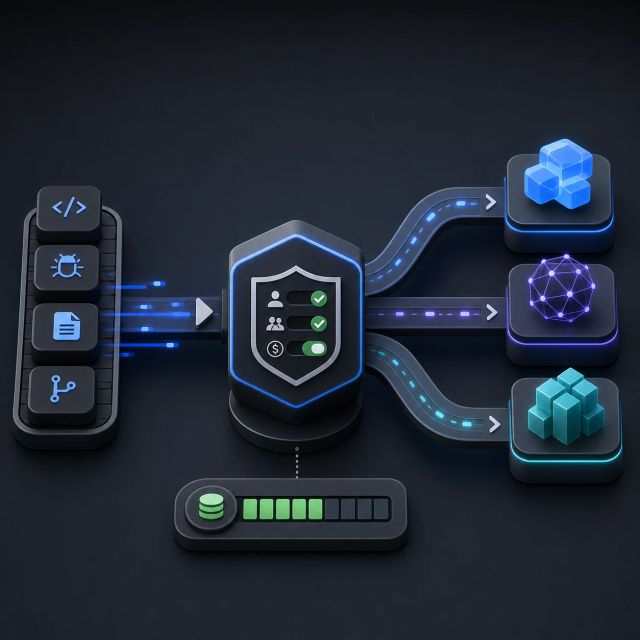
A modular tool arm stands behind green, amber, and red translucent permission gates
+ Microsoft News

GitHub adds enterprise-managed permissions for Copilot agent operations

GitHub now lets Copilot Business and Enterprise administrators centrally block, require approval for, or permit agent shell, file, and network operations.

GitHub has made enterprise-managed permissions for Copilot agent operations generally available. The controls let Copilot Business and Enterprise administrators centrally decide which actions are blocked, require human approval, or can proceed without a prompt.

The policy surface covers shell commands, file reads and edits, and network domains. GitHub says managed restrictions cannot be weakened by user or workspace settings, auto-approval, or previously saved approvals. Enterprises can also define specialized policies for different teams.

This is a control plane for agent access

Agent coding tools need more than a general instruction to be cautious. They can read a repository, change files, run commands, and reach external services. Those operations have very different risk profiles depending on the workspace, team, and environment.

GitHub’s feature creates a centrally enforced layer above individual sessions. A platform team can, for example, keep file reads available, put edits or selected shell commands behind approval, and block network access to unapproved domains. GitHub says the controls are generally available in the Copilot app, Copilot CLI, and Visual Studio Code sessions using Agent Host.

Policies need a threat model

The release establishes an enforcement surface. It does not make any arbitrary rule set safe by default. A broad allowlist can still create an overly capable agent; a restrictive policy can still break a needed workflow or encourage workarounds.


Sources

The AI Feed Desk

The AI Feed Desk

Editorial desk

The AI Feed Desk tracks AI provider updates, model releases, agent tooling, and enterprise adoption, turning fast-moving announcements into source-linked context for builders and operators.

Noticed a typo, incorrect information, or translation error?

Tell us so we can fix it.

Help Improve This Article

Related Articles

An abstract coding agent session timeline flows into a secure audit collector

GitHub exposes Copilot agent sessions for enterprise audit

GitHub's public preview lets enterprise owners stream or retrieve Copilot agent session data, including prompts, responses, and tool calls, across major Copilot clients.

The AI Feed Desk

By The AI Feed Desk

A routing switchboard sends coding tasks into different model lanes from an admin control plate

Copilot auto model selection turns routing into an admin setting

GitHub Enterprise admins can now default Copilot conversations to auto model selection through managed-settings.json, tying model routing to enterprise AI standards.

The AI Feed Desk

By The AI Feed Desk

Shared AI credit tokens flow through team lanes while one cost center lane is stopped by a cap gauge

GitHub cost centers can cap shared AI credit pools

GitHub added AI credit pools for cost centers, letting enterprise admins cap how much monthly included Copilot credit one group can draw before metered budgets apply.

The AI Feed Desk

By The AI Feed Desk

Developer tasks pass through a policy gate into several abstract model routing lanes with a cost meter below

GitHub turns Copilot model choice into a governed routing layer

GitHub's July 1 Copilot changes put model routing, browser tools, vision, Kimi K2.7 Code access, and AI-credit caps under clearer admin control.

The AI Feed Desk

By The AI Feed Desk

An enterprise AI coding policy panel routes model access, billing seats, and review controls

GitHub changes Copilot policy and billing for enterprise AI work

GitHub announced Copilot policy and billing changes covering paid seat assignment, usage overages, cloud-agent convergence, data retention, and code-review defaults.

The AI Feed Desk

By The AI Feed Desk