Google has reshuffled the top of Google DeepMind while a group of longtime Google AI and systems leaders leaves to form Discovery Loop.
In an internal message Google published this week, Sundar Pichai said Demis Hassabis will become Chair of Google DeepMind and Chief Scientist of Alphabet while continuing to lead Isomorphic Labs. Koray Kavukcuoglu, Google DeepMind’s CTO and Google’s Chief AI Architect, will become SVP of Google DeepMind and report to Pichai.
Pichai also said Jeff Dean and Sanjay Ghemawat are launching an independent public benefit corporation to accelerate discoveries in machine learning, science, and engineering. Google will work with the new company as a founding investor and Cloud partner.
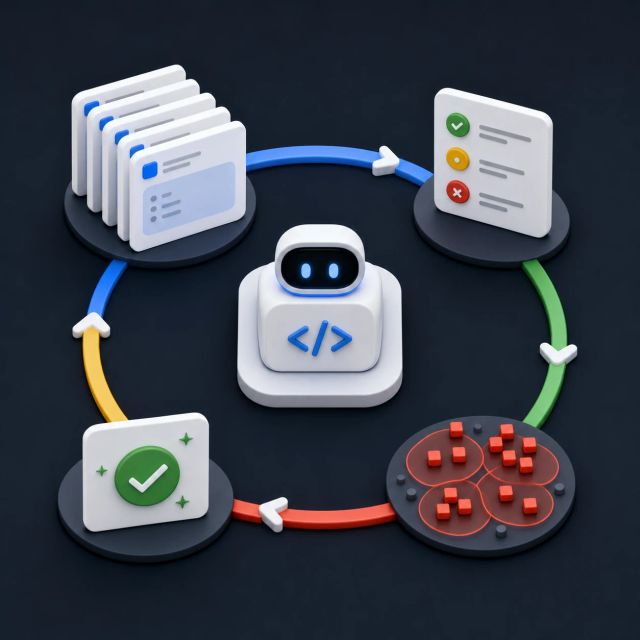
Discovery Loop’s own site lists Jeff Dean, Sanjay Ghemawat, Quoc Le, and Oriol Vinyals as its founding team. The company says it is building systems to automate experimental loops: proposing experiments, implementing and running them, evaluating results, and iterating at large scale.
Google is separating two kinds of AI work
The official message frames the change as a way to do two things at once: keep Google DeepMind moving faster on Gemini and related product work, while giving Hassabis more room to focus on AGI, science, and long-range strategy.
That split matters because “AI leadership” now covers different jobs. One job is frontier research. Another is shipping model releases, developer tools, apps, and enterprise-facing products on a schedule. A third is translating AI into scientific and health outcomes through work like Isomorphic Labs.
Pichai’s memo makes the product pressure explicit without making it the cause of the personnel change. He says Google has to accelerate and stay focused on the AI frontier, while also citing demand for Gemini models, the Gemini app reaching more than 950 million monthly users, and Gemma models passing 900 million downloads.
Discovery Loop is a talent and market-structure signal
Discovery Loop is not just another AI startup announcement. Its founding team includes people tied to Google File System, MapReduce, Bigtable, Spanner, TensorFlow, TPUs, AlphaStar, AlphaCode, AlphaFold, Gemini, sequence-to-sequence models, and chain-of-thought reasoning.
The company’s first stated focus is automated machine learning research and engineering. That places it in the same broad direction as a growing class of agentic science and engineering systems: AI that does not only answer questions, but proposes tests, runs experiments, evaluates outcomes, and repeats the loop.
Axios reported that outside observers read the reshuffle against a backdrop of model delays, researcher departures, and pressure from OpenAI and Anthropic. Google’s official message does not attribute the changes to those pressures. The useful conclusion is narrower: Google is reorganizing authority around Gemini execution while allowing a historically important research-systems group to form a company around automated discovery.