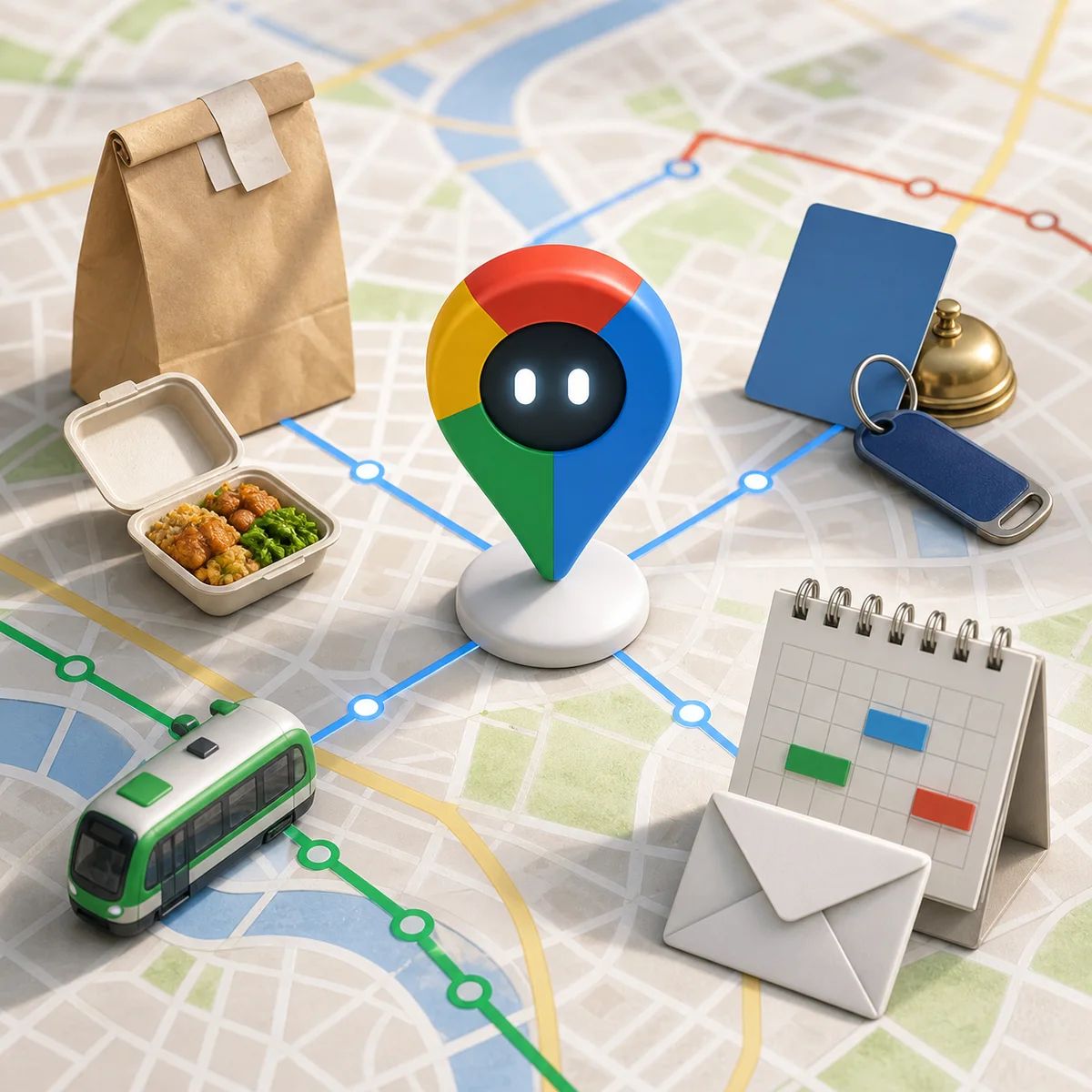
Google is turning Ask Maps from a conversational search layer into a task assistant inside Google Maps.
The company said on August 6 that Ask Maps is adding agentic food ordering, hotel and event help, real-time transit information, Personal Intelligence, and conversational contributions. Google describes Ask Maps as the biggest transformation of Google Maps in more than a decade, combining Gemini model capabilities with its live map data.
The food-ordering flow is the clearest shift. A user can ask for a specific meal near a location or along a route, then move from discovery toward ordering inside the Maps experience. TechCrunch reports that Square and Toast are initial ordering partners, with Uber Eats support coming soon.
Google is also extending Ask Maps beyond the United States to Australia, Brazil, Canada, Indonesia, Japan, and Mexico. That makes the update more than a feature test for one market.
Maps is becoming a task surface
Maps used to answer where and how: where a place is, how to get there, how long it takes, and what nearby users think. Ask Maps pushes the product toward what to do next.
That matters because local intent is unusually close to a transaction. A person looking for lunch, a hotel, an event, or a route disruption is not just browsing. They are deciding where to go, what to buy, and which service to trust.
The Personal Intelligence piece raises the stakes. Google says users can opt in to let Ask Maps use Gmail signals, with Calendar support planned. If that works well, Maps can understand a trip, reservation, or event context without the user retyping it. If it works poorly, the failure is not an abstract chatbot mistake. It can send someone to the wrong place, expose too much context, or narrow options in ways the user does not notice.
Local businesses now answer the agent, not only the search box
Google’s conversational contributions feature also changes the local-data loop. The company says users can update place information through conversation, including confirming a storefront photo or business-hours change.
That is useful for Maps freshness, but it also means local businesses have to think about machine-readable trust. Photos, menus, hours, reservation surfaces, ordering partners, descriptions, and reviews become inputs to an assistant that may summarize and act, not just rank links.
For restaurants and hotels, the practical question is no longer only whether a listing appears in search results. It is whether the information on that listing is complete enough for Ask Maps to recommend, compare, and route a user into a transaction.