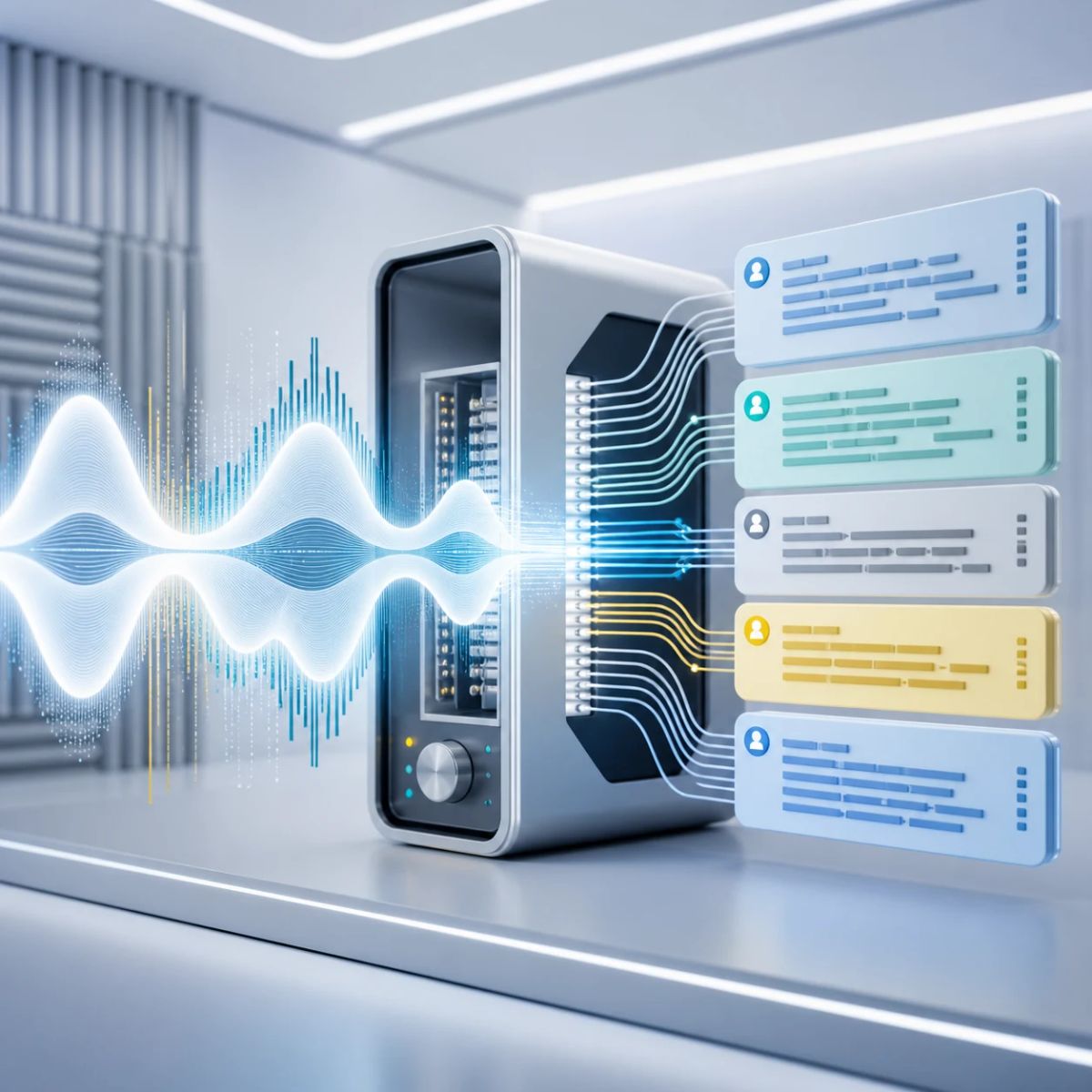
Google has introduced Gemini 3.5 Transcribe, a speech-to-text model designed for real-time transcription, recorded-audio processing, voice agents, dictation, captions, and call-analysis workflows.
The release has two developer surfaces. gemini-3.5-transcribe-live handles continuous bidirectional streaming through the Live API. gemini-3.5-transcribe handles recorded audio through the Interactions API, including speaker attribution and word-level timestamps.
Google says the model is available in public preview through the Gemini API in Google AI Studio and the Gemini Enterprise Agent Platform. For end users, it is already used in the Gemini app on macOS in English and in Rambler on Android in selected countries and languages, with Chrome support coming later.
Transcription is becoming part of the agent layer
Google frames the model as more than conventional speech recognition. The company says Gemini 3.5 Transcribe can clean up disfluencies, handle self-corrections, auto-format text, recognize custom vocabulary, detect more than 85 languages, and identify up to three speakers in prerecorded audio, with support for more speakers marked experimental.
Those features are useful for transcription, but they are also important for agents. A voice agent needs to understand intent, not only capture words. If a user says “Tuesday, no, Wednesday,” the system has to preserve the correction in the final action. If a caller says a product code, address, or file name, transcription errors can become workflow errors.
Google says the model can delegate complex tasks to other Gemini models through function calls in the Gemini macOS app. That connects transcription to action: voice can become a control layer for file analysis, image generation, search, or app-specific workflows.
Google cites accuracy and latency gains
Google says Gemini 3.5 Transcribe achieves a 4.0% average Word Error Rate for streaming and 2.6% for non-streaming use cases, as measured by Artificial Analysis. It also says time to final transcription improves by 70% over Chirp 3.
On FLEURS across selected languages and locales, Google says the model reaches 5.50% WER in streaming mode and 5.04% WER in non-streaming mode.
Those numbers should be read as source-reported claims, not The AI Feed measurements. The useful comparison for developers is narrower: test the model on the domain audio that actually matters, including background noise, accents, overlapping speakers, industry terms, customer names, and alphanumeric identifiers.
The deployment surfaces are the adoption test
Google lists developer platforms including Agora, Fishjam, LangChain, LiveKit, Pipecat, Vercel, and Vision Agents as early integration paths. It also names vivo, Intellitek Health, and Lingopal as companies that shared feedback.
That matters because speech models are rarely deployed alone. Production voice systems need real-time media infrastructure, interruption handling, routing, monitoring, domain vocabulary, privacy controls, and fallback behavior when the transcription is uncertain.