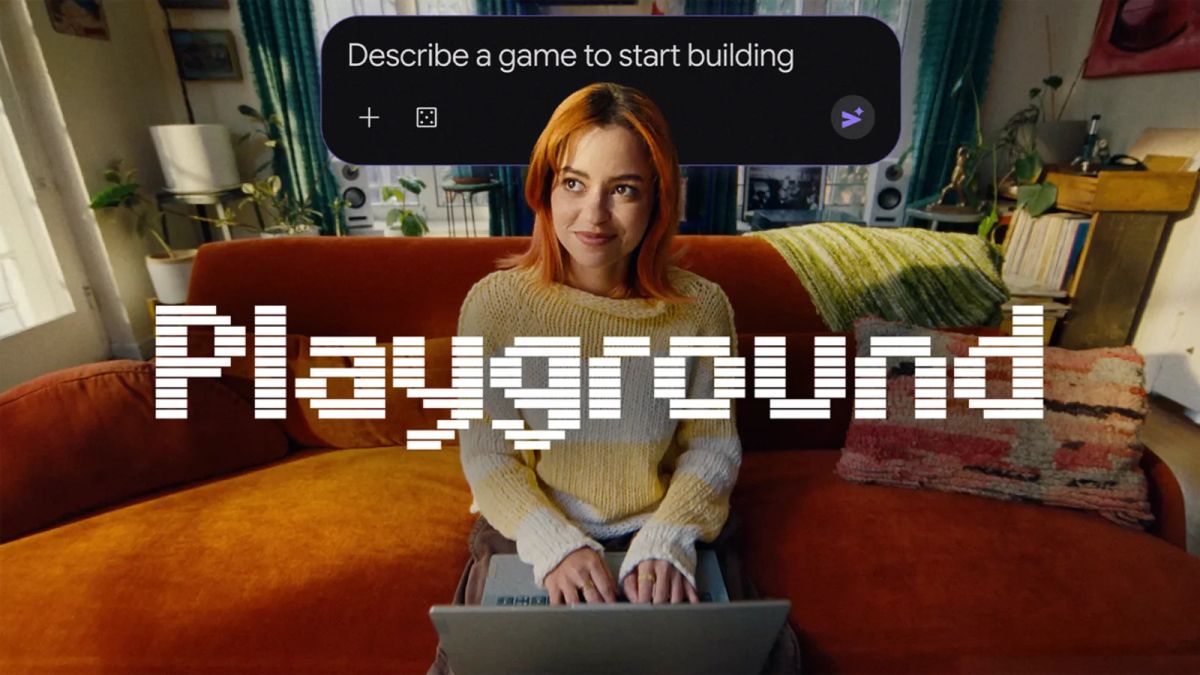
Playground promotional image with a woman using a laptop, a game-description prompt and the Playground name
+ AI News

Google Labs tests Playground, a platform for making games from text prompts

Google's Playground creates and shares browser games through text prompts. The Labs experiment launches for U.S. adults, with Unity Spark integration still ahead.

Google Labs launched Playground on October 7, an experimental platform for creating, playing and sharing browser games through text prompts. Google’s announcement calls it an early experiment. Initial access is for U.S. users aged 18 and older.

Describe a game, then change it

Creators can start from scratch, remix starter prompts or use guided support. Google’s conversational interface lets them request changes to physics, rules, characters and environments, then test the game. Games run in a browser on phones and laptops.

Creators can keep games private, share a link or publish to the Explore gallery. Google says multiplayer works in select genres. Published games undergo safety screening, and players can report them.

TechCrunch reports that playing is free, while creation uses weekly tokens. Free accounts get limited tokens; Google One AI subscribers receive higher limits.

Unity support is still ahead

Google plans a Unity Spark integration for more advanced mechanics and higher-fidelity 3D games. Spark is in testing, with a closed beta coming soon. Creators should treat those capabilities as planned additions when choosing a project today.


Sources

The AI Feed Desk

The AI Feed Desk

Editorial desk

The AI Feed Desk tracks AI provider updates, model releases, agent tooling, and enterprise adoption, turning fast-moving announcements into source-linked context for builders and operators.

Noticed a typo, incorrect information, or translation error?

Tell us so we can fix it.

Help Improve This Article

Related Articles

A search page opens into a visual gallery while an AI overview turns a prompt into a new image

Google brings Nano Banana image generation into Search AI Overviews

Google's 25th-anniversary Images update adds a personalized image home and brings Nano Banana image generation into AI Overviews.

The AI Feed Desk

By The AI Feed Desk

A structured audio waveform flows from a prompt card into studio speakers

Google brings Lyria 3.5 music generation to Gemini and the Gemini API

Google made Lyria 3.5 available in Gemini and the Gemini API, with text-and-image inputs, MP3 output, lyrics, and full-song generation.

The AI Feed Desk

By The AI Feed Desk

A controlled workflow graph routes tasks through two glowing AI reasoning nodes

Google ADK 2.0 puts workflows around agents

Google's ADK 2.0 framing separates deterministic workflow routing from open-ended model reasoning, giving production agents a stricter execution boundary.

The AI Feed Desk

By The AI Feed Desk

A coding agent workflow loops through traces, grading, failure clusters, and approved fixes

Google gives coding agents an eval flywheel instead of another prompt tweak

Google's new quality-flywheel skill lets coding agents run structured agent evaluations with independent grading and production-trace loops.

The AI Feed Desk

By The AI Feed Desk

Google AI Edge Foresight answering a question about its architecture, with source citations below the answer

Google releases AI Edge Foresight, an offline meeting note-taker

Google's Mac app combines meeting transcripts with local documents. Test its offline answers and citations before replacing your current note-taker.

The AI Feed Desk

By The AI Feed Desk