Google has opened SynthID Detector to everyone, giving the public a website to check images, video and audio for its AI watermark. TechCrunch reports that access previously went to select journalists, media professionals and researchers. The useful question is narrower than whether a file is AI-generated. The detector looks for a SynthID mark.
That distinction matters because its coverage depends on which generation tools use SynthID. A file made with a different watermark system, or with no watermark, falls outside that check.
What the site accepts
The site supports common image formats including JPEG, PNG, WebP, AVIF, HEIC, TIFF and GIF. Video uploads can use MP4, MOV or WebM. Audio formats include WAV, MP3, OGG, FLAC, AAC and M4A, according to TechCrunch.
Google introduced SynthID in 2023. TechCrunch says Nano Banana, Veo and Lyria use it, along with generation tools such as Gemini, Flow, ProducerAI and Vids. Google’s product page also names partners OpenAI, Nvidia and Kakao, with Apple support coming later. Those names describe support for the watermark system, rather than proof that every file from those companies will produce a detection.
What a result establishes
Google says SynthID adds invisible marks when it creates images and video. It designs those marks to survive changes such as cropping, filters and lossy compression. Audio marks are inaudible. These are Google’s descriptions of the technology, rather than an independent accuracy test of the public site.
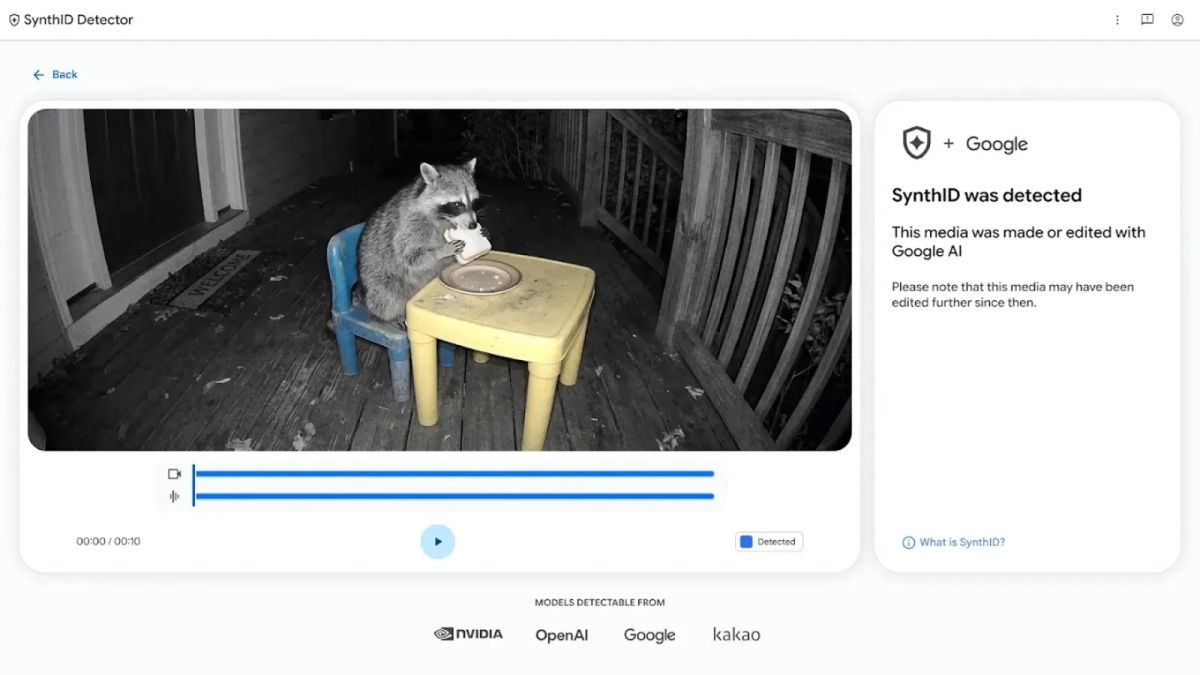
The Google-published screenshot above shows a positive result for a raccoon video. Its result says the media was made or edited with Google AI and warns that further edits may have followed. That wording leaves room for AI editing of existing material, as well as generation of a whole file.