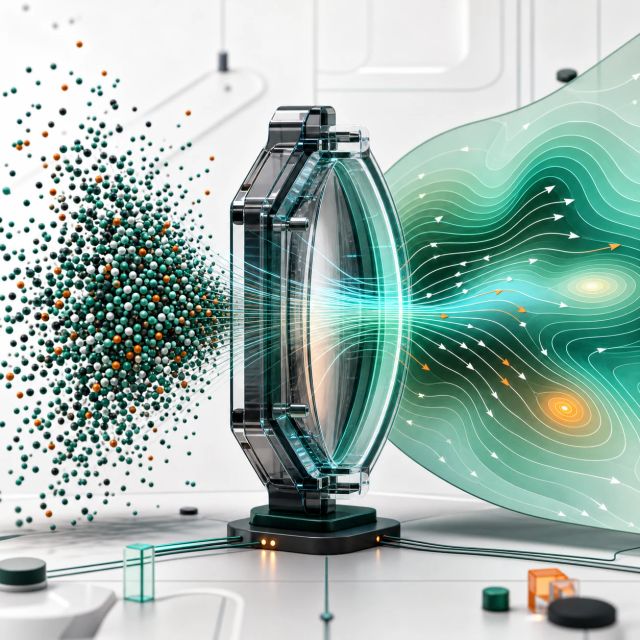
An abstract model graph passes through a glass optimization lens into high-speed inference lanes
+ Large Language Models News

Hugging Face and vLLM bring native-speed serving to Transformers model definitions

Hugging Face and vLLM introduced a backend that can run compatible Transformers model definitions at native vLLM speed through runtime graph analysis and rewrites.

Hugging Face and vLLM introduced a new Transformers backend that can run compatible model definitions at native vLLM serving speed.

The July 8 post addresses a practical open-model problem. A new architecture may work in Transformers for training, evaluation, and local experimentation, but production serving often needs custom vLLM integration work to reach high throughput.

The new backend tries to reduce that split. Hugging Face says it uses torch.fx graph analysis and runtime AST rewrites to recognize model patterns and apply inference-specific optimizations without requiring model authors to maintain separate vLLM-native implementations.

The target is duplicate model code

Open model teams often pay an integration tax after release. They publish model code, then wait for optimized inference support, then debug differences between the research implementation and serving implementation.

That slows adoption for architectures that are not already common. It also creates risk: two code paths can drift, and an optimization bug can look like a model-quality problem.

Hugging Face says the backend can rewrite compatible Transformers modules into forms that support vLLM features such as expert parallelism for mixture-of-experts models and tensor-parallel-friendly execution. The point is not that every model gets faster automatically. It is that supported patterns can move from model definition to serving path with less custom code.

Faster support can change which open models get tested

Inference support shapes attention. Developers are more likely to test a model if it is easy to serve at usable speed, especially when the model is large, sparse, or unusual.

That means the backend could matter even when it is invisible to most users. If new model architectures can land in Transformers and reach vLLM performance sooner, smaller labs and open-model teams get a better path from paper or checkpoint to production evaluation.

The caveat is compatibility. Runtime graph rewriting depends on recognizable patterns. Teams should still benchmark their specific model, quantization setup, batch behavior, and deployment hardware before assuming native speed.


Sources

The AI Feed Desk

The AI Feed Desk

Editorial desk

The AI Feed Desk tracks AI provider updates, model releases, agent tooling, and enterprise adoption, turning fast-moving announcements into source-linked context for builders and operators.

Noticed a typo, incorrect information, or translation error?

Tell us so we can fix it.

Help Improve This Article

Related Articles

A microphone waveform passes through a fast inference core and exits as a speaker waveform

Hugging Face and Cerebras make open voice AI a latency problem

A Hugging Face and Cerebras speech-to-speech demo uses Parakeet, Gemma 4, Cerebras inference, and Qwen3TTS to show where voice AI latency actually lives.

The AI Feed Desk

By The AI Feed Desk

A command-line prompt launches an inference endpoint on a small GPU cluster

Hugging Face makes vLLM serving a one-command Jobs workflow

HF Jobs can now spin up a private OpenAI-compatible vLLM endpoint for tests, evals, and batch generation without provisioning servers or managing Kubernetes.

The AI Feed Desk

By The AI Feed Desk

A transformer-shaped lens maps scattered data points into smooth density contours

Allen AI's DiScoFormer tests one transformer for density and score

The Hugging Face writeup frames DiScoFormer as a reusable estimator for density and score, with stronger high-dimensional results than kernel density estimation.

The AI Feed Desk

By The AI Feed Desk

A metallic chip tile connects to flowing local model tokens and a small speed gauge

BaseRT makes Apple Silicon LLM speed a runtime-design question

BaseRT's paper and release argue that native Metal kernels, unified-memory-aware layout, and custom dispatch can raise local LLM throughput on Apple Silicon.

The AI Feed Desk

By The AI Feed Desk

A testing gauge compares a clean tool path with a longer tangled debugging path

Hugging Face measures whether tools are agent-friendly

Hugging Face's agent-focused benchmark tests whether software changes help coding agents finish tasks with fewer errors, tokens, and detours.

The AI Feed Desk

By The AI Feed Desk