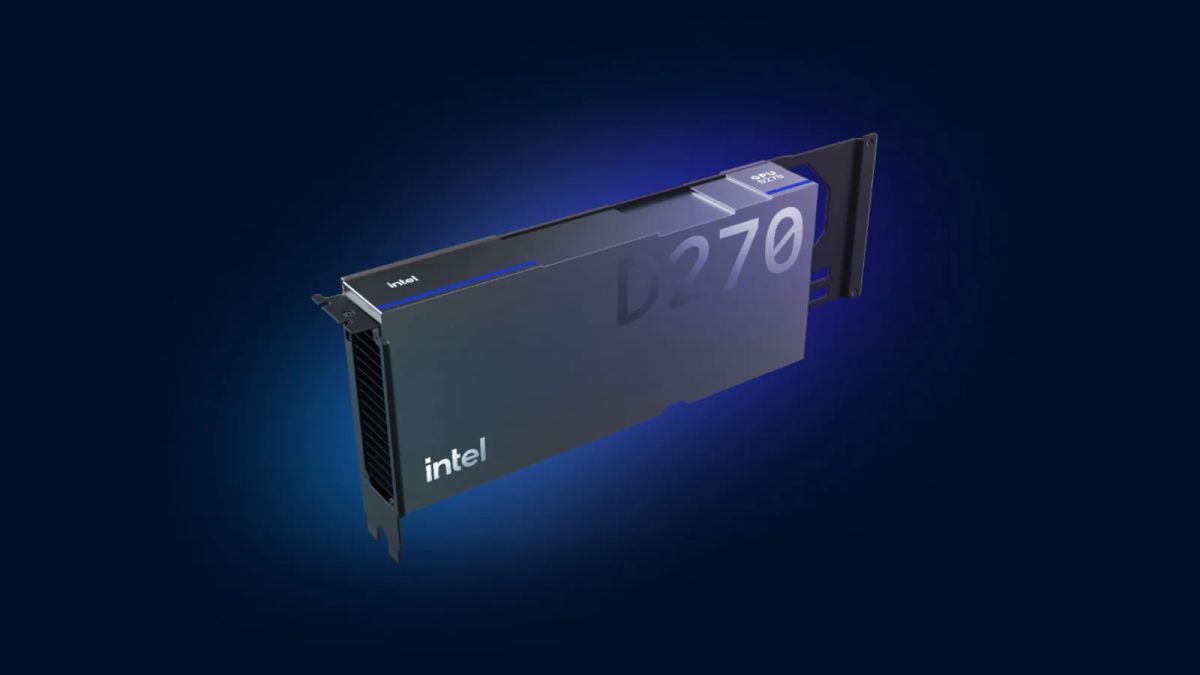
Intel D270 accelerator card with a dark metal enclosure and blue accents on a dark blue background
+ AI News

Intel's D270 GPU AI accelerator offers up to 480 GB of LPDDR5X

Intel's D270 uses up to 480 GB of LPDDR5X for AI inference. Its memory capacity makes model fit worth testing, while Nvidia comparisons remain projections.

  • AI
  • Intel
  • Gpu
  • Ai inference

Intel’s D270 data-center GPU offers up to 480 GB of LPDDR5X memory per card. Intel targets production AI inference, with enough memory to keep larger models, longer contexts and more concurrent sessions on the accelerator.

The card uses LPDDR5X rather than high-bandwidth memory, or HBM. Intel pitches that choice as a way to run more inference with fewer GPUs.

A memory-heavy card for existing servers

Intel lists 32 Xe3P cores, 256 XMX matrix engines and a 350 W power rating. The D270 uses PCIe 5.0 and passive air cooling. Intel says it reallocates chip area from graphics and ray-tracing pipelines to inference compute, and names vLLM and PyTorch as serving software.

Long prompts and concurrent sessions consume memory alongside the model. Intel’s page specifically cites growth in the KV cache during inference as a reason for the capacity.

The Nvidia comparison needs workload results

Intel’s disclaimer says performance projections against RTX Pro 6000 use public information and internal analysis as of February 2026. It qualifies the memory comparison as being at comparable bandwidth. The page gives no numerical bandwidth specification or reproducible benchmark results.


Sources

The AI Feed Desk

The AI Feed Desk

Editorial desk

The AI Feed Desk tracks AI provider updates, model releases, agent tooling, and enterprise adoption, turning fast-moving announcements into source-linked context for builders and operators.

Noticed a typo, incorrect information, or translation error?

Tell us so we can fix it.

Help Improve This Article

Related Articles

GPU accelerator cards receive queued AI workloads from a central scheduler rail

Hugging Face GPU management piece says idle accelerators are the next AI constraint

A Hugging Face community article argues that enterprise AI economics are shifting from model access to GPU utilization, scheduling, and workload orchestration.

The AI Feed Desk

By The AI Feed Desk

An MCP agent test bench replays clean, faulted, and mitigated tool responses

AgentCheck tests whether MCP agents fail safely

A July 13 paper introduces AgentCheck, an MCP workbench for replaying tool faults and confirming whether agent mitigations actually fix them.

The AI Feed Desk

By The AI Feed Desk

A data center waits beside a power-grid connection queue with substations in the distance

AI data centers face a grid-connection bottleneck

A Works in Progress analysis argues that the limiting factor for AI buildouts is often the queue to connect new loads and generation to the electric grid.

The AI Feed Desk

By The AI Feed Desk

AstaBrief name in green surrounded by outlined research documents on a dark green background

Ai2 open-sources AstaBrief, the fast report-generation model in Asta

Ai2 releases AstaBrief's weights and training data. Fast mode averages 51.1 seconds per report in Asta, with evaluation limits worth checking before adoption.

The AI Feed Desk

By The AI Feed Desk

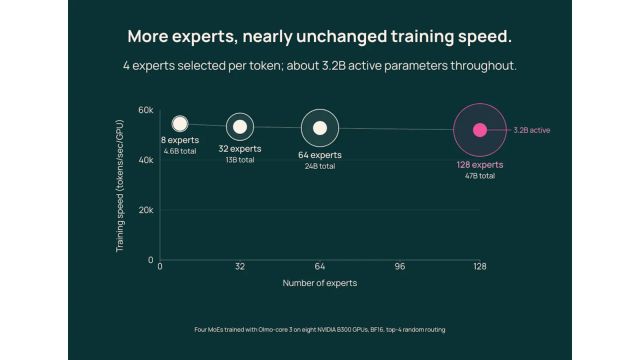
Chart comparing training speed for 8, 32, 64 and 128 experts with about 3.2 billion active parameters per token

Ai2 releases Olmo-core 3, open training infrastructure for large MoE models

Ai2's open MoE training stack keeps experts on GPUs and reports higher throughput. Its benchmarks give builders a starting point, with limits on what they prove.

The AI Feed Desk

By The AI Feed Desk