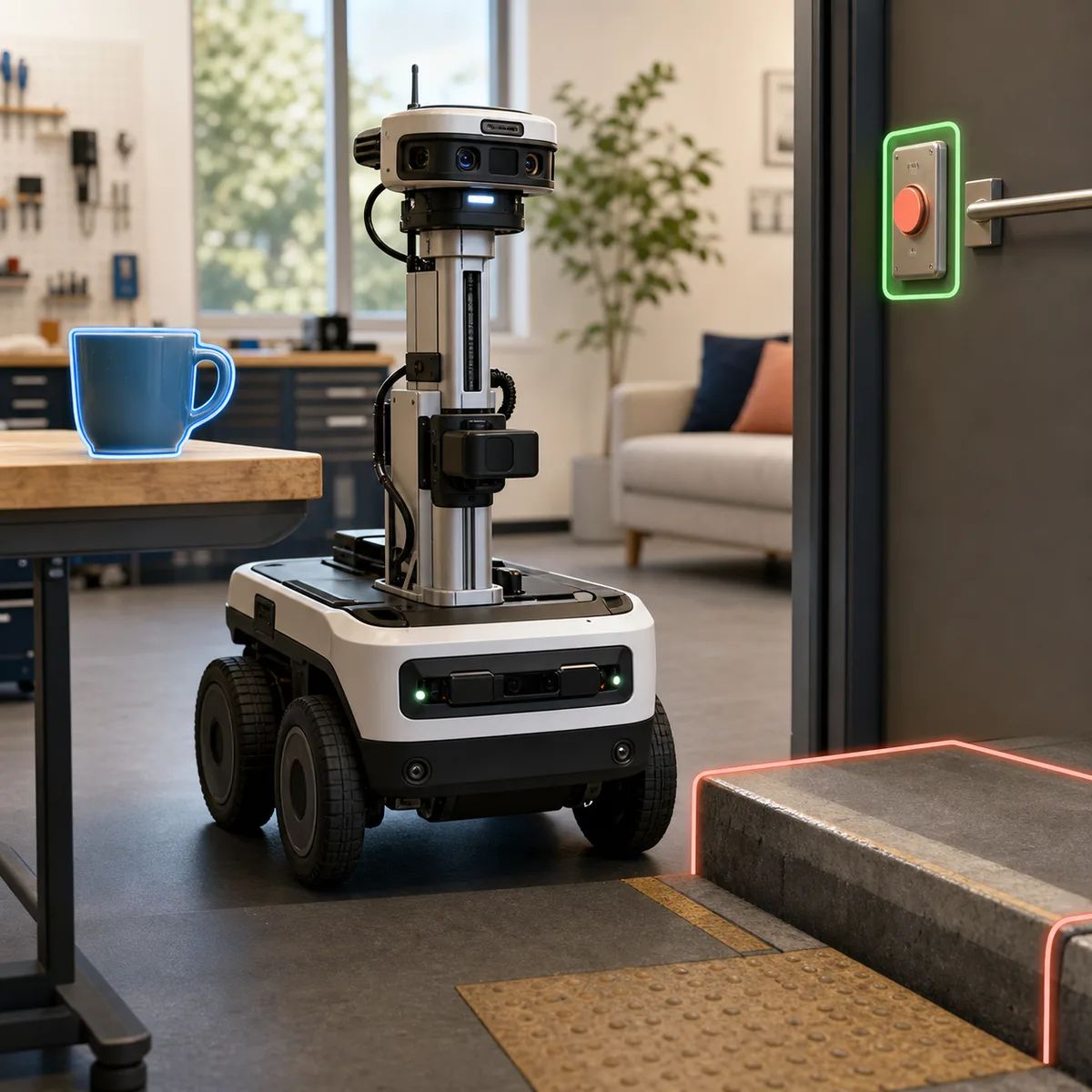
Meta’s Genesis Mission project examples show its open-source vision models being used in assistive robotics work, where the model problem is physical perception rather than chatbot reasoning.
The official Meta AI article fetched in this run focuses on Reimagining Independence, a University of Pittsburgh Human Engineering Research Laboratories initiative with ATDev. Meta says the project has up to $41.5 million in funding from ARPA-H and is building the Robotic Assistive Mobility and Manipulation Platform Providing Independence for People with Disabilities, or RAMMP.
The article says the project uses Meta vision model work including DINO and Segment Anything for assistive mobility.
This is not a Meta consumer-product launch. It is more useful as an applied research signal: open vision models are moving into edge systems that need to understand ordinary physical spaces.
For assistive robotics, the hard part is not only recognizing an object in a clean benchmark image. A useful system must perceive cups, counters, buttons, doors, curbs, obstacles, and people in changing light while running close enough to the device to be responsive.
Edge perception is the practical test
Vision foundation models are often discussed as general-purpose perception layers. Robotics makes that claim harder to hide behind. The model has to support decisions in physical space, where latency, power, reliability, and error handling matter.
DINO-style representation learning and Segment Anything-style object segmentation are useful because they can help a system identify and separate objects without training a narrow detector for every possible scene. But an assistive system still needs a full stack around the model: sensors, onboard compute, navigation logic, safety constraints, and user control.
That is why the Genesis Mission example is worth watching. The value is not that a model can label a scene. The value is whether open model components can reduce the custom work needed to build practical perception systems for accessibility and mobility.
Open models have a deployment advantage
Open-source or openly available vision components can matter more in robotics than in some cloud AI workflows. Teams may need to run locally, adapt to custom sensors, reduce latency, or inspect model behavior in safety-sensitive settings.
That does not make deployment easy. Assistive technology has a high trust bar because errors affect daily movement and independence. A system that works in a lab but fails in crowded streets, low light, rain, or cluttered rooms is not ready.