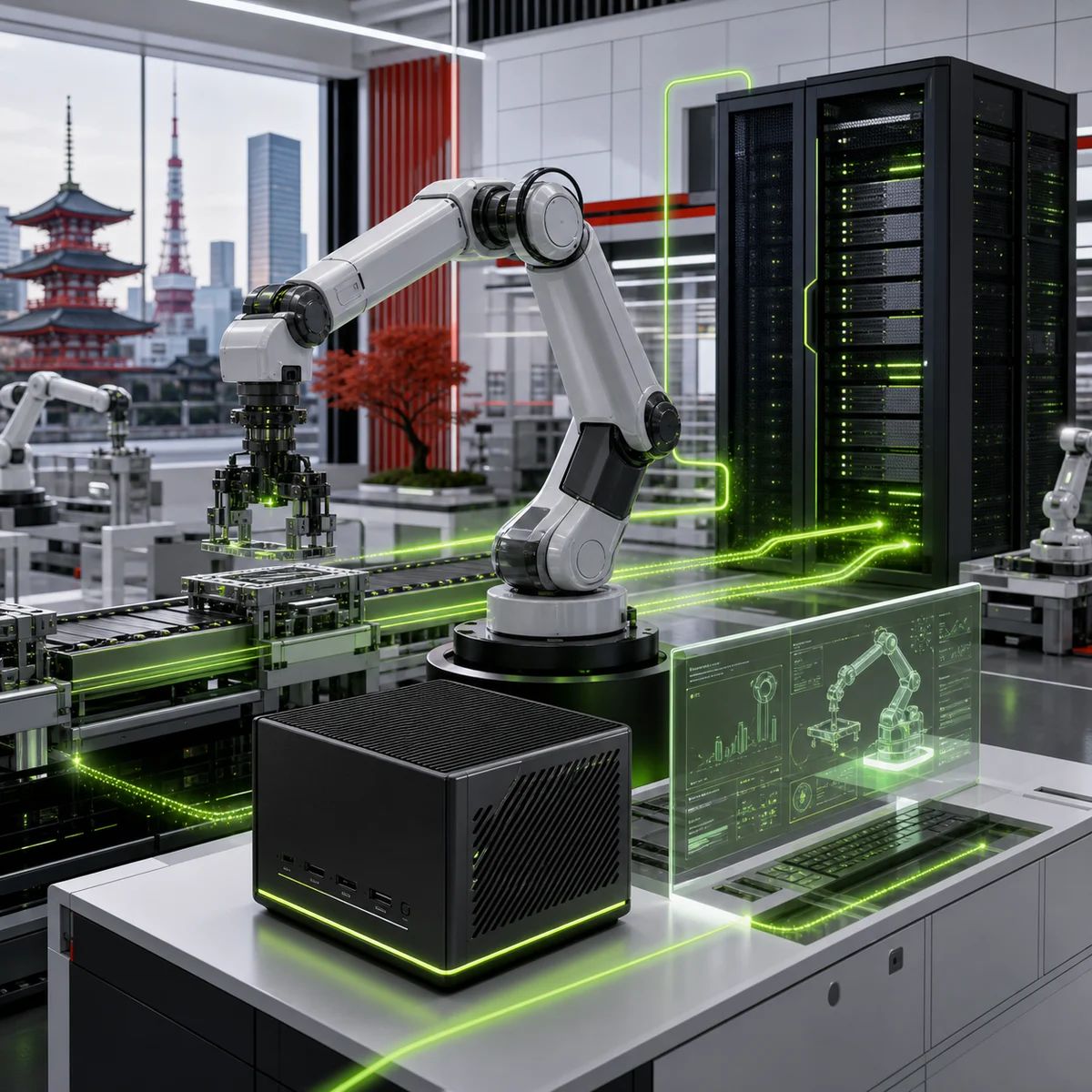
A Japan manufacturing floor connects robotics arms, compact AI PCs, and data-center compute into one NVIDIA stack
+ NVIDIA AI News

NVIDIA uses Japan to package physical AI as a full-stack ecosystem

NVIDIA's July 15 Japan ecosystem update ties RTX Spark, robotics, manufacturing, and local partners into a physical AI stack.

NVIDIA’s July 15 Japan ecosystem update packages physical AI as a full-stack market, not a single chip story.

The NVIDIA Blog post says the company and its partners in Japan are showcasing AI and robotics across the full stack. The opening example is gaming-adjacent: NVIDIA and SEGA are marking 30 years of collaboration by bringing VIRTUA FIGHTER CROSSROADS and future SEGA titles to NVIDIA RTX Spark, a superchip platform for slim Windows laptops and compact desktop PCs.

That is only one part of the post. The broader framing is Japan as a center for AI manufacturing, robotics, infrastructure, and partner-led deployment.

Japan is a useful physical AI testbed

NVIDIA’s Japan story works because the country has the pieces physical AI needs: large manufacturers, robotics suppliers, automotive and electronics companies, factory automation, and local demand for productivity technology.

For NVIDIA, that lets one ecosystem post point across many layers. RTX Spark puts local AI capability closer to developers and creators. Robotics and manufacturing partners give the company a route into machines, factories, and industrial workflows. Data-center and infrastructure partners support the training, simulation, and deployment side.

This is the commercial pattern behind “physical AI.” The model is not enough. A robot, car, production line, or inspection system needs sensors, simulation, edge compute, cloud training, fleet management, safety cases, and local integration. NVIDIA wants to sell into that stack rather than compete only on accelerators inside a data center.

The announcement is ecosystem evidence

The July 15 post is not a clean benchmark result or a single product release. It is evidence of go-to-market coordination.

That makes the claims narrower but still useful. NVIDIA is showing where it thinks adoption can happen: consumer and creator devices, game development, industrial robotics, and national or regional partner ecosystems. Japan gives the company a concentrated place to tell that story because the same industrial base can connect robotics, simulation, manufacturing, and embedded AI.

Outside coverage around the SEGA event adds a reminder that NVIDIA is also using cultural and developer attention to make RTX Spark visible. But the harder business question is not whether a Tokyo event draws attention. It is whether local partners turn the stack into shipped systems.

Sources

The AI Feed Desk

The AI Feed Desk

Editorial desk

The AI Feed Desk tracks AI provider updates, model releases, agent tooling, and enterprise adoption, turning fast-moving announcements into source-linked context for builders and operators.

Noticed a typo, incorrect information, or translation error?

Tell us so we can fix it.

Help Improve This Article

Related Articles

An AI server rack connects to a warm closed-loop liquid cooling system and dry cooler

NVIDIA says 45 C liquid cooling can reshape AI factory design

NVIDIA says Rubin-generation AI infrastructure can run with 45 C coolant in closed-loop liquid-cooled AI factories, reducing cooling energy and water dependence.

The AI Feed Desk

By The AI Feed Desk

A large AI factory rack sends green revenue tokens toward a smaller cloud node

NVIDIA turns AI cloud capacity into a revenue-sharing model

NVIDIA's new AI cloud model pairs revenue sharing with credit support, giving emerging cloud providers a way to finance AI factories while tying NVIDIA to downstream token demand.

The AI Feed Desk

By The AI Feed Desk

A mountain-side AI factory lights rows of liquid-cooled compute racks connected to regional power lines

Firebird opens NVIDIA-backed AI factory in Armenia

Firebird opened an NVIDIA-backed AI factory in Armenia and plans more than 70,000 Rubin and Blackwell GPUs with 300 MW of capacity by 2027.

The AI Feed Desk

By The AI Feed Desk

10 minutes ago
A mixture-of-experts model is split across GPUs while a single import path feeds the training pipeline

NVIDIA NeMo AutoModel makes MoE fine-tuning a one-import upgrade

NVIDIA's Hugging Face article shows NeMo AutoModel wrapping expert parallelism and custom kernels behind the familiar Transformers loading path for MoE fine-tuning.

The AI Feed Desk

By The AI Feed Desk

A compact AI factory module combines a chip wafer, server racks, cooling pipes, and power equipment

NVIDIA frames U.S. AI buildout as a 43-state supply chain

NVIDIA says its U.S. partner network spans 43 states and plans up to $500 billion of American-built AI infrastructure with semiconductor, system, power, and cloud partners.

The AI Feed Desk

By The AI Feed Desk