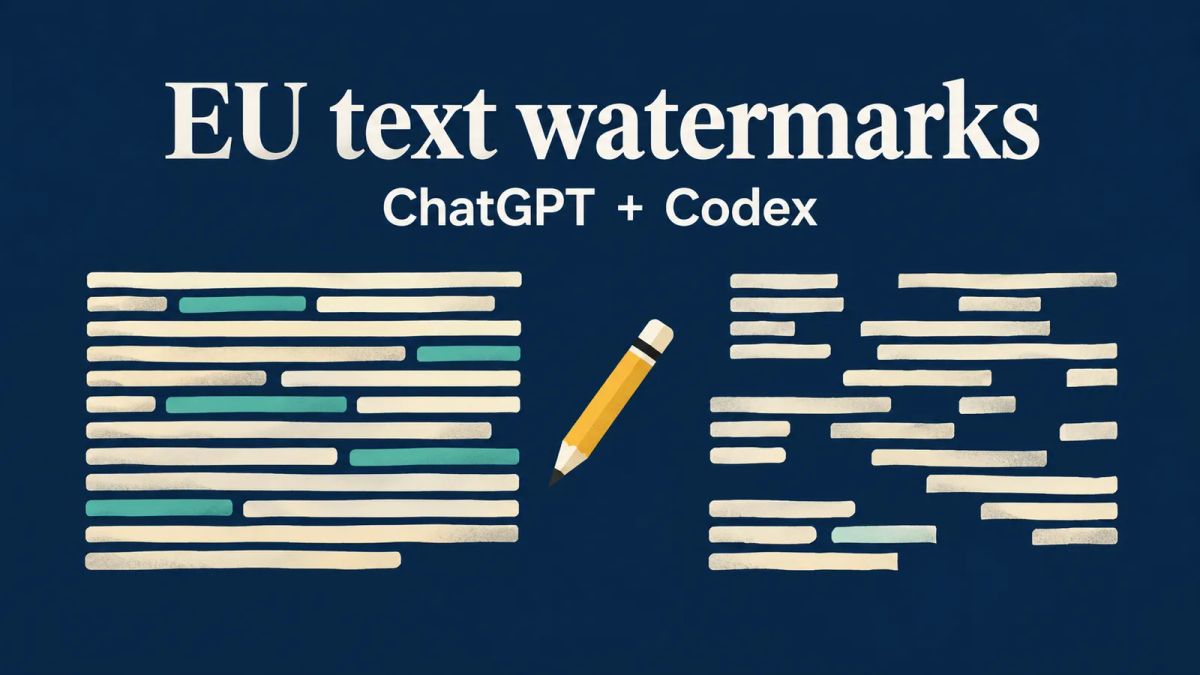
OpenAI will add invisible watermarks to eligible ChatGPT and Codex text output across all plans in the European Union over the coming weeks. TechCrunch reports that the October 5 announcement responds to the EU AI Act’s transparency rules, which took effect on August 2 and require machine-readable marks on AI-generated content.
The launch separates watermarking from access to the detector. EU users will receive marked text, while approved researchers and expert organizations get the first opportunity to evaluate detection.
Where the marks apply
ChatGPT and Codex get the regional rollout. OpenAI is keeping text watermarking limited to the EU at launch rather than making it a global default.
API developers worldwide can opt in for select models starting October 5. Watermarking stays off by default in the API. A developer therefore needs to check the model and setting before assuming that an API response carries a mark.
According to TechCrunch, OpenAI’s method, called textGrain, subtly changes word choices to leave a statistical pattern. Readers cannot see it, but a detector with the relevant key can look for it. Because the pattern is in the words, it survives copying and pasting. OpenAI says it does not identify the user and that its benchmark tests showed no meaningful performance change with watermarking enabled.
Editing weakens the signal
TechCrunch reports that replacing 10% of words with synonyms reduced detection from about 92% to 66% in one OpenAI test. Short passages, mathematical answers and translated text are also harder to detect.
OpenAI’s announcement specifies that the synonym test used 400-token passages. Replacing 25% of words reduced detection to 17%. These are evaluation results, so readers should keep the passage length and edit method attached to the percentages.
A mark can indicate that OpenAI generated or processed part of a passage. As TechCrunch explains, it cannot measure how much human judgment, editing or creativity went into the text. A missing mark also cannot establish human authorship. Editing may have weakened it, the passage may be too short, or another company’s model may have produced it.
Why detector access starts with researchers
OpenAI cites missed watermarks and false positives as reasons to withhold public access at launch. Researchers and expert organizations can apply for access, which OpenAI will grant case by case to support evaluation and improvement. The detector reports whether it finds an OpenAI watermark without revealing prompts or conversations.