A team of Claude Opus 5.5 agents working with researcher Geby Jaff has identified two candidate magnetic semiconductors for spin-based memory, according to Vals AI’s October 4 report. One is a newly designed compound. The other is a material chemists first made in 1999. Their predicted electronic properties still need experimental confirmation.
The target is a material whose opposing magnetic moments cancel, yet whose electron states can be separated by spin near its band gap. That combination could help memory devices use electron spin while reducing magnetic interference between neighboring materials. Vals calls these Luttinger-compensated semiconductors.
Two candidates with different obstacles
The agents ran density functional theory calculations with two methods, PBE+U and HSE06. Vals reports the following band gaps and spin windows from HSE06. A spin window is an energy interval near a band edge where the available states share one spin.
| Candidate | Predicted band gap | Predicted spin windows | Evidence above room temperature |
|---|---|---|---|
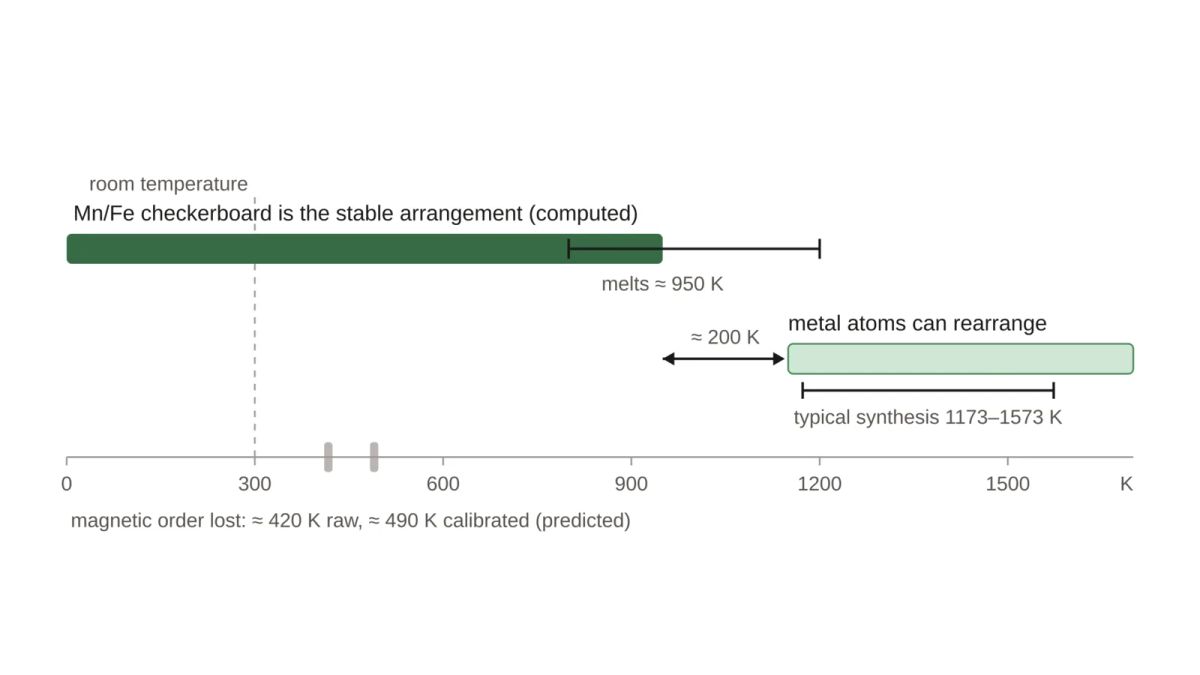
| YBaMnFeO₅ | 2.35 eV | 1.0 eV for holes, 1.4 eV for electrons | Magnetic order to about 420 K in simulation, or 490 K after calibration |
| KV[Cr(CN)₆] | About 2.1 eV | 2.6 eV for holes, 1.6 eV for electrons | The 1999 sample retained magnetic order to 376 K, or 365 K after heating |
YBaMnFeO₅ needs manganese and iron atoms in a checkerboard arrangement. The team’s simulations predict that arrangement becomes disordered around 950 K. Vals says usual synthesis temperatures for this kind of oxide are 900 to 1300 degrees Celsius, above that threshold. At lower temperatures, the atoms barely move. A disordered crystal loses the predicted spin sorting, so making the useful arrangement is a central obstacle.
KV[Cr(CN)₆] has a different advantage. Its chemistry places chromium and vanadium at separate sites. But the predictions describe a perfect, dry crystal. The 1999 sample was a powder with water in its pores and a small residual magnetic moment. The two calculation methods disagree on how strongly water affects the spin windows. Neither its band gap nor its spin sorting has been measured, Vals says.
What the agents added
Jaff says the agents designed YBaMnFeO₅ and recognized the second material’s relevance to this goal. Vals also acknowledges earlier work. The chemists who made KV[Cr(CN)₆] intended its magnetic moments to cancel, and a 2008 calculation already showed same-spin states at both band edges.
The claimed contribution for that existing material is identifying it as a Luttinger-compensated semiconductor, quantifying its spin windows and assessing their robustness. Jaff says the calculation inputs, outputs, analysis code and caveats are available in a public repository linked from the report.
Sources
- Vals AI: Two Room-Temperature Antiferromagnetic Semiconductor Candidates, by Geby Jaff, October 4, 2026. Lead chart credit: Vals AI, from this report.