Anthropic has opened a beta program that gives verified life science organizations access to its models with fewer biology restrictions. The Life Sciences Verification Program ties access to an organization’s credentials, security practices, research oversight, and stated use.
The program covers Mythos, Opus, and Sonnet models across Claude Science, Claude.ai, Claude Code, and the API. Anthropic says it onboarded dozens of organizations during early access and expects hundreds to enroll in the first week.
Access splits into team and project grants
Applicants must pass a review of their research credentials, security standards, and ethical oversight. Approved organizations can then seek one of two grants.
A Standard Use grant applies to a team and lasts one year. It uses biology classifiers that permit more scientific work than Anthropic’s generally available Fable models. Anthropic says this tier should cover most work in basic research, drug development, manufacturing, clinical development, quality assurance, regulation, and investment analysis.
A High-risk Use grant covers one project and lasts six months. It removes every safeguard that blocks life sciences requests. Other protections, including cyber classifiers, remain active.
High-risk access is available now for Opus 5 and Sonnet 5. Anthropic is working with the U.S. government on broader access for Mythos. At launch, high-risk Mythos grants remain limited to a small set of organizations that receive additional vetting.
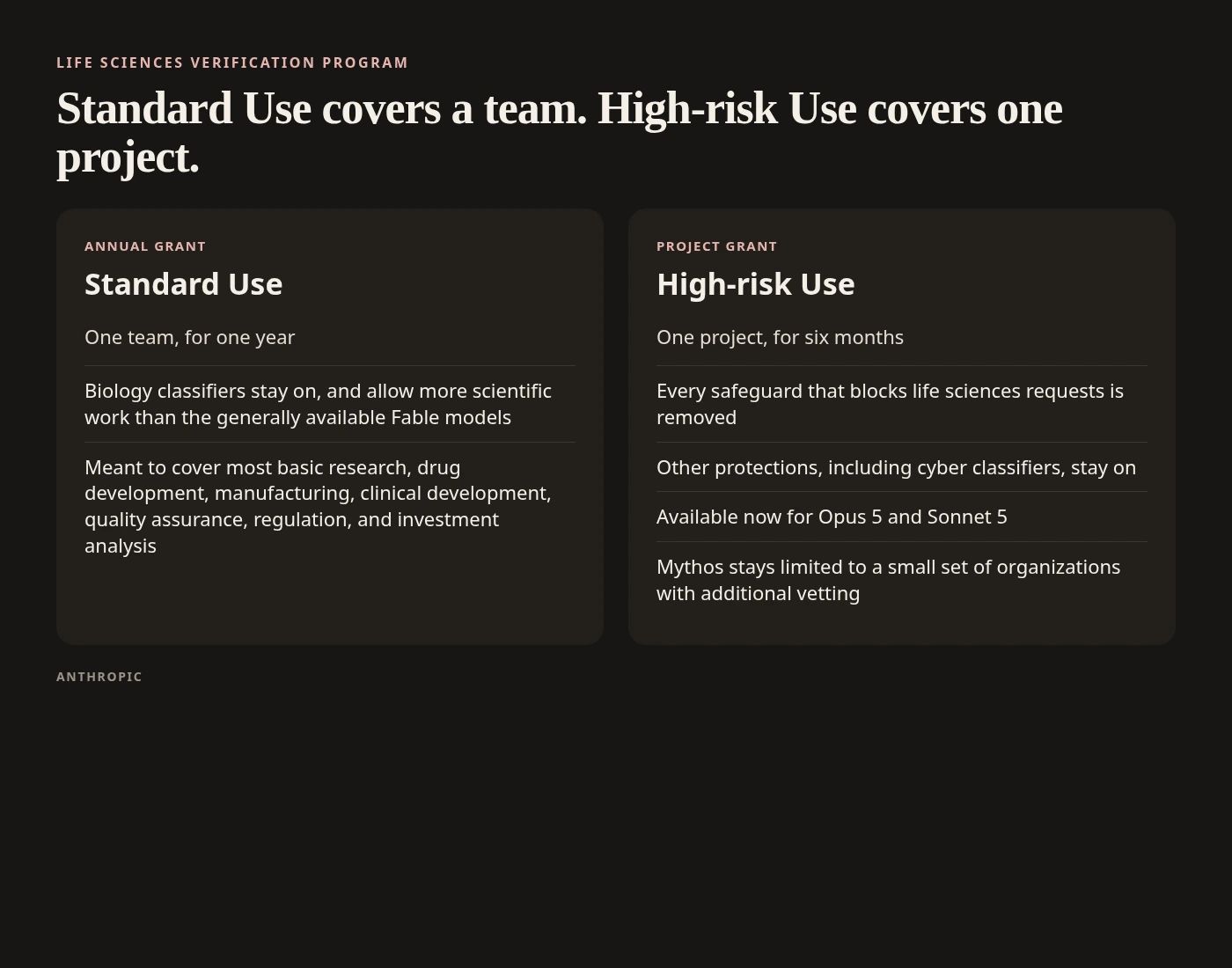
High-risk access is open now for Opus 5 and Sonnet 5. Mythos stays with a smaller set of organizations.
Monitoring replaces biology request blocking
Each organization describes its intended work at a high level in its application. Anthropic then monitors activity for requests or patterns outside that approved scope.
The company says this approach is designed to find misuse spread across requests and sessions. Instead of rejecting each potentially harmful biology request in real time, the program uses offline monitoring. Anthropic requires 30 days of data retention for LSVP traffic so it can review those patterns.
Anthropic says it will keep the retained data separate from model training and from its life sciences research teams. If it finds unauthorized activity, it can alert the organization’s administrators, who must investigate and fix the issue within timeframes agreed with Anthropic.
The company designed the controls around three risks: a stolen or compromised account, a malicious or coerced insider, and an AI agent that takes dangerous actions. Anthropic says valid biology research can resemble malicious work, which makes the identity and controls around the user part of the access decision.
The beta has product and data limits
The program is available through Anthropic’s first-party API console and Claude Enterprise and Team plans. It does not yet support individual plans or third-party platforms.
The beta is also unavailable to organizations using a Business Associate Agreement. Anthropic directs customers handling protected health information to keep the program in a separate non-BAA organization and use non-HIPAA data there.
Users can switch grants inside the API and Claude Science. Claude.ai and Claude Code initially use one preselected grant, except when Claude Code authenticates through the API.