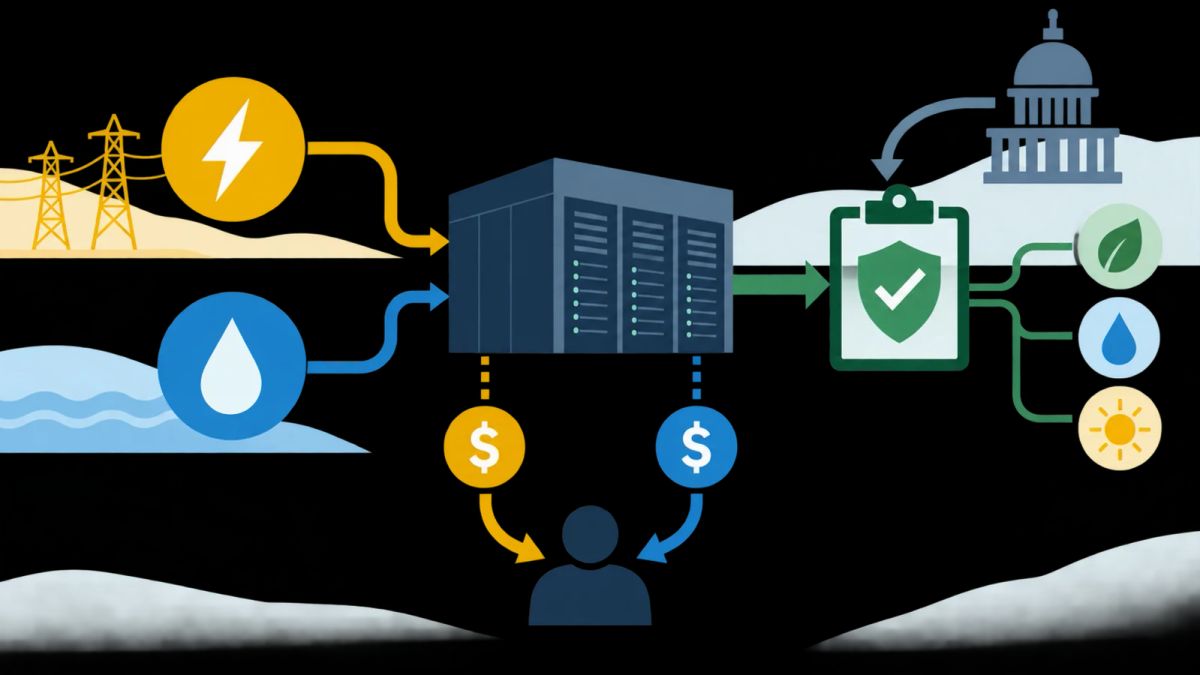
Electricity and water connect to a data center, with cost arrows and a permit gate; illustration
+ AI News

California shifts more AI data center infrastructure costs to operators

Seven California laws create a data center utility rate class, make operators pay for local grid and water upgrades, and tie faster approvals to resource requirements.

California Gov. Gavin Newsom has signed seven bills that change how AI data centers pay for and report their use of electricity and water. The package directs the California Public Utilities Commission to create a new rate classification for data centers and requires operators to pay for upgrades to local power grids and water systems.

The laws also add disclosure and permitting rules. Proposed data centers must give local governments estimates of their water use, along with information about energy efficiency and drought planning. Projects must meet requirements for energy, water, and fuel consumption to qualify for a streamlined approval process.

Faster approval now comes with resource conditions

The package connects operating costs to project approval. A developer seeking the faster route must first meet the state’s resource requirements. Local governments also receive water-use estimates and planning information before a proposed site begins operating.

The rate classification and upgrade rules address a different stage of development. They are intended to keep the cost of added grid and water capacity with data center operators instead of shifting it to utility customers.

Newsom framed the laws as a response to higher electricity demand, grid constraints, water use, and pollution associated with data center growth. The source report does not provide the new rate formula, the resource thresholds for streamlined approval, or details on how agencies will enforce the requirements.

Sources

The AI Feed Desk

The AI Feed Desk

Editorial desk

The AI Feed Desk tracks AI provider updates, model releases, agent tooling, and enterprise adoption, turning fast-moving announcements into source-linked context for builders and operators.

Noticed a typo, incorrect information, or translation error?

Tell us so we can fix it.

Help Improve This Article

Related Articles

A data center waits beside a power-grid connection queue with substations in the distance

AI data centers face a grid-connection bottleneck

A Works in Progress analysis argues that the limiting factor for AI buildouts is often the queue to connect new loads and generation to the electric grid.

The AI Feed Desk

By The AI Feed Desk

Matt Garman wearing a blue jacket with his arms crossed against a dark background

Amazon says it no longer uses NDAs for data centers as backlash grows

AWS says it has stopped using NDAs with government agencies. Its new commitments leave questions about existing agreements and access to local project data.

The AI Feed Desk

By The AI Feed Desk

Boom Supersonic rendering of its Superpower gas turbine and generator

Crusoe drops Boom turbine order as its AI power plans change

Crusoe will no longer launch Boom's Superpower turbine after ordering 29 units. The change affects a planned 1.21 GW supply deal, while Crusoe's power choices vary by site.

The AI Feed Desk

By The AI Feed Desk

A California policy desk reviews teen AI safety controls beside a ChatGPT education interface

OpenAI backs California youth AI safety bill

OpenAI endorsed California Senate Bill 1119, arguing that teen AI products need automatic age-appropriate safeguards, audits, parental tools, and crisis-support paths.

The AI Feed Desk

By The AI Feed Desk

A model access gate with security classifiers sorting safe requests from blocked cyber-risk paths

Anthropic restores Fable 5 and proposes a jailbreak severity framework

Fable 5 returns after US export controls were lifted, but the bigger change is Anthropic's push for a common way to score AI jailbreak risk.

The AI Feed Desk

By The AI Feed Desk