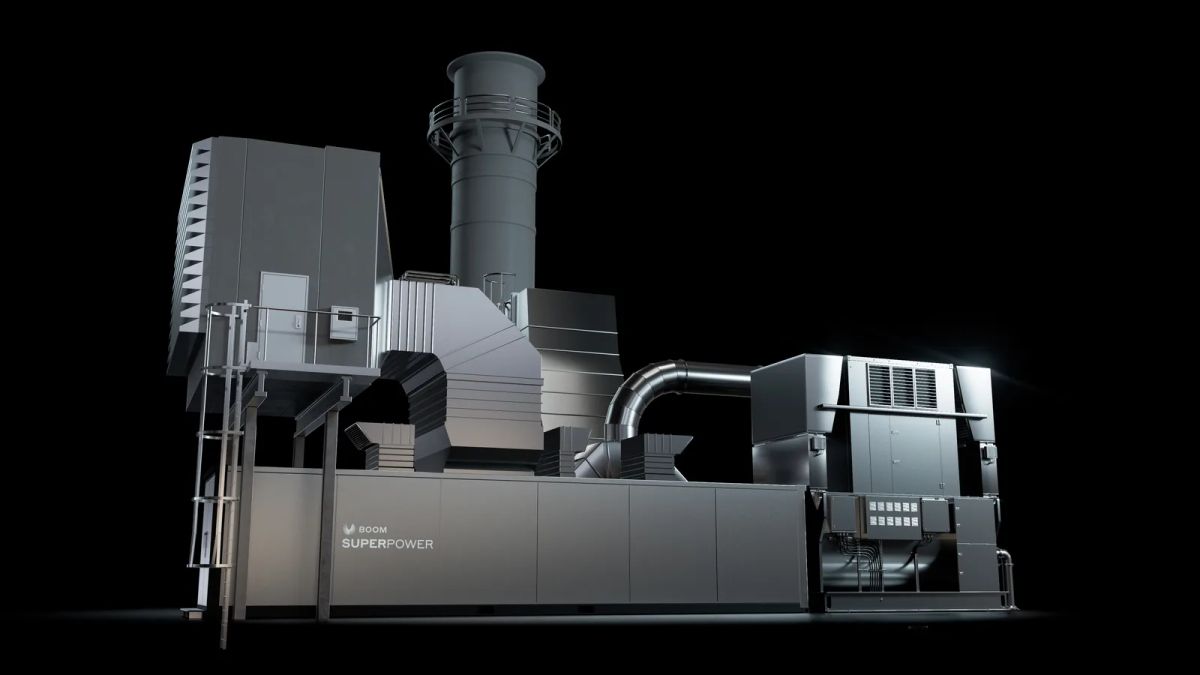
Boom Supersonic rendering of its Superpower gas turbine and generator
+ AI News

Crusoe drops Boom turbine order as its AI power plans change

Crusoe will no longer launch Boom's Superpower turbine after ordering 29 units. The change affects a planned 1.21 GW supply deal, while Crusoe's power choices vary by site.

Crusoe and Boom Supersonic have ended their plan to launch Boom’s Superpower gas turbine together. Boom named Crusoe as its first customer in December 2025, with an order for 29 turbines and 1.21 gigawatts of planned capacity. The order formed part of a deal valued at more than $1.25 billion.

Boom CEO Blake Scholl said the turbines are no longer in Crusoe’s near-term primary power mix at Abilene and other sites. Crusoe confirmed to TechCrunch that the companies are no longer doing business. It said it chooses energy sources for each site as its plans change.

The cancellation removes the launch customer for a turbine Boom planned to start delivering in 2027. Scholl said Boom expects to deliver about 250 megawatts to other sites next year and is targeting one gigawatt in 2028. Those are Boom’s plans, not completed installations.

Different sites need different power

The change does not identify a single replacement for the Boom order. TechCrunch reports that Crusoe’s first 1.2-gigawatt Abilene campus, built for Oracle and OpenAI, draws its main power from the grid and uses a gas turbine plant for backup. A separate 900-megawatt Abilene campus for Microsoft is planned around on-site gas turbines. Crusoe has not said those turbines replace the Boom units.

That distinction matters for construction schedules. A data center needs power available when its computing equipment is ready, but a supplier’s announced capacity and delivery target are not the same as an energized campus. Crusoe’s decision shows how a builder can change the equipment in its plan before a proposed supply becomes operating capacity.

Sources

The AI Feed Desk

The AI Feed Desk

Editorial desk

The AI Feed Desk tracks AI provider updates, model releases, agent tooling, and enterprise adoption, turning fast-moving announcements into source-linked context for builders and operators.

Noticed a typo, incorrect information, or translation error?

Tell us so we can fix it.

Help Improve This Article

Related Articles

A data center waits beside a power-grid connection queue with substations in the distance

AI data centers face a grid-connection bottleneck

A Works in Progress analysis argues that the limiting factor for AI buildouts is often the queue to connect new loads and generation to the electric grid.

The AI Feed Desk

By The AI Feed Desk

Matt Garman wearing a blue jacket with his arms crossed against a dark background

Amazon says it no longer uses NDAs for data centers as backlash grows

AWS says it has stopped using NDAs with government agencies. Its new commitments leave questions about existing agreements and access to local project data.

The AI Feed Desk

By The AI Feed Desk

Electricity and water connect to a data center, with cost arrows and a permit gate; illustration

California shifts more AI data center infrastructure costs to operators

Seven California laws create a data center utility rate class, make operators pay for local grid and water upgrades, and tie faster approvals to resource requirements.

The AI Feed Desk

By The AI Feed Desk

Optical data-center components sit beside a refined metal sample, shipping documents, and a global supply-chain route map

Indium scrutiny puts AI data-center optics in the supply-chain frame

Reuters reports that buyers are seeing tighter Chinese scrutiny around indium exports, raising attention on a niche material used in high-speed optical chips for AI data centers.

The AI Feed Desk

By The AI Feed Desk

Project Suncatcher name and sun-shaped symbol on a yellow, orange and blue background

Google's space AI plan assumes around 1,800 Starship launches to cut launch costs

Google's first TPU satellite is in orbit. Its launch-cost projection assumes a decade of heavy Starship traffic, while power, cooling and laser links still need testing.

The AI Feed Desk

By The AI Feed Desk