Docker’s Docker Agent project lets developers define AI agents in YAML and run them through docker agent. The open-source builder and runtime can connect agents to cloud models or Docker Model Runner, give them tools, and arrange teams of agents that delegate work.
For Docker users, the connection to the company’s AI tools is concrete. Model Runner supplies the local-model option, Docker-based MCP servers supply tools, and OCI registries distribute agent packages. Docker Agent puts the instructions and choices for those services in a configuration file.
What an agent configuration does
The README’s starter example defines a root agent with an OpenAI model, a written instruction and a DuckDuckGo tool through the Model Context Protocol, or MCP. The user runs that file with docker agent run agent.yaml.
That example is a single assistant. The project also supports teams of specialized agents, built-in think, todo and memory tools, and document retrieval. Its retrieval options include keyword search with BM25, embeddings, hybrid search and reranking.
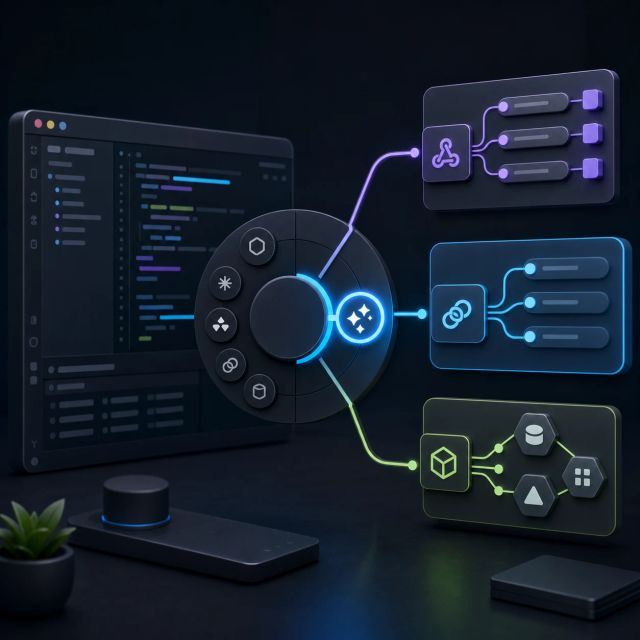
Docker lists support for OpenAI, Anthropic, Gemini, AWS Bedrock, Mistral and xAI, alongside Docker Model Runner. Tools can come from local, remote or Docker-based MCP servers.
The project also lets users push agents to any OCI registry and run them by a registry reference such as docker agent run myorg/agent:tag. OCI is the registry format used for container artifacts.
How it fits Docker’s agent efforts
The repository describes several distinct jobs within the setup:
| Part | Job in the agent setup |
|---|---|
| Docker Agent | Reads the agent definition and runs the agent or agent team |
| Docker Model Runner | Provides the local-model option |
| MCP servers | Provide tools the agent can use |
| OCI registry | Stores agent packages for sharing and later use |
According to the README, Docker Desktop 4.63 and later include the CLI plugin. Users can also install it through Homebrew or download a binary from GitHub Releases. Cloud models require a provider API key; the README offers Model Runner as the local alternative.
docker agent new generates a configuration interactively, while docker agent run starts the default agent. Docker says its developers use the project’s own golang_developer.yaml agent to work on Docker Agent. The README also discloses anonymous usage telemetry.