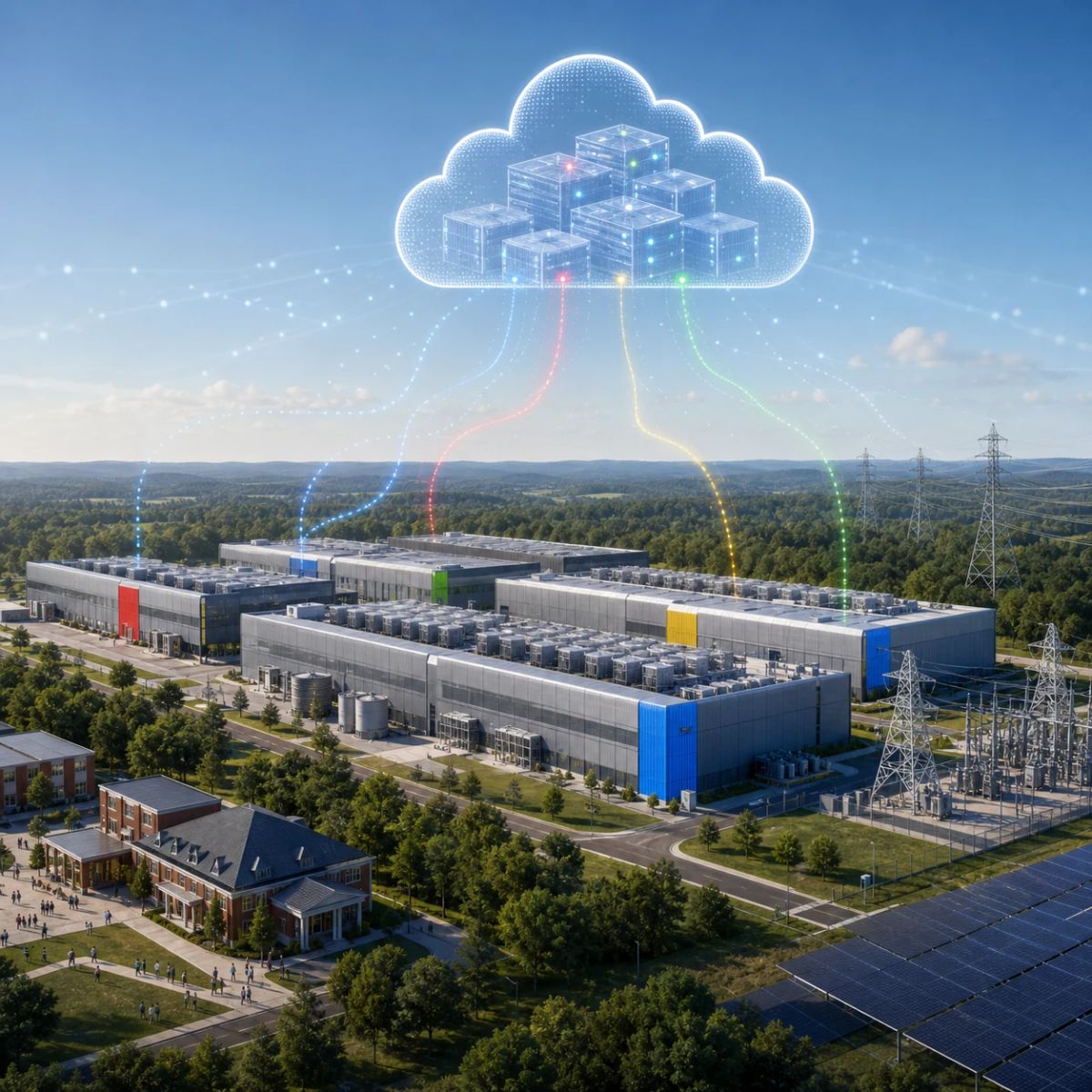
Google announced a $1.5 billion investment to expand its data-center campus in Jackson County, Alabama across 2026 and 2027. The company says the facility has operated since 2019 on the site of the Tennessee Valley Authority’s retired Widows Creek coal plant, and that the new expansion will be paired with energy-affordability, STEM, workforce, and water-stewardship programs.
The AI angle is infrastructure, not a new model. Large AI products need compute, and compute turns into physical campuses, power contracts, water plans, grid commitments, and local politics. Google’s announcement is useful because it makes those constraints visible.
The power promise is the story
Google says it will pay for 100% of the power it uses and cover infrastructure costs directly driven by its operations, including the Jackson County expansion. That language is tied to the White House’s Ratepayer Protection Pledge, a political response to public concern that data-center growth could raise electricity costs for nearby residents.
The pledge matters because AI infrastructure is no longer a quiet back-office story. Every new data center now has to answer two questions at once: how much capacity does the company need, and who pays for the grid upgrades that capacity requires?
Google’s answer is to describe itself as both a power customer and a grid partner. The company says it has contracted to bring more than 300 megawatts of new generation capacity to the Tennessee Valley region. It also points to a 2025 Google, Kairos Power, and TVA agreement to supply up to 50 megawatts of advanced nuclear power to Google data centers in Tennessee and Alabama.
Community programs are part of the permit environment
The announcement also includes a $2 million Energy Impact Fund with TVA and the Community Action Agency of Northeast Alabama to support local energy efficiency and weatherization programs. Google says it is donating $550,000 for STEM kits for fourth-to-eighth-grade students in the Jackson County School District.
Those items are not side decorations. They are part of how hyperscalers now explain data-center expansion. Compute capacity creates local jobs and tax revenue, but it also concentrates demand for power, water, land, construction labor, and public attention. Community programs help answer the question of what the host region receives beyond the facility itself.
Google also says it has trained more than 130,000 Alabamians in digital skills through partnerships with more than 150 organizations, and that its local work includes water stewardship in the Paint Rock River Watershed. Those are company-reported figures, so readers should treat them as Google’s account of its local footprint unless separately audited.
Why this belongs on an AI site
It is easy to under-rank infrastructure stories because they do not ship a model ID. That would miss the economics of the current market. Frontier models, multimodal products, coding agents, video generation, and enterprise inference all depend on regional capacity that has to be financed, powered, cooled, and justified locally.
The Alabama expansion also shows how the AI infrastructure argument has changed. It is not enough for a company to say a campus will support the cloud. The public case now includes ratepayer protection, clean energy supply, demand response, education funding, and local economic impact.
The counter-case is that Google’s announcement is still a company announcement. It does not provide independent measurement of future ratepayer effects, water usage, construction impacts, or how much of the added capacity will be used specifically for AI workloads. The story is best read as a clear example of the commitments hyperscalers now attach to compute expansion, not as proof that every impact has been solved.