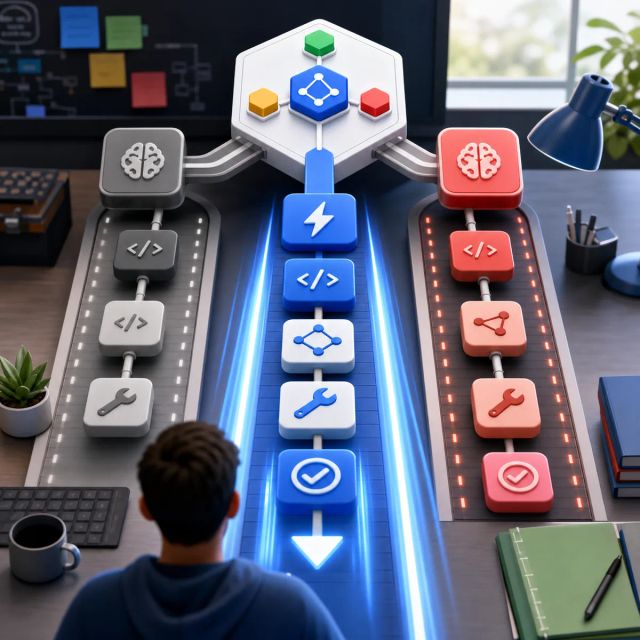
Google DeepMind says it is piloting double-blind AI evaluations for a proprietary frontier-class model, using cryptographic isolation to reduce the risk that model owners see confidential benchmark prompts or evaluators receive model weights.
The company says it is working with the Singapore AI Safety Institute, OpenMined, AVERI, and MLCommons to test a Gemini Flash Lite model against confidential benchmarks in a privacy-preserving GPU environment.
The goal is benchmark integrity. If a model provider can see test prompts before evaluation, future training can contaminate the benchmark. If an evaluator needs access to model weights, the provider takes intellectual-property and security risk. Google DeepMind’s pilot is an attempt to avoid both problems.
The evaluation runs inside a secure box
Google DeepMind describes the system as a cryptographic “box” for external evaluations. The model owner sends the model into a secure GPU enclave, while the evaluator keeps the benchmark confidential. The evaluation can run without either side receiving the other side’s sensitive asset.
The company says the approach builds on privacy-preserving environments and technical safeguards rather than relying only on contracts and zero-logging promises. That distinction matters because benchmark leakage is not just a trust problem. It is also a systems-design problem.
Google DeepMind calls the pilot the world’s first double-blind evaluation of a proprietary, frontier-class AI model. The article should treat that as Google’s claim, not an independently settled category boundary.
Benchmark contamination is becoming a governance problem
AI benchmarks are increasingly used by labs, governments, buyers, and safety institutes to judge model capability and risk. As model training corpora grow and labs run more external tests, the chance that a model has seen benchmark-like material increases.
Contamination can inflate scores. It can also mislead policy discussions if a model appears safer, weaker, or stronger than it actually is. Confidential safety tests are meant to reduce that risk, but they create a practical conflict: someone has to run the model on the test.
The double-blind design tries to separate those roles. Model owners do not need to inspect the benchmark. Evaluators do not need to hold the model weights. The execution environment becomes the trusted middle layer.
The pilot is not a complete eval answer
The pilot does not solve every benchmark problem. Secure execution can protect prompts and weights during a test, but it does not automatically make the benchmark representative, adversarial enough, statistically robust, or relevant to real deployments.
It also leaves implementation questions. Buyers and regulators will need to know how enclaves are audited, how failures are handled, how logs are protected, how prompts are versioned, and how results can be reproduced without leaking the benchmark.
Still, this is a useful step because it makes benchmark trust more technical and less performative. The industry needs evaluation systems that can withstand stronger models, higher financial stakes, and public-policy reliance.