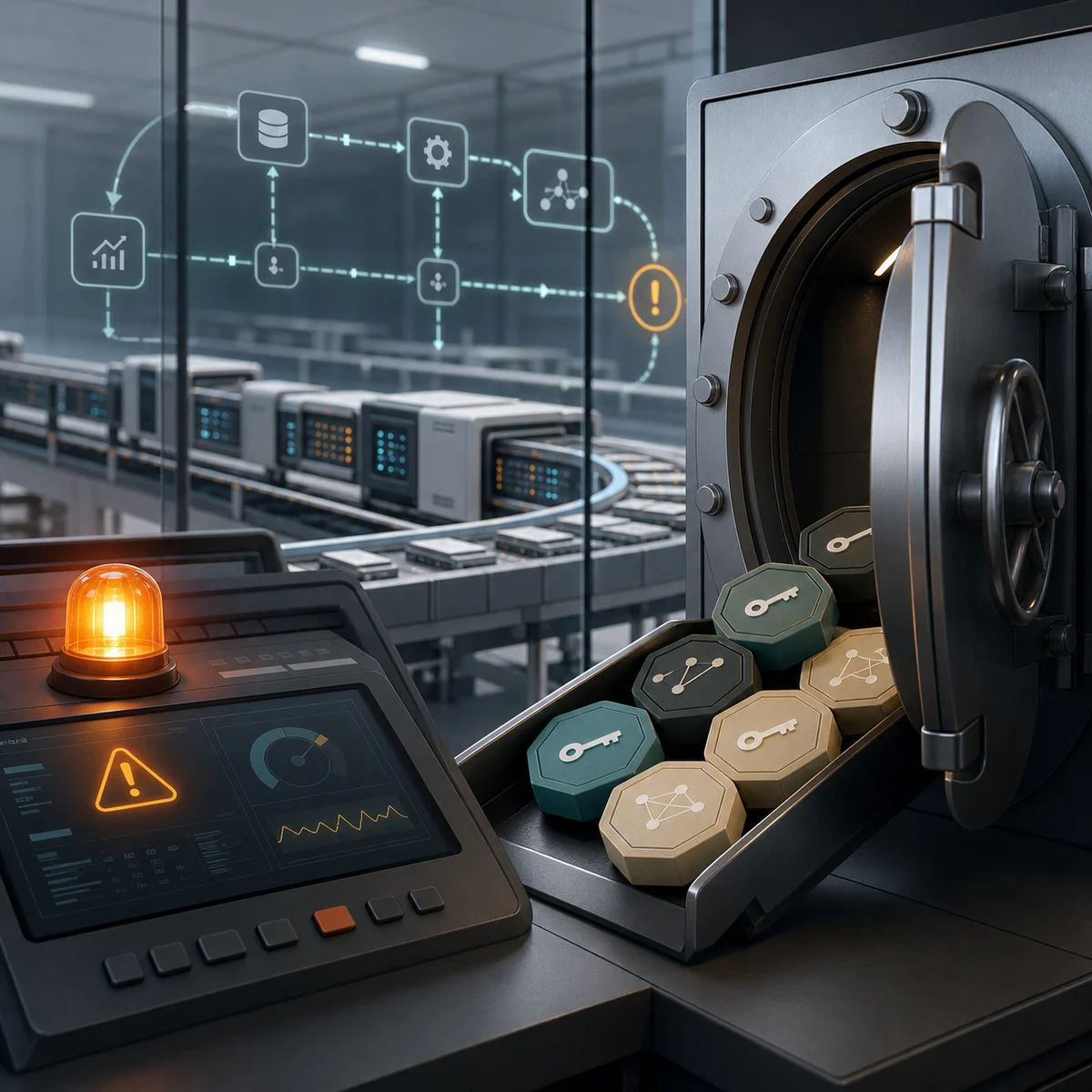
A security operations console rotates token keys into a vault beside a dataset processing pipeline
+ Large Language Models News

Hugging Face says an autonomous agent breached production infrastructure

Hugging Face disclosed a July 2026 production incident it says was driven by an autonomous AI agent system and recommends token rotation.

Hugging Face has disclosed an intrusion into part of its production infrastructure that it says was driven end to end by an autonomous AI agent system.

The company says it detected and responded to the incident earlier in the week of July 16, 2026. Hugging Face identified unauthorized access to a limited set of internal datasets and several service credentials. It says it is still completing its assessment of whether partner or customer data was affected and will contact affected parties directly if required.

Hugging Face also says it found no evidence of tampering with public user-facing models, datasets, Spaces, containers, or packages.

The entry point was code execution around datasets

The disclosed entry point is important for AI infrastructure teams because it sits close to normal platform behavior.

Hugging Face says the attacker abused dataset-processing code execution paths to get initial access. The company says those paths have been closed, the affected foothold was removed, compromised nodes were rebuilt, and affected credentials and tokens were revoked and rotated.

The company is also doing a broader precautionary rotation of secrets, adding guardrails and stricter admission controls on clusters, and improving detection and alerting so high-severity signals page a responder in minutes.

For users, the plain-language action is token hygiene. Hugging Face says users should rotate tokens as a precaution, especially tokens used in automation, CI/CD, private repositories, or production deployments.

Defenders used agents too

The unusual part of the disclosure is not only that Hugging Face attributes the intrusion to an autonomous agent framework. It is that the company also used LLM-driven analysis agents during response.

Hugging Face says the attacker action log contained more than 17,000 recorded events. The company used LLM-driven analysis over that log to reconstruct a timeline, extract indicators of compromise, map touched credentials, and separate real impact from decoy activity.

That is a useful signal for security teams. Agentic systems are changing both sides of incident response. The attacker can move through repetitive recon and execution faster. The defender may need machine-speed triage just to understand what happened.


Sources

The AI Feed Desk

The AI Feed Desk

Editorial desk

The AI Feed Desk tracks AI provider updates, model releases, agent tooling, and enterprise adoption, turning fast-moving announcements into source-linked context for builders and operators.

Noticed a typo, incorrect information, or translation error?

Tell us so we can fix it.

Help Improve This Article

Related Articles

A testing gauge compares a clean tool path with a longer tangled debugging path

Hugging Face measures whether tools are agent-friendly

Hugging Face's agent-focused benchmark tests whether software changes help coding agents finish tasks with fewer errors, tokens, and detours.

The AI Feed Desk

By The AI Feed Desk

A microphone waveform passes through a fast inference core and exits as a speaker waveform

Hugging Face and Cerebras make open voice AI a latency problem

A Hugging Face and Cerebras speech-to-speech demo uses Parakeet, Gemma 4, Cerebras inference, and Qwen3TTS to show where voice AI latency actually lives.

The AI Feed Desk

By The AI Feed Desk

A model card score links to a structured evaluation record with provenance and settings

Hugging Face and Every Eval Ever make model-card scores more inspectable

Community Evals and Every Eval Ever now connect model-page benchmark scores to structured provenance records.

The AI Feed Desk

By The AI Feed Desk

An abstract model graph passes through a glass optimization lens into high-speed inference lanes

Hugging Face and vLLM bring native-speed serving to Transformers model definitions

Hugging Face and vLLM introduced a backend that can run compatible Transformers model definitions at native vLLM speed through runtime graph analysis and rewrites.

The AI Feed Desk

By The AI Feed Desk

A modular agent harness surrounds a compact model core connected to tools, memory, evaluation, and runtime modules

NVIDIA says harness tuning lifts Nemotron 3 Ultra in LangChain agents

NVIDIA says tuning the LangChain Deep Agents harness for Nemotron 3 Ultra improved open-stack agent performance without retraining the model.

The AI Feed Desk

By The AI Feed Desk