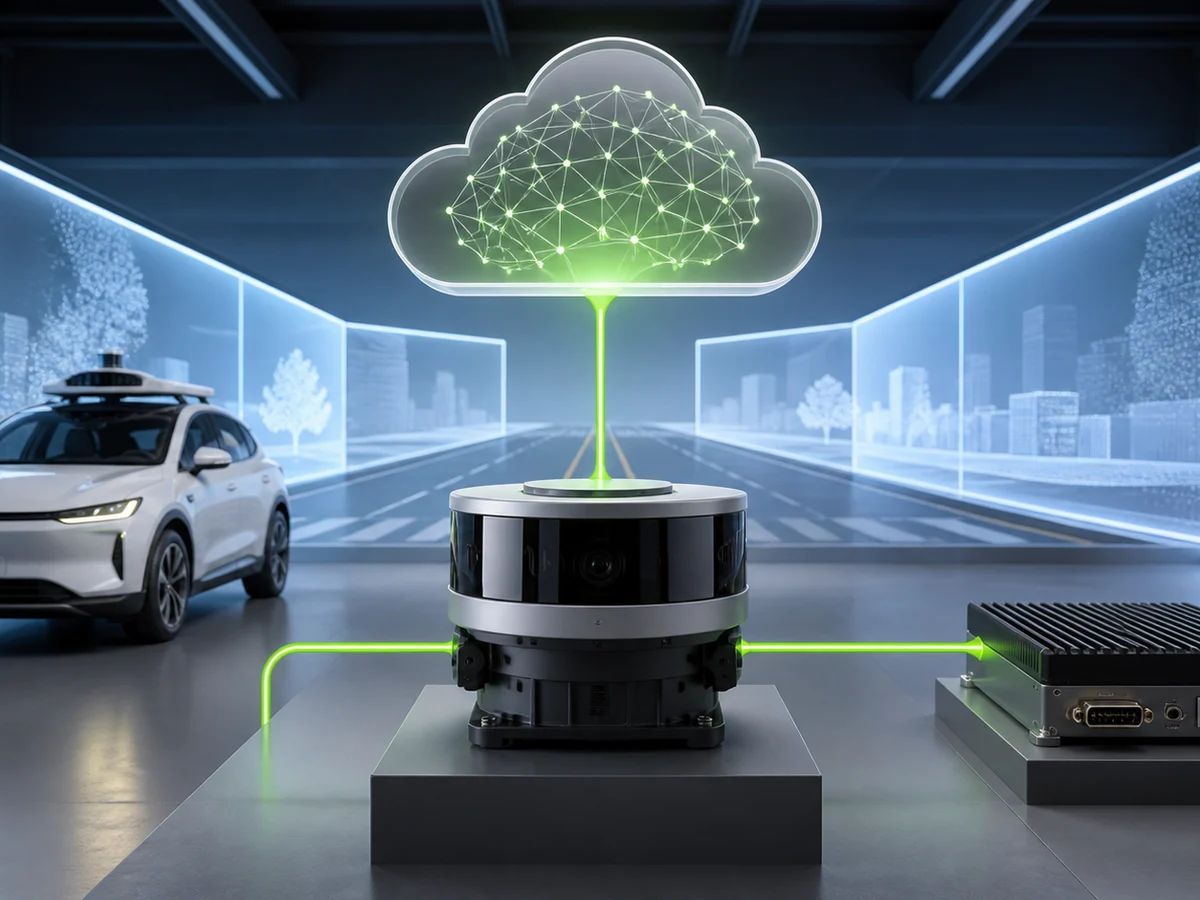
An autonomous vehicle sensor module links a cloud reasoning model to in-vehicle compute inside a simulated road lab
+ NVIDIA AI News

NVIDIA makes Alpamayo 2 Super available for commercial robotaxi development

NVIDIA released Alpamayo 2 Super for commercial autonomous-vehicle development, tying an open 32B reasoning model to its simulation and validation stack.

NVIDIA has released Alpamayo 2 Super, an open 32B vision-language-action model for autonomous driving, and says the model is available now for commercial use.

The August 4 launch moves Alpamayo from a research signal into a more practical development path for robotaxi and autonomous-vehicle teams. NVIDIA says the model is released under its OpenMDW-1.1 license, can be fine-tuned, and can be used to build derivative models for commercial redistribution.

The company is positioning Alpamayo 2 Super as part of a larger “cloud-to-car” stack rather than a standalone model file. The model is meant to reason over driving scenes, explain decisions, and connect with NVIDIA’s simulation tools before a system reaches road testing.

The commercial license is the shift

Open autonomous-driving models are useful only if developers can move beyond demo evaluation. NVIDIA’s launch says Alpamayo 2 Super is available on Hugging Face and can be used commercially, which changes the procurement question for teams already building around the DRIVE ecosystem.

That does not make the model a finished driver. It makes it a testable component in a regulated physical-world workflow. Developers still have to validate perception, planning, controls, fallback behavior, safety cases, and domain transfer from simulation to real roads.

NVIDIA says the broader Alpamayo model family has passed 500,000 downloads on Hugging Face. That is a usage signal, not proof of deployment. It does suggest that developers are already treating the family as a reference point for open autonomous-driving research.

Simulation is part of the product story

The launch connects Alpamayo 2 Super to NVIDIA’s autonomous-vehicle simulation stack. NVIDIA’s developer page describes Omniverse NuRec for reconstructing real-world scenes, Cosmos-Dreams for generating scenario variations, and AlpaSim for closed-loop testing across virtual scenarios.

That matters because autonomous driving is not only a model-quality problem. A driving model needs to be tested against rare events, weather shifts, lighting changes, sensor artifacts, road geometry, traffic behavior, and policy decisions that are hard to collect safely at scale.

The useful read is that NVIDIA is selling an inspectable model plus the environment around it: training data workflows, simulation, synthetic scenarios, validation, and in-vehicle deployment hardware.

Sources

The AI Feed Desk

The AI Feed Desk

Editorial desk

The AI Feed Desk tracks AI provider updates, model releases, agent tooling, and enterprise adoption, turning fast-moving announcements into source-linked context for builders and operators.

Noticed a typo, incorrect information, or translation error?

Tell us so we can fix it.

Help Improve This Article

Related Articles

Editorial illustration of a local text model generating many tokens in parallel on a GPU

Google releases DiffusionGemma for faster local text generation

Google's DiffusionGemma is an experimental open text-diffusion model that generates blocks of text in parallel for lower-latency local workflows.

The AI Feed Desk

By The AI Feed Desk

A surgical robot simulator streams generated tabletop suturing frames from robot actions inside a controlled research lab

NVIDIA Cosmos-H-Dreams turns surgical world models into a real-time simulator

NVIDIA published Cosmos-H-Dreams, a real-time action-conditioned generative simulator for surgical robotics built from Cosmos-H-Surgical-Simulator.

The AI Feed Desk

By The AI Feed Desk

A Japan manufacturing floor connects robotics arms, compact AI PCs, and data-center compute into one NVIDIA stack

NVIDIA uses Japan to package physical AI as a full-stack ecosystem

NVIDIA's July 15 Japan ecosystem update ties RTX Spark, robotics, manufacturing, and local partners into a physical AI stack.

The AI Feed Desk

By The AI Feed Desk

An AI server rack connects to a warm closed-loop liquid cooling system and dry cooler

NVIDIA says 45 C liquid cooling can reshape AI factory design

NVIDIA says Rubin-generation AI infrastructure can run with 45 C coolant in closed-loop liquid-cooled AI factories, reducing cooling energy and water dependence.

The AI Feed Desk

By The AI Feed Desk

A large AI factory rack sends green revenue tokens toward a smaller cloud node

NVIDIA turns AI cloud capacity into a revenue-sharing model

NVIDIA's new AI cloud model pairs revenue sharing with credit support, giving emerging cloud providers a way to finance AI factories while tying NVIDIA to downstream token demand.

The AI Feed Desk

By The AI Feed Desk