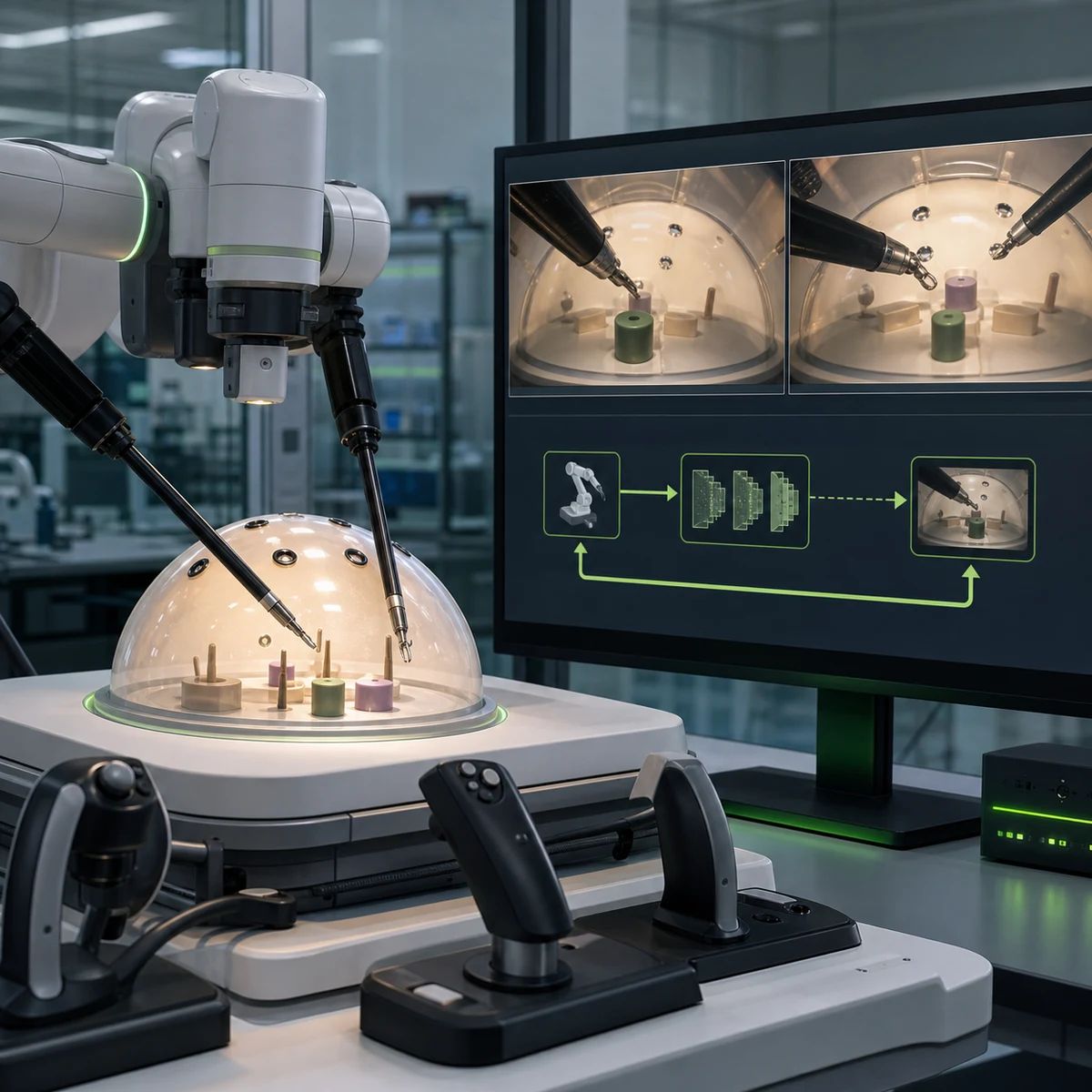
NVIDIA has published Cosmos-H-Dreams, a real-time, action-conditioned generative simulator for surgical robotics.
The July 27 Hugging Face article says Cosmos-H-Dreams distills Cosmos-H-Surgical-Simulator into a causal student model and serves it through FlashDreams, NVIDIA’s accelerated streaming-inference library. The result is an interactive environment where a person or learned policy can control a generated surgical scene in a closed loop.
NVIDIA says the released model focuses on da Vinci Research Kit tabletop suturing and runs on a single NVIDIA RTX PRO 6000 GPU. The article says FlashDreams takes the distilled surgical world model from roughly ten frames per second in standard Cosmos-H-Surgical-Simulator inference to interactive operation at about 160 frames per second.
The change is closed-loop interaction
World models for robotics are useful when they let teams test actions before touching expensive hardware or fragile material. Surgical robotics makes that harder than many domains because the scene includes deformable tissue, fine instruments, occlusions, needles, sutures, smoke, and reflective surfaces.
Cosmos-H-Surgical-Simulator already generated likely future surgical video from an initial frame and a sequence of robot actions. Cosmos-H-Dreams moves that idea into a faster loop. The model receives an initial RGB frame and live robot kinematics, then generates the next chunk of frames before continuing with the next action block.
NVIDIA says it also worked with CMR Surgical and Cambridge Consultants to integrate Cosmos-H-Dreams with the Versius surgeon controller for real-time operation on that platform.
Research platform, not clinical product
The important caveat is in NVIDIA’s own framing. Cosmos-H-Dreams is a research and development platform. The article says it is not a diagnostic system, not a replacement for intraoperative imaging, and not a controller for a physical surgical robot.
That boundary matters. A simulator can accelerate training, policy evaluation, synthetic data generation, and rare-failure exploration. It cannot be treated as proof that a surgical policy will transfer safely to real patients.
NVIDIA points to the next evaluation problem: moving beyond visual quality. A practical surgical simulator must preserve instrument and scene structure over long rollouts, respond correctly to actions, and support conclusions that transfer to physical robots.