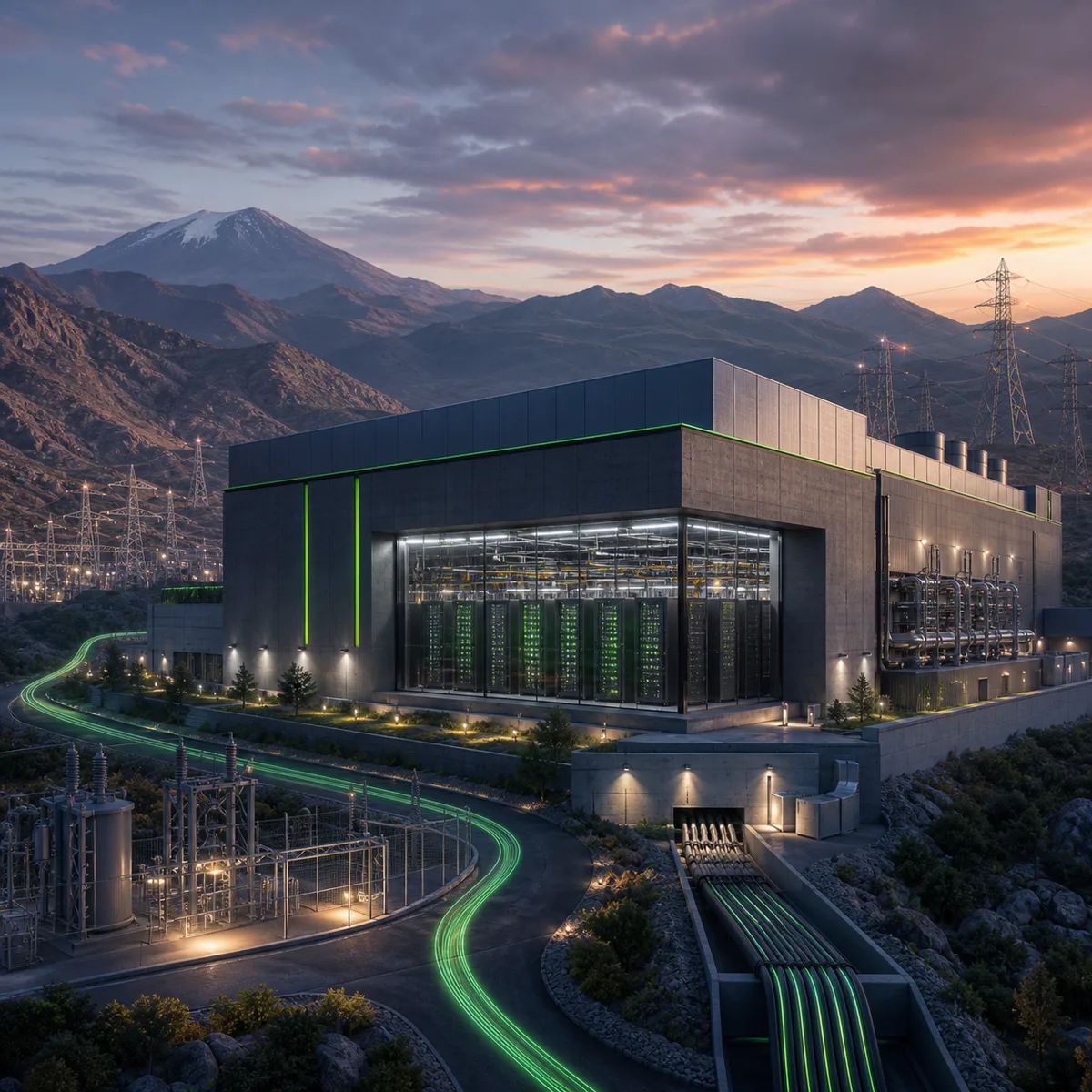
A mountain-side AI factory lights rows of liquid-cooled compute racks connected to regional power lines
+ NVIDIA AI News

Firebird opens NVIDIA-backed AI factory in Armenia

Firebird opened an NVIDIA-backed AI factory in Armenia and plans more than 70,000 Rubin and Blackwell GPUs with 300 MW of capacity by 2027.

10 minutes ago

Firebird has opened what NVIDIA describes as the CIS region’s largest AI factory in Armenia.

NVIDIA says the site is powered by NVIDIA accelerated computing and Dell Technologies high-performance AI infrastructure. The opening ceremony included Armenia’s prime minister, Kazakhstan’s deputy prime minister, and the U.S. charge d’affaires in Armenia.

The bigger number is the expansion plan. Firebird plans to deploy more than 70,000 NVIDIA Rubin and Blackwell GPUs and 300 megawatts of AI infrastructure capacity in Armenia by the end of 2027.

Firebird’s own site presents Armenia as the first AI factory in a wider emerging-markets platform. It lists three purpose-built data centers, 150,000 GPUs, 400 MW total capacity, and more than 5 TiB/s interconnect bandwidth as platform-level claims. Its current Armenia DC-1 is described as 6,144 NVIDIA B200 GPUs across 15 MW, with later Armenia phases planned around NVIDIA VR200 capacity.

AI capacity is becoming regional infrastructure

The project is not only another GPU cloud announcement. It is part of a shift toward regional AI capacity as a strategic asset.

NVIDIA’s post frames the Armenia factory as local compute for national languages, local industries, universities, public institutions, developers, and startups. That is the sovereign-AI argument in infrastructure form: countries and regions do not only consume global AI services; they want enough local capacity to build, fine-tune, and serve models around their own priorities.

Firebird is also pitching the facility as a commercial platform. Its site lists bare-metal GPU capacity, managed inference endpoints, Kubernetes, Slurm, programmable network fabric, observability, and high-performance storage. That makes the factory both a national-capacity story and a customer-acquisition story.

Power density is the constraint hiding inside the GPU count

NVIDIA says Firebird’s AI factory is built on the NVIDIA DSX platform, which codesigns accelerated compute, networking, power, and cooling. NVIDIA also says DSX can run up to 40% more GPUs on the same footprint.

That is the operational hinge. Large GPU counts are only useful if the site can feed, cool, connect, schedule, and monetize them. Firebird’s plan depends on power infrastructure from Schneider Electric, high-density liquid cooling, resilient facilities, and network links that make Armenia capacity usable from broader AI hubs.

Sources

The AI Feed Desk

The AI Feed Desk

Editorial desk

The AI Feed Desk tracks AI provider updates, model releases, agent tooling, and enterprise adoption, turning fast-moving announcements into source-linked context for builders and operators.

Noticed a typo, incorrect information, or translation error?

Tell us so we can fix it.

Help Improve This Article

Related Articles

An AI server rack connects to a warm closed-loop liquid cooling system and dry cooler

NVIDIA says 45 C liquid cooling can reshape AI factory design

NVIDIA says Rubin-generation AI infrastructure can run with 45 C coolant in closed-loop liquid-cooled AI factories, reducing cooling energy and water dependence.

The AI Feed Desk

By The AI Feed Desk

A compact AI factory module combines a chip wafer, server racks, cooling pipes, and power equipment

NVIDIA frames U.S. AI buildout as a 43-state supply chain

NVIDIA says its U.S. partner network spans 43 states and plans up to $500 billion of American-built AI infrastructure with semiconductor, system, power, and cloud partners.

The AI Feed Desk

By The AI Feed Desk

A large AI factory rack sends green revenue tokens toward a smaller cloud node

NVIDIA turns AI cloud capacity into a revenue-sharing model

NVIDIA's new AI cloud model pairs revenue sharing with credit support, giving emerging cloud providers a way to finance AI factories while tying NVIDIA to downstream token demand.

The AI Feed Desk

By The AI Feed Desk

A Japan manufacturing floor connects robotics arms, compact AI PCs, and data-center compute into one NVIDIA stack

NVIDIA uses Japan to package physical AI as a full-stack ecosystem

NVIDIA's July 15 Japan ecosystem update ties RTX Spark, robotics, manufacturing, and local partners into a physical AI stack.

The AI Feed Desk

By The AI Feed Desk

A mixture-of-experts model is split across GPUs while a single import path feeds the training pipeline

NVIDIA NeMo AutoModel makes MoE fine-tuning a one-import upgrade

NVIDIA's Hugging Face article shows NeMo AutoModel wrapping expert parallelism and custom kernels behind the familiar Transformers loading path for MoE fine-tuning.

The AI Feed Desk

By The AI Feed Desk