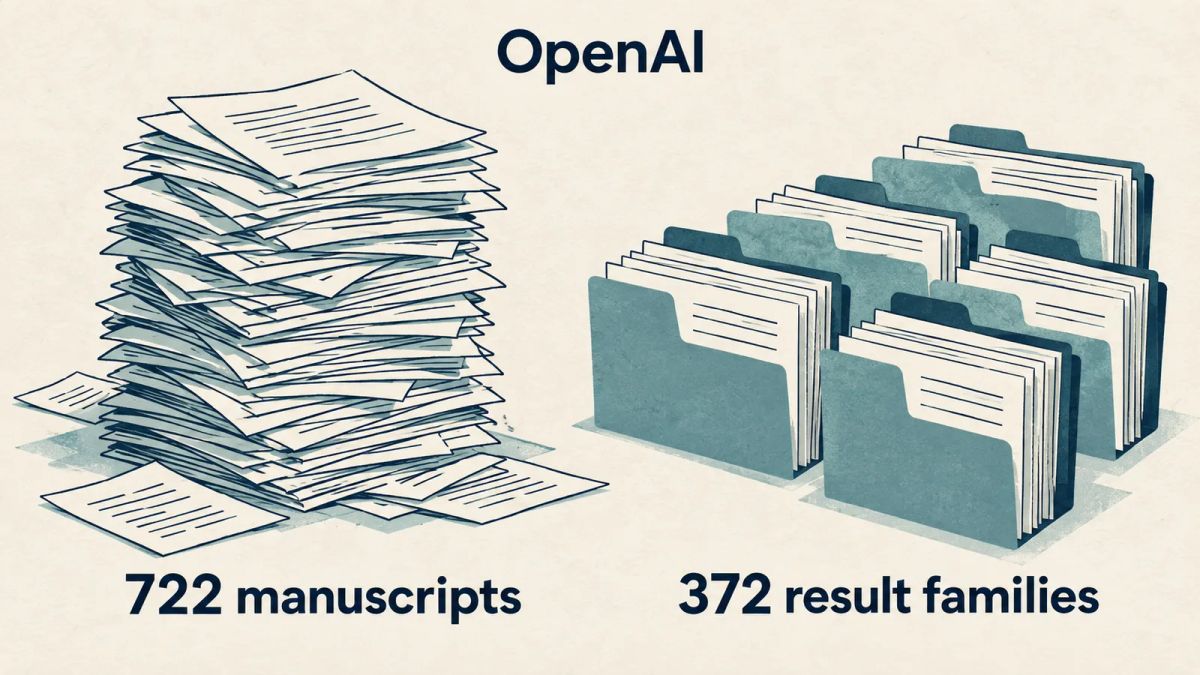
Illustration of paper stacks labeled 722 manuscripts beside grouped folders labeled 372 result families under the name OpenAI
+ AI News

OpenAI publishes 722 manuscripts of math results from an unreleased frontier model

OpenAI's batch covers 372 result families. Lean proofs offer a path to checking results, while review coverage and access to the model remain separate questions.

OpenAI has released 722 mathematical manuscripts produced by an unreleased frontier model. The Verge reports that the batch covers 372 result families, which group related papers. Those two counts describe the size of the release, rather than a tally of independently verified solutions.

The release follows OpenAI’s September claim that its model had resolved more than 100 long-standing open problems. The Verge says the Advisory Group on Mathematics and Artificial Intelligence, or AGMAI, describes the new batch as containing solutions to hundreds of open questions. Mathematicians still have to assess the collection’s impact.

What readers can check

In its October 6 announcement, OpenAI says its GitHub repository includes Lean formalizations for many proofs. Lean allows a computer to check mathematical proofs. The company plans to add more formalizations.

The repository also contains ten summaries of model reasoning, attempted-problem statistics and compute estimates. OpenAI puts average compute per result at roughly three hours of ChatGPT Pro thinking. That is a compute comparison, rather than a quoted price for reproducing a result.

Publication and model access follow different schedules

OpenAI says it is working toward releasing the model. Its announcement gives no release date. Researchers can inspect published results before they can use the system that produced them.

The Verge reports that AGMAI’s recommendations ask labs to disclose model names, prompts and compute costs, and to avoid using mathematical releases as marketing. OpenAI says it consulted the group and has revision and citation protocols for this GitHub release.

Sources

The AI Feed Desk

The AI Feed Desk

Editorial desk

The AI Feed Desk tracks AI provider updates, model releases, agent tooling, and enterprise adoption, turning fast-moving announcements into source-linked context for builders and operators.

Noticed a typo, incorrect information, or translation error?

Tell us so we can fix it.

Help Improve This Article

Related Articles

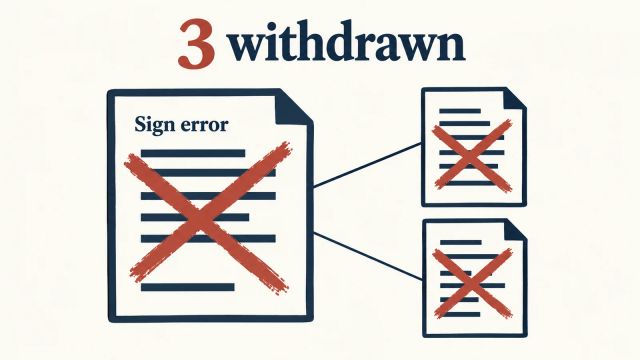
Illustration of three crossed-out manuscript sheets, with a sheet labeled Sign error connected to two dependent sheets under the words 3 withdrawn

OpenAI withdraws three of its math papers

One sign error led OpenAI to withdraw three math manuscripts. Its update also separates substantive revisions from citation changes, which matters for judging reliability.

The AI Feed Desk

By The AI Feed Desk

Nine adviser circles lead to a proof sheet, while a separate decision arrow continues; illustration

OpenAI's math advisory group can assess results but cannot slow the research

A new independent group gives mathematicians a formal channel into OpenAI, but the company keeps control over research pace, direction, and decisions.

The AI Feed Desk

By The AI Feed Desk

Mathematical proof pages become verified geometric certificates on a quiet research desk

OpenAI publishes ten AI-generated math and theoretical CS advances

OpenAI published ten AI-generated results in mathematics and theoretical computer science with Lean 4 formalizations in a public repository.

The AI Feed Desk

By The AI Feed Desk

A scientific computing lab compares agent-written code against datasets, tests, and validation reports

OpenAI says coding agents help scientific software when validation is strong

OpenAI published a field report on eight agent-assisted scientific-computing projects, showing gains in maintenance and rewrites while keeping validation as the boundary.

The AI Feed Desk

By The AI Feed Desk

Researchers gather around a shared AI-assisted laboratory workspace for academic discovery

OpenAI gives 100,000 academic researchers free ChatGPT access

OpenAI launched ChatGPT for Academic Researchers, starting with 10,000 researchers this summer and expanding to 100,000 through 2027.

The AI Feed Desk

By The AI Feed Desk