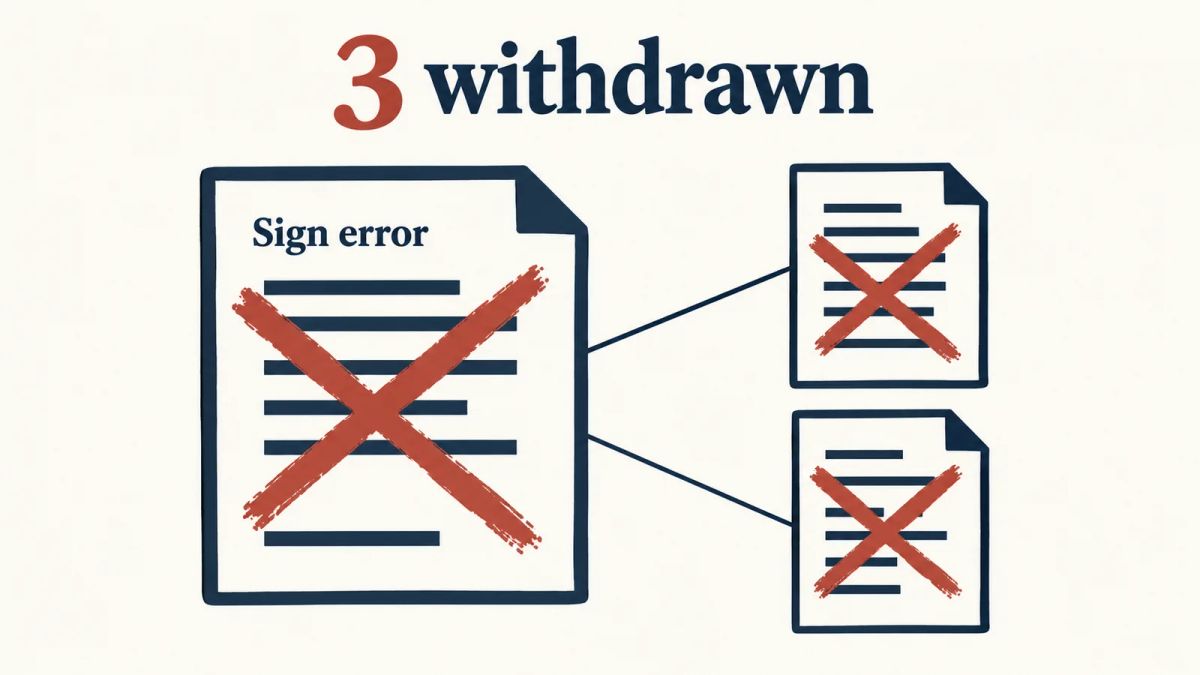
Illustration of three crossed-out manuscript sheets, with a sheet labeled Sign error connected to two dependent sheets under the words 3 withdrawn
+ AI News

OpenAI withdraws three of its math papers

One sign error led OpenAI to withdraw three math manuscripts. Its update also separates substantive revisions from citation changes, which matters for judging reliability.

OpenAI has withdrawn three mathematical manuscripts after finding a sign error in an argument that two other papers depended on. The October 7 entry in its repository history also records revisions to 14 other manuscripts. The update follows the 722-manuscript release we covered, produced with an unreleased internal model.

The withdrawals show how one failed argument can affect several published results. The size of the release alone gives readers too little evidence to judge the reliability of the batch.

One error affects three manuscripts

OpenAI says the sign error invalidates a stabilization-trace cancellation argument in “Algebraicity of Weil classes on split abelian eightfolds” and the construction used by two dependent papers. It withdrew:

  • “Algebraicity of Weil classes on split abelian eightfolds”
  • “Algebraicity of Kuga-Satake Correspondences for K3 Surfaces”
  • “The rational Hodge conjecture for products of K3 surfaces”

The papers’ README files now explain the gap and link to archived manuscripts. OpenAI’s repository README lists 719 manuscripts in the current catalogue and says results are at different stages of verification.

Revisions cover more than the withdrawals

The 14 revisions include proof repairs, corrected statements, clearer hypotheses and dependencies, and a correction to an obsolete citation. Among them, OpenAI corrected a cone-equality claim in “Taming implies compatibility” and added an example of strict inclusion. Six manuscripts on Kähler minimal model programs and abundance received expanded arguments and clearer statements of the results they rely on.

OpenAI also updated 13 additional manuscripts to cite revised companion papers. The history describes those changes as reference and version-date updates. They belong in a different category from repairs to a paper’s own argument.

The same entry reports six additional formalizations and five additions covering supporting results. OpenAI puts the total share of top-line results formalized at 300 out of 719, about 42%.

Sources

The AI Feed Desk

The AI Feed Desk

Editorial desk

The AI Feed Desk tracks AI provider updates, model releases, agent tooling, and enterprise adoption, turning fast-moving announcements into source-linked context for builders and operators.

Noticed a typo, incorrect information, or translation error?

Tell us so we can fix it.

Help Improve This Article

Related Articles

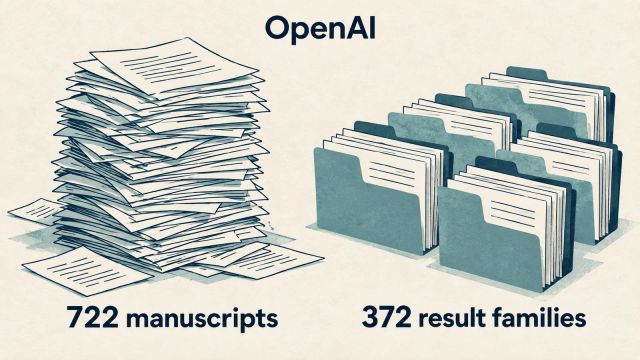
Illustration of paper stacks labeled 722 manuscripts beside grouped folders labeled 372 result families under the name OpenAI

OpenAI publishes 722 manuscripts of math results from an unreleased frontier model

OpenAI's batch covers 372 result families. Lean proofs offer a path to checking results, while review coverage and access to the model remain separate questions.

The AI Feed Desk

By The AI Feed Desk

Nine adviser circles lead to a proof sheet, while a separate decision arrow continues; illustration

OpenAI's math advisory group can assess results but cannot slow the research

A new independent group gives mathematicians a formal channel into OpenAI, but the company keeps control over research pace, direction, and decisions.

The AI Feed Desk

By The AI Feed Desk

Mathematical proof pages become verified geometric certificates on a quiet research desk

OpenAI publishes ten AI-generated math and theoretical CS advances

OpenAI published ten AI-generated results in mathematics and theoretical computer science with Lean 4 formalizations in a public repository.

The AI Feed Desk

By The AI Feed Desk

A scientific computing lab compares agent-written code against datasets, tests, and validation reports

OpenAI says coding agents help scientific software when validation is strong

OpenAI published a field report on eight agent-assisted scientific-computing projects, showing gains in maintenance and rewrites while keeping validation as the boundary.

The AI Feed Desk

By The AI Feed Desk

Researchers gather around a shared AI-assisted laboratory workspace for academic discovery

OpenAI gives 100,000 academic researchers free ChatGPT access

OpenAI launched ChatGPT for Academic Researchers, starting with 10,000 researchers this summer and expanding to 100,000 through 2027.

The AI Feed Desk

By The AI Feed Desk