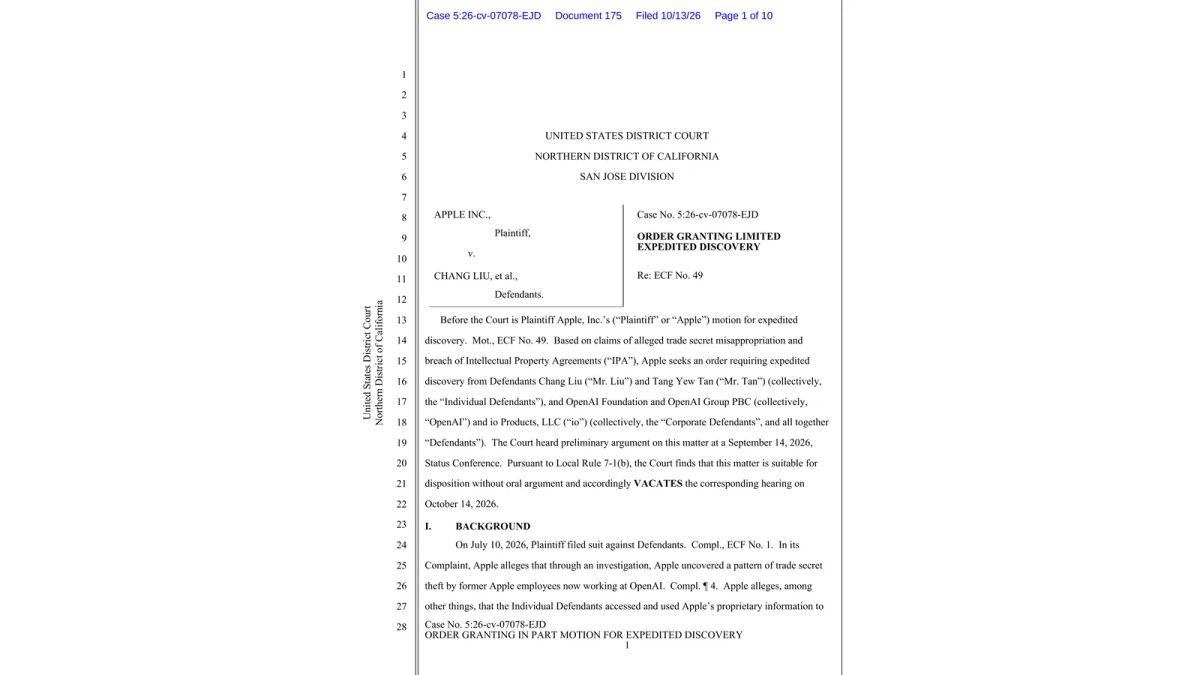
First page of the court's October 13 order granting limited expedited discovery in Apple's case against Chang Liu and other defendants
+ AI News

Judge orders OpenAI to hand over hiring records in Apple's trade secrets case

Apple gets OpenAI interview records, private messages and testimony. The order puts recruitment under scrutiny while limiting access to hardware research.

A federal judge has ordered OpenAI to give Apple interview materials concerning Apple employees who sought jobs in its consumer hardware and robotics groups. TechCrunch reported the ruling on October 13. The decision gives Apple evidence to examine how OpenAI recruited its staff as the companies compete over consumer hardware talent.

U.S. District Judge Edward Davila’s order accelerates part of the evidence exchange in Apple’s trade secrets lawsuit. Apple’s accusations of theft remain allegations. The ruling decides which evidence Apple can obtain on an expedited schedule.

What Apple gets

The required records include interview guides and scripts, technical presentations and documents recording interview discussions or references to Apple technology or parts. Defendants have five days to respond with materials already collected for the litigation and 14 days for the remaining permitted requests.

The order also covers LINE conversations between Chang Liu and Alyssa Peng since January 1, 2026. Apple can take depositions of Liu, Peng and OpenAI hardware chief Tang Yew Tan. TechCrunch identifies all three as former Apple employees.

Apple alleges that former staff used confidential information to help OpenAI develop hardware and coached prospective recruits. The defendants opposed Apple’s requests as too broad.

Hardware research faces a separate process

Davila denied expedited access to research on metal finishes, power management and battery functionality, leaving those requests for ordinary discovery. He deferred requests using Apple’s broad definition of “Apple Originated Information” and gave Apple five days to propose a narrower definition after conferring with the defendants.

Sources

The AI Feed Desk

The AI Feed Desk

Editorial desk

The AI Feed Desk tracks AI provider updates, model releases, agent tooling, and enterprise adoption, turning fast-moving announcements into source-linked context for builders and operators.

Noticed a typo, incorrect information, or translation error?

Tell us so we can fix it.

Help Improve This Article

Related Articles

Huxe personal podcast preview with an orange and purple topic card about human potential

Apple discloses deal to hire Huxe staff and license its personalized audio tech

Apple's Huxe agreement points to an interest in personalized AI audio. The deal leaves open which employees will join and what Apple will build.

The AI Feed Desk

By The AI Feed Desk

A white hard drive symbol inside a gray rounded square on a pale background

Apple tightens macOS Full Disk Access controls because of AI agents

Apple plans more explicit consent for macOS Full Disk Access. Local agent users and developers need to distinguish a task's needs from broad access to private data.

The AI Feed Desk

By The AI Feed Desk

A phone-shaped beta test lane routes a Siri AI signal through privacy and app permission checkpoints

Apple opens the public beta path for Siri AI

Apple's iOS 27 public beta path puts Siri AI in front of testers, shifting the story from WWDC promise to device, region, and workflow reality.

The AI Feed Desk

By The AI Feed Desk

Apple TV 4K below a television, with two full-sized HomePods beside the screen and two HomePod Mini 2 speakers in front

Apple's new Apple TV 4K and HomePod Mini 2 are built for Siri AI, but only one can use it at launch

Apple TV 4K gets hands-free Siri AI in beta at launch. HomePod Mini 2 ships earlier, but its AI update comes later and requires a compatible iPhone.

The AI Feed Desk

By The AI Feed Desk

Illustration of a cartoon card with abstract speech bubbles and a red question mark in the signature position, beside a ChatGPT label

ChatGPT is adding real cartoonists' signatures to fake New Yorker cartoons

Nieman Lab documented real artists' signatures on generated cartoons. Publishers need to verify authorship separately from an image's style.

The AI Feed Desk

By The AI Feed Desk