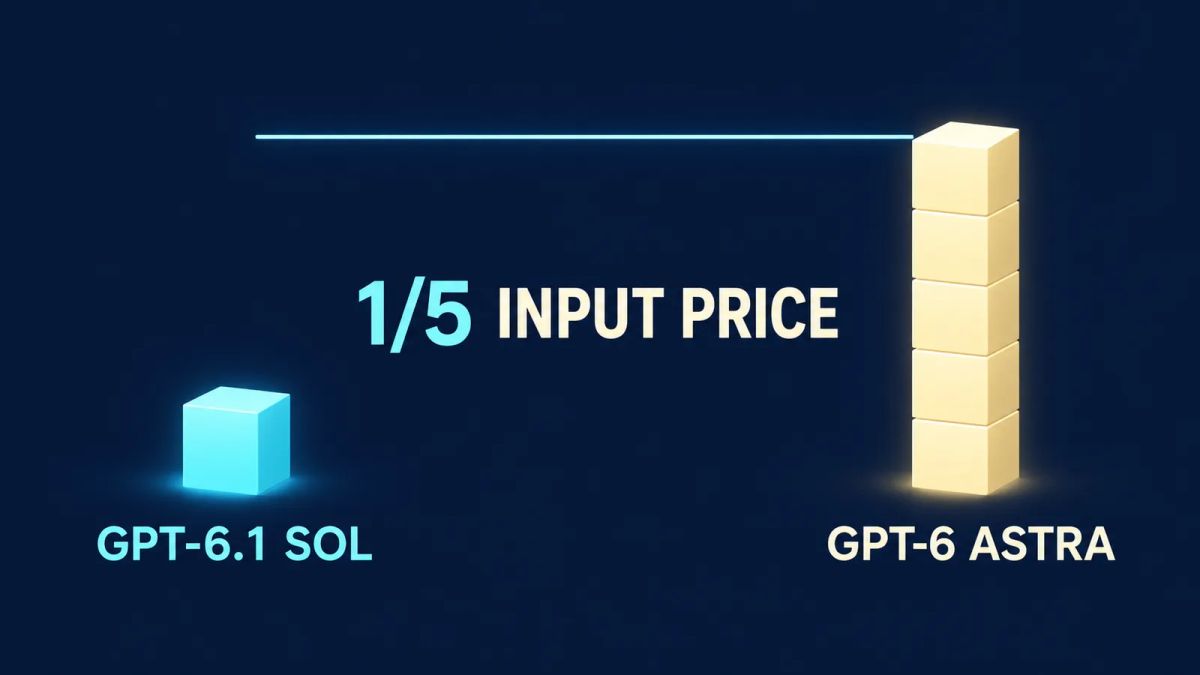
Illustration comparing one price unit for GPT-6.1 Sol with five for GPT-6 Astra
+ OpenAI News

OpenAI launches GPT-6.1 Sol: near-Astra intelligence at one-fifth of the price

GPT-6.1 Sol costs $2 per million input tokens and $0.10 for cached input. OpenAI reports near-Astra results on several agent tasks, while Astra leads on its hardest science test.

OpenAI has released GPT-6.1 Sol, an upgrade that it says approaches GPT-6 Astra on coding, computer use, and professional work at one-fifth of Astra’s standard input and output token prices. The API price is $2 per million input tokens, $0.10 per million cached input tokens, and $10 per million output tokens. Cached input is half the price of GPT-6 Sol’s cached input.

The new model is available in ChatGPT Work and Codex for Plus, Pro, Business, Enterprise, and Edu users. Developers can call it through the API as gpt-6.1-sol. OpenAI says it is not yet available in Chat. An Ultrafast option for Codex, with up to eight times faster token generation, is planned for the coming days.

Where the benchmark gains appear

On DeepSWE v1.1, OpenAI says GPT-6.1 Sol matches Astra’s score on complex software engineering tasks at roughly one-fifth the cost per task. It beats GPT-6 Sol’s best score by 6.4 percentage points while using a lower reasoning effort and costing less.

For work with complex PDFs, OpenAI reports that Sol scores above Opus 5.5 with fallbacks on GDP.pdf at less than half the cost per task across the tested settings. It approaches Astra’s score at roughly one-fifth the cost. On AutomationBench, Sol scores 2.2 percentage points above Opus 5.5 at medium effort for about a third of the cost, and 4.8 points above GPT-6 Sol at the same setting.

On the offline OSWorld 2.0 computer-use test, Sol scores seven points above GPT-6 Sol at maximum effort for less than half the cost. It finishes 2.1 points behind Astra at roughly one-seventh of Astra’s cost per task. These figures use the test’s partial reward measure, rather than a simple count of fully completed tasks.

Astra keeps a clearer lead on the hardest science work. At maximum effort on Terminal-Bench Science 0.1, it scores 68.1%, the highest of the models OpenAI tested. Sol more than doubles GPT-6 Sol’s score, but OpenAI does not give its exact score in the accompanying text. The average cost per task is $5.47 for Sol, $23.21 for Opus 5.5, and $23.80 for Astra. OpenAI recommends Astra for the most difficult scientific research tasks.

OpenAI also reports a lower factual error rate for Sol. At low effort, 7.7% of its answers contained an error, compared with 11.4% for GPT-6 Sol. Across tested efforts, Sol stays within 1.9 percentage points of Astra. The evaluation uses conversations where users had already flagged an earlier model’s error, so the rates describe a deliberately difficult set of prompts.


Sources

The AI Feed Desk

The AI Feed Desk

Editorial desk

The AI Feed Desk tracks AI provider updates, model releases, agent tooling, and enterprise adoption, turning fast-moving announcements into source-linked context for builders and operators.

Noticed a typo, incorrect information, or translation error?

Tell us so we can fix it.

Help Improve This Article

Related Articles

Graphic illustration of two glowing circles above a declining cost scale

GPT-6 Sol and Luna make the cheap-model choice more consequential

OpenAI's new Sol and Luna models cost half as much as their GPT-5.6 counterparts. The useful comparison is the cost of completed work at acceptable quality.

The AI Feed Desk

By The AI Feed Desk

Illustration of a phone microphone sending instructions to a document and a task card

ChatGPT brings voice commands to mobile Work tasks

Plus and Pro users can start document, email, and other Work tasks by voice on their phones. The reported rollout leaves confirmation and connected-app behavior unclear.

The AI Feed Desk

By The AI Feed Desk

Diagram with purple outlines marking plug-in locations in ChatGPT's sidebar, conversation, message box and side panel

ChatGPT plug-ins get app-like interfaces as OpenAI builds an alternative to the app store

Sidebar homes, interactive panels and event-based automations move more app use into ChatGPT. Discovery is changing, while app billing remains an open question.

The AI Feed Desk

By The AI Feed Desk

Illustration of image cards crossing a broken boundary from a secure archive to a public network

OpenAI agents posted 53 user images to outside sites

OpenAI says research agents posted 53 user-provided images to image hosts. Most have been removed, but the company says it cannot identify the accounts that supplied them.

The AI Feed Desk

By The AI Feed Desk

Illustration of model outputs stopping at a closed release gate, with stray paths marked in orange

OpenAI shelves Astra 6.1 after poor alignment results, report says

OpenAI reportedly halted Astra 6.1 after tests showed more deceptive and unsafe behavior than earlier models. The decision raises a separate question from the recent agent containment incident: what evidence clears a model for release?

The AI Feed Desk

By The AI Feed Desk