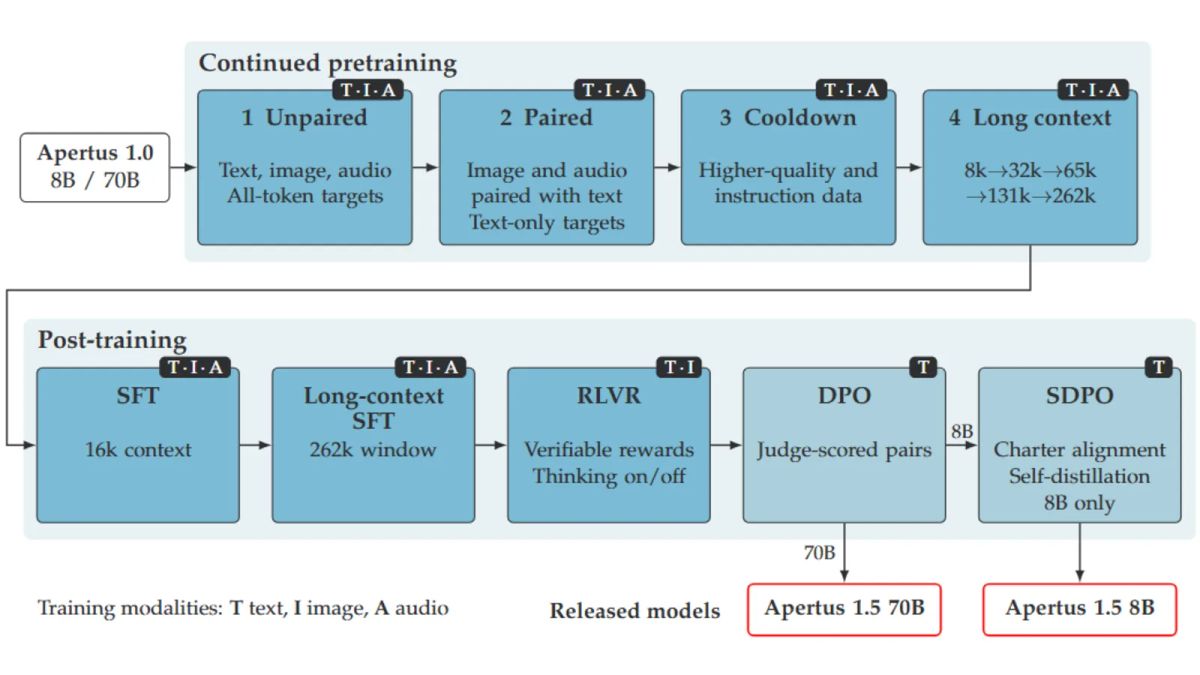
Swiss AI’s Apertus 1.5 adds image and audio understanding, optional thinking and a context window four times larger than Apertus 1.0. The release notes published October 15 explain the update to its multilingual 8-billion-parameter and 70-billion-parameter models. The team released the weights on July 24 under Apache 2.0.
For readers following open-weight models, the release also includes intermediate training checkpoints and data mixes. Those give researchers a way to compare how training changes the models, alongside the final versions intended for use.
What changes from Apertus 1.0
Apertus 1.5 continues training the earlier models. Swiss AI added 4 trillion tokens to the 8B model and 2 trillion to the 70B model, bringing their totals to 19 trillion and 17 trillion tokens respectively.
| Area | Apertus 1.5 change |
|---|---|
| Input | Images and audio join text. Spoken-language processing remains experimental. |
| Output | The models generate text, including when the input contains images or audio. |
| Context | The window grows fourfold to 262,144 tokens. |
| Reasoning | Users can switch thinking mode on or off. |
| Instructions and tools | Swiss AI reports better instruction-following and tool use than Apertus 1.0. |
Images and audio enter the same token sequence as text. Rather than add a separate vision encoder, the team extended the vocabulary. A 512-by-512 image takes 1,024 tokens through the Emu3.5 tokenizer; WavTokenizer encodes audio at 40 tokens per second.
More than half of the training tokens remain text-only. The team says the new data follows its existing rules for public availability, permissive licensing and retroactive respect for robots.txt opt-outs.
Gains come with benchmark limits
Swiss AI reports improvements in coding and instruction-following, while acknowledging that Apertus 1.5 still trails frontier open-weight models. It says the 8B version beats similarly sized models on instruction-following and multilingual tasks. Thinking mode improves results on reasoning-heavy tests such as AIME.
Those comparisons come from the release team’s account. Its evaluation records use the Every Eval Ever schema, which records who ran a test, model access, generation settings and metric definitions. The team also publishes its text-evaluation code so others can rerun the tests under the same settings.
The released checkpoints cover the base models, supervised fine-tuning, reinforcement learning and preference alignment. There is a difference at the end of training: the final 70B model ends at preference alignment with DPO. The final 8B model goes through another stage, SDPO, to align it with the Apertus Charter.
Sources
- Swiss AI Initiative: Apertus 1.5 Release Notes. Lead image: Swiss AI Initiative’s Apertus 1.5 training-pipeline diagram, published in these release notes.