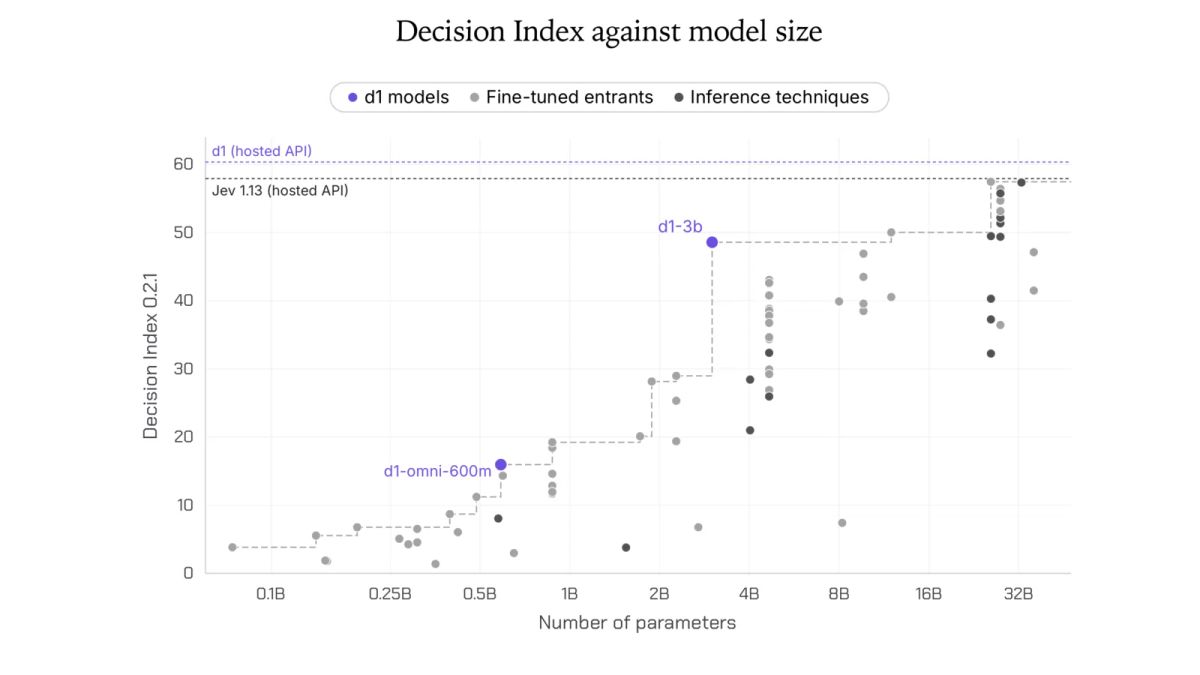
Scatter chart comparing Decision Index 0.2.1 scores against parameter counts, with d1-3B and d1-omni-600M marked in purple
+ AI News

Liquid AI releases open multimodal d1 decision models for the edge

Liquid AI's d1-3B handles text and images, while an experimental 600M model adds audio. Published timings show how input size changes edge latency.

Liquid AI has released two open-weight decision models aimed at edge devices. d1-3B accepts text and images. The smaller d1-omni-600M accepts text with images or text with audio, and Liquid AI describes it as an experimental research release.

The October 7 announcement reports decisions in a single forward pass, rather than answers generated token by token. Its code example asks several questions about one support ticket, including which team should handle it and how urgent it is. Another example asks the model to choose how many cats appear in an image.

Two models with different evidence behind them

d1-3B uses Liquid AI’s LFM2.5-VL-3B vision-language model as its base. d1-omni-600M uses the bidirectional LFM2.5-Encoder-350M with added vision and audio encoders. Its stated input combinations give developers separate paths for image and audio decisions.

Liquid AI reports a Decision Index 0.2.1 score of 48.57 for d1-3B, ahead of Decider 35B-A3B at 47.11. The lead chart is the company’s published comparison of index scores and model sizes.

On a separate table of seven public text benchmarks, d1-3B averages 82.9 against Decider 4B’s 81.1. d1-omni-600M averages 78.4 against Decider 2B’s 77.1. Those averages conceal different strengths. Decider 4B leads d1-3B on MASSIVE intent, BoolQ and XNLI, while d1-3B leads on the other four rows.

Liquid AI says it validated the models’ image capabilities, but publishes no vision or audio benchmark scores in this release. It also publishes no speed measurements for d1-omni-600M. Developers evaluating audio decisions therefore have less published evidence than those evaluating d1-3B’s text tasks.

Edge speed changes with the input

Liquid AI’s d1-3B timing table separates a single question, a longer text state and an image input. These are company-reported measurements.

DeviceOne question3.4K-token state384px image
Apple M5 Pro30 ms640 ms62 ms
Jetson AGX Thor16 ms220 ms35 ms
Jetson AGX Orin 64 GB26 ms560 ms83 ms
Jetson Orin Nano50 ms1,640 ms202 ms

The release also reports that three questions on AGX Thor take 20 ms, compared with 16 ms for one. Its examples use system_one for named questions and system_one_batch for packed requests. The setup requires transformers>=5.14 and loads the model’s own code with trust_remote_code=True.


Sources

The AI Feed Desk

The AI Feed Desk

Editorial desk

The AI Feed Desk tracks AI provider updates, model releases, agent tooling, and enterprise adoption, turning fast-moving announcements into source-linked context for builders and operators.

Noticed a typo, incorrect information, or translation error?

Tell us so we can fix it.

Help Improve This Article

Related Articles

A compact local model core links a laptop, phone, and edge device inside a privacy boundary

Liquid AI releases LFM2.5-2.6B for on-device agents

Liquid AI released LFM2.5-2.6B, a small local model trained for tool calling, multi-step workflows, and 128K-token context.

The AI Feed Desk

By The AI Feed Desk

Bar charts comparing LFM2.5-24B-A2B prompt processing, token generation and memory use against three other models on Apple and AMD hardware

Liquid AI releases LFM2.5-24B-A2B for fast on-device agents

Liquid AI's 24B mixture-of-experts model uses 2B active parameters for local reasoning and tool calls. Its agent workflows differ from d1's single-pass decisions.

The AI Feed Desk

By The AI Feed Desk

Diagram of Apertus 1.5 training stages, with separate final paths for the 8B and 70B models

Swiss AI releases Apertus 1.5

Apertus 1.5 adds image and audio input, optional thinking and a fourfold context increase. Its open checkpoints reveal different final training stages for 8B and 70B.

The AI Feed Desk

By The AI Feed Desk

A luminous Q-shaped data path runs between cloud infrastructure and modular open model weights

Alibaba releases Qwen3.8-Max with QwenCloud access and open weights next week

Qwen3.8-Max puts Alibaba back into the frontier-model fight with a large coding-focused model available through QwenCloud now and open weights promised next week.

The AI Feed Desk

By The AI Feed Desk

A browser-shaped glass panel, image tile, and testing checklist converge on a developer workstation

Copilot browser and vision tools make agents multimodal testers

GitHub made Copilot browser tools in VS Code generally available and opened Copilot vision across plans, giving coding agents browser, screenshot, image, and PDF context.

The AI Feed Desk

By The AI Feed Desk