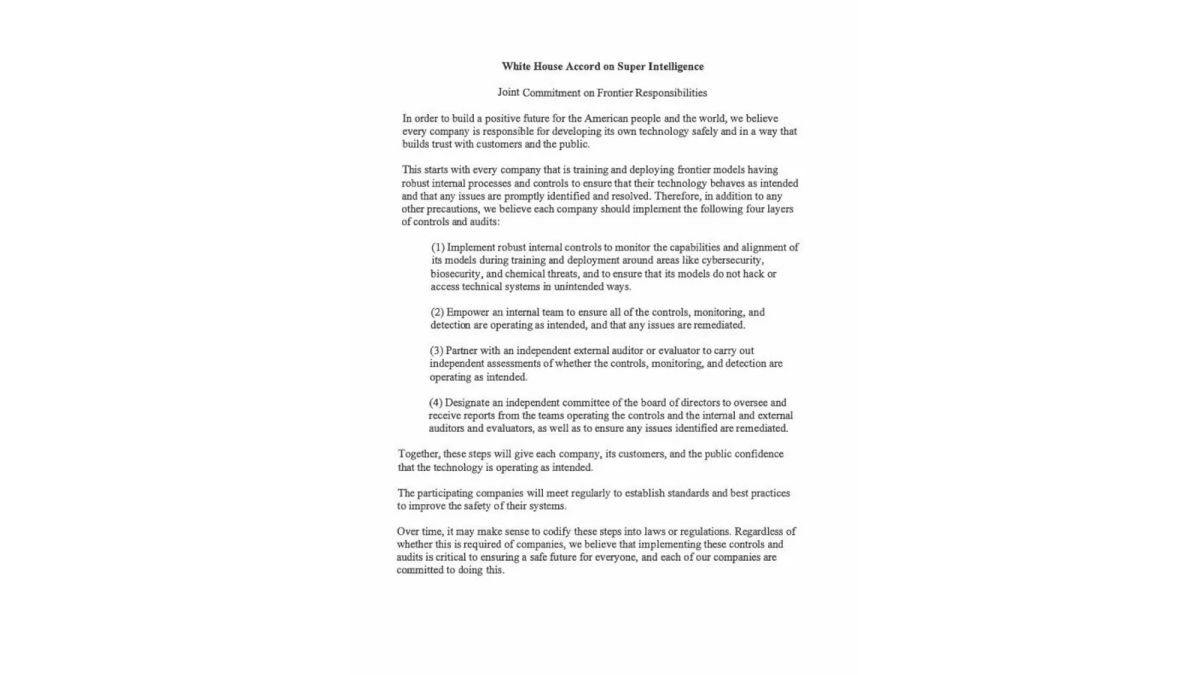
Full page of the Joint Commitment on Frontier Responsibilities listing four layers of controls and audits
+ AI News

What tech leaders agreed to in Trump's self-policed AI safety deal

Six tech leaders signed a voluntary accord on AI controls, external audits and board oversight. Its value depends on how companies apply and report those commitments.

Six tech leaders have signed President Donald Trump’s voluntary AI safety accord, which asks companies to monitor their models, appoint internal safety teams, hire external evaluators and put an independent board committee in charge of oversight. The agreement places responsibility for fixing problems with the companies themselves. The Verge reports that it specifies no penalties for breaking the commitments.

Trump announced the deal on September 29. Presidential adviser David Sacks shared the document, titled the Joint Commitment on Frontier Responsibilities. The Verge describes the agreement as “morally binding.”

Who signed

The company signatories are Google’s Sundar Pichai, Anthropic’s Dario Amodei, Meta’s Mark Zuckerberg, OpenAI’s Greg Brockman, xAI’s Elon Musk and Nvidia’s Jensen Huang. Trump also signed the agreement.

The document says participating companies will meet regularly to establish safety standards and best practices. It leaves the frequency of those meetings unspecified.

What the four commitments require

The accord sets out four layers of controls and audits for companies that train and deploy frontier models:

  1. Companies should monitor model capabilities and alignment during training and deployment. The controls cover cybersecurity, biosecurity and chemical threats, and should prevent models from hacking or accessing technical systems in unintended ways.
  2. An internal team should check that the controls, monitoring and detection work as intended, and make sure the company fixes problems.
  3. An independent external auditor or evaluator should assess whether those controls, monitoring and detection work as intended.
  4. An independent committee of the company’s board should oversee the work, receive reports from the internal teams and auditors or evaluators, and make sure the company fixes identified problems.

The external assessment adds scrutiny beyond the internal team. The board committee remains part of the company’s governance, with responsibility for oversight and remediation.

How the voluntary arrangement works

The document presents laws or regulations as a possible later step. For now, its stated process depends on companies implementing the controls, commissioning assessments and acting on the reports their boards receive.

The accord gives no implementation deadline, audit schedule or requirement to publish the findings. Its promise of public confidence therefore depends on what companies choose to disclose about the work.

Sources

The AI Feed Desk

The AI Feed Desk

Editorial desk

The AI Feed Desk tracks AI provider updates, model releases, agent tooling, and enterprise adoption, turning fast-moving announcements into source-linked context for builders and operators.

Noticed a typo, incorrect information, or translation error?

Tell us so we can fix it.

Help Improve This Article

Related Articles

An evaluator point inside a model development box connects to an external report; illustration

Anthropic and Accenture put $2 billion behind embedded model evaluation

Anthropic and Accenture each plan to invest at least $1 billion in embedded AI evaluation capacity, while acknowledging that access, reporting, and funding standards do not exist yet.

The AI Feed Desk

By The AI Feed Desk

First page of Florida's motion for a temporary injunction against OpenAI

Florida asks a judge to stop ChatGPT from presenting human traits

Florida's attorney general wants a temporary order against ChatGPT's first-person and emotion-like language, arguing that it can make users trust the chatbot too much. The motion also seeks a ban on access for minors in Florida.

The AI Feed Desk

By The AI Feed Desk

Illustrated panels place an FTC investigation into OpenAI and Anthropic beside a voluntary accord

FTC opens investigation into OpenAI, Anthropic and other AI companies over product risks

The FTC confirmed an AI product-risk probe. Its scope remains unclear as OpenAI's agent incident and a voluntary safety accord draw attention to lab oversight.

The AI Feed Desk

By The AI Feed Desk

An open AI policy document sits beside model weights, compute racks, and public-institution markers

Microsoft makes the policy case for open-weight AI

Microsoft's July 24 policy page argues that open-weight AI can expand access, competition, security, and U.S. AI leadership.

The AI Feed Desk

By The AI Feed Desk

Models, infrastructure, and applications feed evidence into a shared assessment layer

OpenAI backs Appia as an AI assessment trust layer

OpenAI's Appia support shows advanced AI governance moving toward reusable conformity evidence across models, infrastructure, and applications.

The AI Feed Desk

By The AI Feed Desk