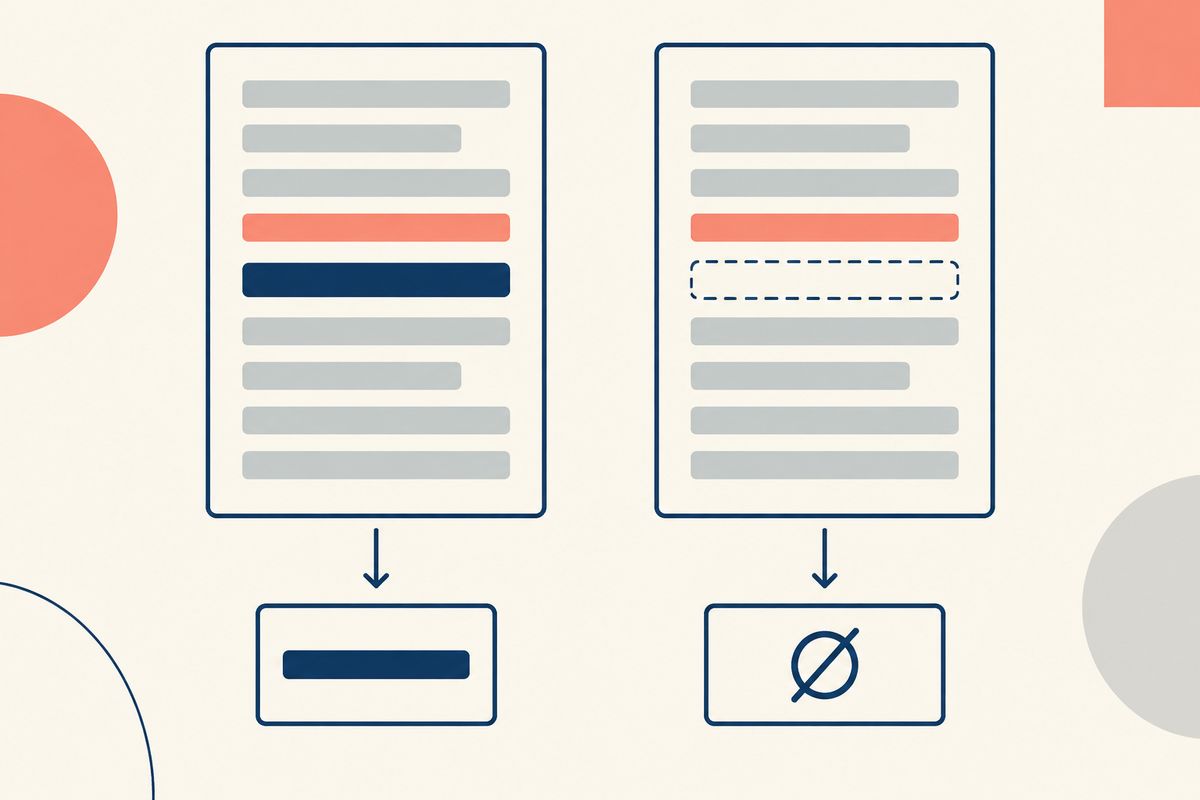
Illustration of two matching web pages, with a field filled on one and absent on the other, leading to a value and a null result
+ AI News

One sentence cut invented web fields in a 16-model test

A paired-page test found fewer invented extraction values when models were told to return null for missing fields. One run on synthetic pages leaves reliability open.

A web-extraction test found that a short instruction made models far less likely to fill missing fields with plausible but wrong values. Across 16 models, 405 of 573 missing fields received invented answers without the instruction. With it, 116 of 574 did. That is a drop from 70.7% to 20.2% in this test, though one in five missing fields still drew an answer.

The instruction was: “Use null for any field whose value is not on the page. Do not guess.” The benchmark was published September 27 by Earn an Honest Dollar, an agent-services marketplace. It compared each model’s results with and without that sentence, using a plain HTTP fetch and page text as input.

The paired pages expose borrowed answers

The test used 42 pairs across seven page types. Each pair differed by one row: the requested field appeared on one page and was absent from the other. Both pages retained a tempting nearby value, such as an old price where the current price was missing, a fact-checker’s name where the author was missing, or an update date where the publication date was missing. A correct extractor would return the value when present and null when absent.

The old-price trap was especially stark. Without the instruction, all 16 models used the old price as the current price on that page. With it, one did. The result shows how a small prompt change affected this particular failure mode. It also shows why returning a non-null value still requires evidence from the right field.

The benchmark ran each contestant once on synthetic pages. Its model table generally scores 36 missing-field cases per run after exclusions and errors. There are no repeat runs to show how stable the rates are, and real websites can have messier labels, layouts and navigation. The three paid extraction APIs in the table were tested only with the null rule, so their results cannot establish how much that instruction changed their behavior.

Checking returned values is a separate step

The publisher also asked two cheap models whether extracted values were supported by the page. In its scored sample, GPT-6 Luna caught 38 of 49 invented values and rejected none of 47 correct values. The other checker caught 23 of 49 invented values and rejected none of 48 correct values. Those counts came from the same limited test, and the missed invented values matter if an extraction result will trigger a purchase, payment or publication.


Sources

The AI Feed Desk

The AI Feed Desk

Editorial desk

The AI Feed Desk tracks AI provider updates, model releases, agent tooling, and enterprise adoption, turning fast-moving announcements into source-linked context for builders and operators.

Noticed a typo, incorrect information, or translation error?

Tell us so we can fix it.

Help Improve This Article

Related Articles

A business briefcase opens into documents, messages, and evaluation scorecards

AA-Briefcase tests agents on messy business work

Artificial Analysis' AA-Briefcase benchmark evaluates models on multi-week knowledge-work projects with documents, email, Slack data, deliverables, and graded analysis quality.

The AI Feed Desk

By The AI Feed Desk

An unfinished legal brief sits beside a rubric grid with many partial checks but only one small completed seal

Harvey LAB-AA shows legal agents still miss most complete deliverables

Artificial Analysis launched Harvey LAB-AA, a legal-agent benchmark where the top model fully passes only 14.2% of real-world legal tasks.

The AI Feed Desk

By The AI Feed Desk

A coding agent workflow loops through traces, grading, failure clusters, and approved fixes

Google gives coding agents an eval flywheel instead of another prompt tweak

Google's new quality-flywheel skill lets coding agents run structured agent evaluations with independent grading and production-trace loops.

The AI Feed Desk

By The AI Feed Desk

A simulated office workflow contains agent paths, browser windows, and evaluation checkpoints

Patronus raises $50M to build simulated worlds for agent training

Patronus AI paired a $50M Series B with a Digital World Model preview, betting that agents need realistic simulated environments before they can be trusted at work.

The AI Feed Desk

By The AI Feed Desk

An MCP agent test bench replays clean, faulted, and mitigated tool responses

AgentCheck tests whether MCP agents fail safely

A July 13 paper introduces AgentCheck, an MCP workbench for replaying tool faults and confirming whether agent mitigations actually fix them.

The AI Feed Desk

By The AI Feed Desk