YouTube Music began rolling out AI labels on October 14, while Deezer plans to let listeners hide fully AI-generated music from search before the end of 2026. The announcements give listeners different kinds of control. YouTube explains AI’s role in a track; Deezer’s planned toggle changes which results a listener sees.
TechCrunch reported both developments in its coverage of YouTube Music’s labels and Deezer’s filter. The companies’ own announcements clarify which music each measure covers.
YouTube puts the disclosure on the player
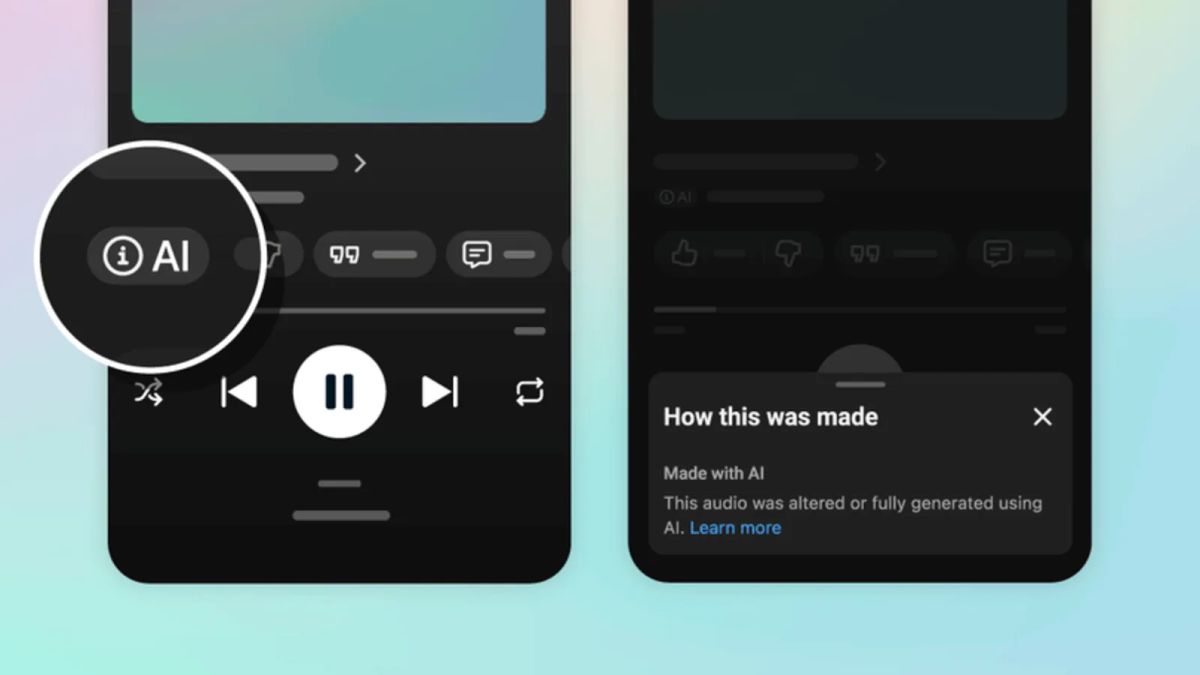
YouTube says its labels identify songs created primarily with generative AI, including tracks where a model creates the composition and vocals. Listeners can tap the player-page label to open more information. The labels will also expand to the main YouTube app.
YouTube says it works with music partners and uses its own detection tools to identify tracks. TechCrunch reports that partners can declare music as “Fully Gen AI,” “Partly Gen AI” or “No Gen AI.” The partial category covers AI-generated components combined with an artist’s live elements. Pitch correction with tools such as Auto-Tune falls into the “No Gen AI” category.
According to TechCrunch, AI involvement alone does not make a YouTube track ineligible for monetization. The change gives listeners information while leaving AI music available.
Deezer adds search control to existing exclusions
Deezer’s October 13 announcement says the optional toggle will exclude fully AI-generated tracks, albums and related artists from search results. Listeners can turn it off to regain access. Deezer plans a global release before the end of 2026.
The company already removes detected AI-generated tracks from algorithmic recommendations and editorial playlists. Its new setting extends that approach to searches. Deezer’s FAQ says the filter targets fully generated music and treats limited AI assistance within a broader human creative process differently.
Deezer says it receives nearly 90,000 fully AI-generated tracks a day. These account for more than half of daily deliveries on peak days, according to its announcement. The same release puts fully AI-generated music at 1% to 3% of streams on the service.
Sources
- TechCrunch: YouTube Music launches new labels as AI-generated music floods streaming platforms
- TechCrunch: Deezer will soon let you filter out AI-generated music
- YouTube: YouTube Music adds new labels for AI music. Lead image credit: YouTube.
- Deezer: Deezer will let you fully exclude AI-generated music from your streaming experience