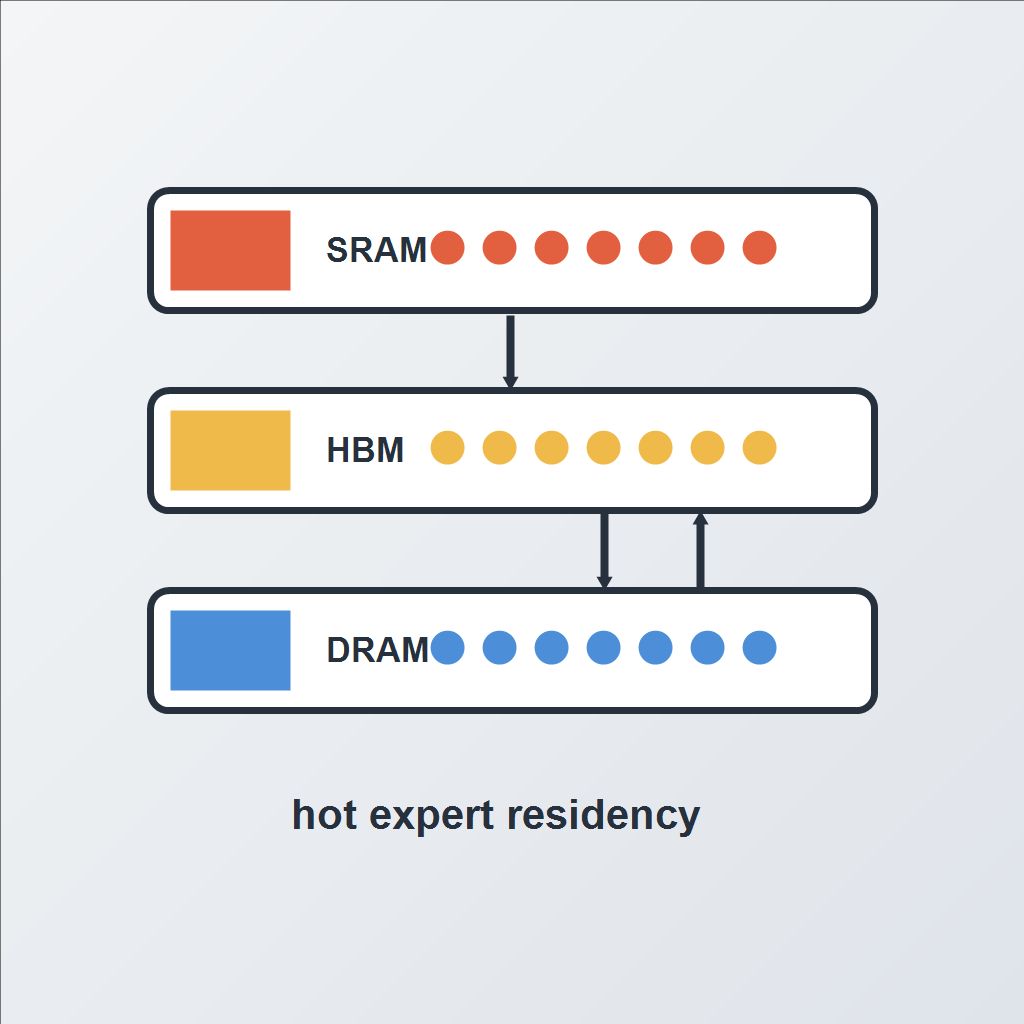
Hot MoE experts move between SRAM, HBM, and shared DRAM tiers on a chiplet package
+ Large Language Models News

HCRMap targets hot-expert bottlenecks in MoE inference

A July 13 paper proposes HCRMap, a pressure-aware residency system for hot MoE experts across 3.5D chiplet memory tiers.

A July 13 arXiv paper proposes HCRMap, a runtime system for managing hot expert replicas in mixture-of-experts inference on 3.5D chiplet systems.

The paper’s claim is narrow but useful: as MoE models route tokens to a small subset of experts, the bottleneck is not only whether the right expert exists. It is where that expert’s weights live, which memory tier serves them, and how token traffic, memory banks, compute queues, and package links interact during serving.

The authors report that HCRMap cuts end-to-end latency by 43.6% and 43.0% over Hydra in prefill and decode, by 34.5% and 33.1% over MoEntwine, and by 46.7% and 46.0% over PIMoE. Those are paper-reported results, not an independent commercial benchmark.

Hot experts are a memory problem

MoE models activate only part of the network for each token. That saves compute, but it creates a routing pattern where some experts become hot while others are lightly used.

In a simple view, the system should just route tokens to the right expert. HCRMap argues that this is not enough on a 3.5D package with stacked SRAM, local HBM, and group-shared DRAM. The same hot expert can stress memory banks, shared I/O, interconnect paths, and execution queues.

The paper frames the problem as residency. Hot experts may deserve fast nearby storage. Warm experts may not fit in the closest tier but should not always be pushed all the way to far shared memory. A useful serving runtime has to promote, retain, demote, or evict expert replicas based on pressure, not only popularity.

The design is a serving signal, not a product launch

HCRMap is not a claim that a new chip is shipping. It is a research design that points toward where MoE inference optimization is going.

The system uses a two-timescale control loop. A slower residency loop decides where expert replicas should live across tiers. A faster mapping loop routes token groups to suitable resident replicas while accounting for current pressure.

That matters because frontier and open models are leaning hard on MoE designs. If serving costs increasingly come from expert movement, queueing, and memory-tier pressure, the next efficiency gains may come from runtime placement policy as much as from model architecture or raw accelerator speed.


Sources

The AI Feed Desk

The AI Feed Desk

Editorial desk

The AI Feed Desk tracks AI provider updates, model releases, agent tooling, and enterprise adoption, turning fast-moving announcements into source-linked context for builders and operators.

Noticed a typo, incorrect information, or translation error?

Tell us so we can fix it.

Help Improve This Article

Related Articles

A metallic chip tile connects to flowing local model tokens and a small speed gauge

BaseRT makes Apple Silicon LLM speed a runtime-design question

BaseRT's paper and release argue that native Metal kernels, unified-memory-aware layout, and custom dispatch can raise local LLM throughput on Apple Silicon.

The AI Feed Desk

By The AI Feed Desk

A bright workbench shows a fast model core connected to code files, browser panels, and agent task steps

Google makes Gemini 3.7 Flash GA for coding agents

Google's Gemini API release notes list Gemini 3.7 Flash as generally available for software engineering, web development, and agentic workflows.

The AI Feed Desk

By The AI Feed Desk

A model hub router sends open model blocks through provider switches into application endpoints

Hugging Face adds Baseten as an Inference Provider

Hugging Face added Baseten as an Inference Provider, giving developers routed serverless access to open-weight text and chat models from Hub model pages and SDKs.

The AI Feed Desk

By The AI Feed Desk

A microphone waveform passes through a fast inference core and exits as a speaker waveform

Hugging Face and Cerebras make open voice AI a latency problem

A Hugging Face and Cerebras speech-to-speech demo uses Parakeet, Gemma 4, Cerebras inference, and Qwen3TTS to show where voice AI latency actually lives.

The AI Feed Desk

By The AI Feed Desk

A public model hub sorting many model packages into a few high-traffic infrastructure lanes

Hugging Face says open-model adoption is not attention

Hugging Face's summer 2026 open-model report says model repositories grew quickly, while actual downloads concentrated in a small infrastructure layer.

The AI Feed Desk

By The AI Feed Desk