Liquid AI has released LFM2.5-24B-A2B, an open-weight reasoning model for private agents that run on local hardware. It has 24 billion parameters in total and activates about 2 billion per token through a mixture-of-experts architecture.
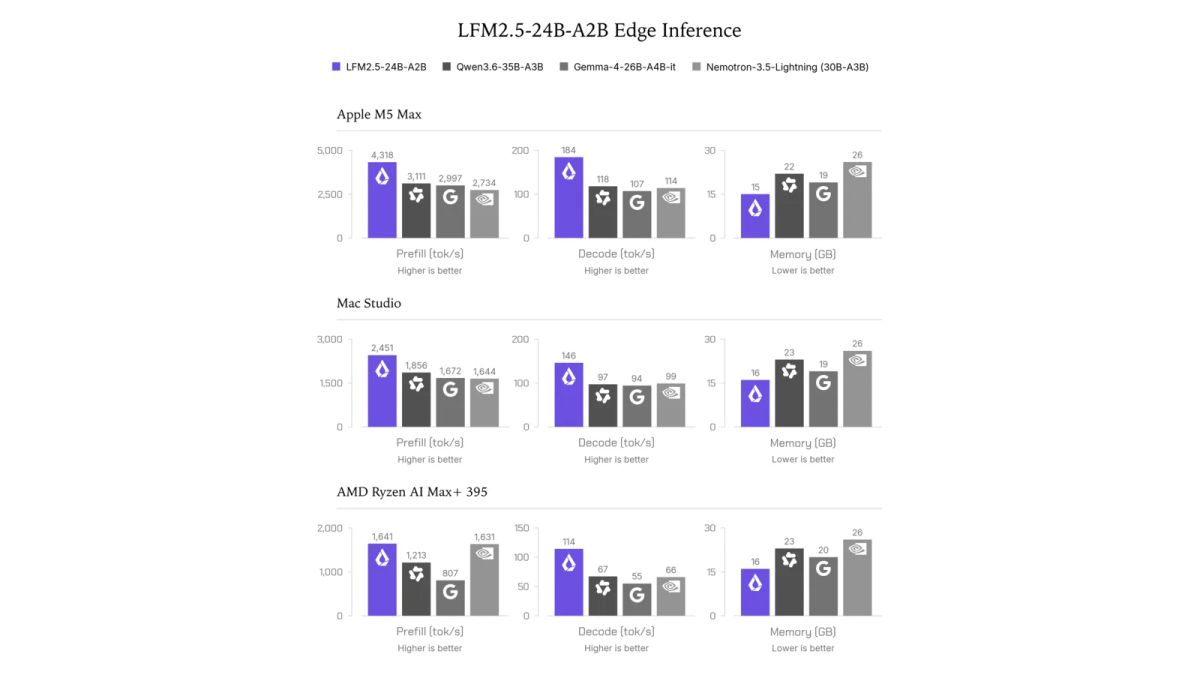
Liquid reports generation speeds of 184 tokens per second on an Apple M5 Max and 114 on an AMD Ryzen AI Max+ 395. The model produces reasoning before its final answer and supports tool calls for multi-step tasks. That makes it a different choice from the company’s recently released d1 models, which return structured decisions in a single pass.
More context on the same architecture
LFM2.5-24B-A2B builds on LFM2-24B-A2B. It retains 40 layers, 64 experts per expert block and routing that selects four experts. Its architecture combines gated short convolutions with grouped-query attention.
The context window grows from 32K to 131K tokens. Liquid also expands the tokenizer vocabulary from 65K to 128K tokens to improve tokenization of non-Latin text. Pre-training grows from about 17 trillion to 33 trillion tokens, followed by training focused on reasoning, long context and tool use.
Liquid trained the model inside agent software including OpenClaw, Hermes Agent, Pi and OpenCode. It offers both the reasoning release and a base model on Hugging Face, with launch support for llama.cpp, MLX, vLLM, SGLang and ONNX. Developers can serve it through a local OpenAI-compatible endpoint and configure their agent software to use that endpoint.
Tool-use results are stronger than coding results
Liquid’s evaluations compare the model with Qwen3.6-35B-A3B, Gemma-4-26B-A4B-it and Nemotron-3.5-Lightning. The company used vLLM and each benchmark’s recommended generation settings.
| Benchmark | LFM2.5-24B-A2B | Qwen3.6-35B-A3B |
|---|---|---|
| AutomationBench | 27.69 | 8.72 |
| LiveClaw | 48.09 | 38.19 |
| BFCLv4 | 65.01 | 65.00 |
| WebArena Verified | 26.75 | 37.62 |
| SWE-Bench Verified with OpenCode | 51.00 | 66.20 |
These company-reported results show a mixed comparison. Liquid’s model leads Qwen on AutomationBench and LiveClaw, while Qwen leads on WebArena Verified and SWE-Bench Verified. Their BFCLv4 scores are nearly identical.
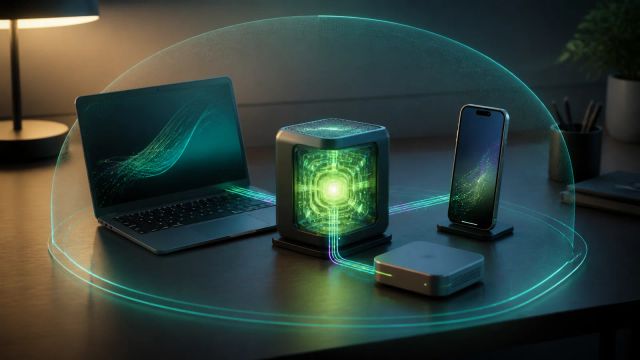
The lead image is Liquid’s edge-inference chart. It reports 15 GB of memory use on the M5 Max and 16 GB on the Ryzen device. Liquid separately reports more than 21,000 output tokens per second on one Nvidia B300 at high concurrency. That GPU figure measures throughput across concurrent requests, so it describes a different workload from one local agent’s generation speed.
How it differs from d1
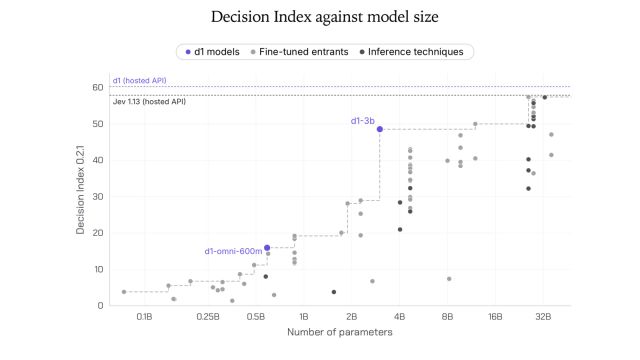
Liquid’s d1 announcement describes models that answer in one forward pass instead of generating tokens. Its support-ticket example returns a refund decision, a team choice and an urgency score from the same input.
d1-3B accepts text and images. The experimental d1-omni-600M accepts text with images or text with audio. LFM2.5-24B-A2B’s release instead centers on generated reasoning, tool calls and multi-turn agent tasks.