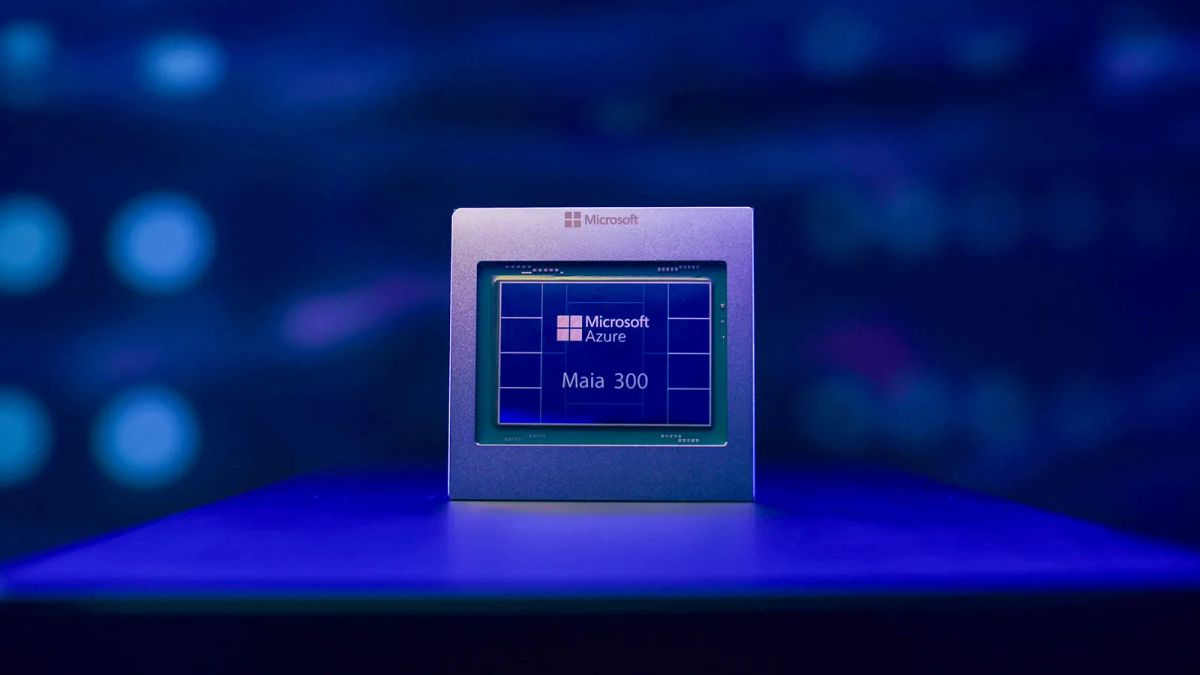
Microsoft has announced Maia 300, its third-generation in-house AI chip, with plans to make the Maia family the primary inference system for its own products and services. Production rollout starts in 2027, The Verge reports. The plan would reduce Microsoft’s reliance on Nvidia and AMD chips for running those AI services.
Inference is the work a model does when it answers a request. Microsoft is targeting that work with a system built for long-context reasoning, conversations that need fast responses, and agents that carry out sustained tasks over multiple steps.
Two performance claims with different baselines
Scott Guthrie, Microsoft’s cloud executive vice president, says the company expects Maia 300 to deliver 40% more tokens per megawatt than leading GPU-based systems. In a full configuration of 96 accelerators, he says it delivers up to seven times Maia 200’s rack-scale token throughput. The Verge quotes both claims.
The power-efficiency comparison uses GPU systems as its baseline. The rack-throughput comparison uses Microsoft’s previous Maia generation. Readers need to keep those baselines separate when judging the size of the improvement.
Microsoft plans to expand the Maia family to deployments at multi-gigawatt scale starting in 2027. Maia 200 already runs production workloads for Microsoft Copilot, GitHub Copilot, Microsoft Foundry and Microsoft’s own AI models, according to The Verge.
A chip designed alongside Microsoft’s models
Maia 300 uses a chiplet architecture that separates compute, memory controller and input/output functions. The Verge reports that it uses TSMC’s N2P process. Microsoft’s hardware team says the design gives more silicon area to compute and lets each function use technology suited to its role.
Microsoft AI chief Mustafa Suleyman describes co-designing Microsoft’s models with Maia as a focus for his team. That connects the hardware plan to the models Microsoft develops itself, as well as the services it operates. Microsoft’s announcement page also presents the chip, server and rack system and identifies Microsoft 365 as a Maia use case.