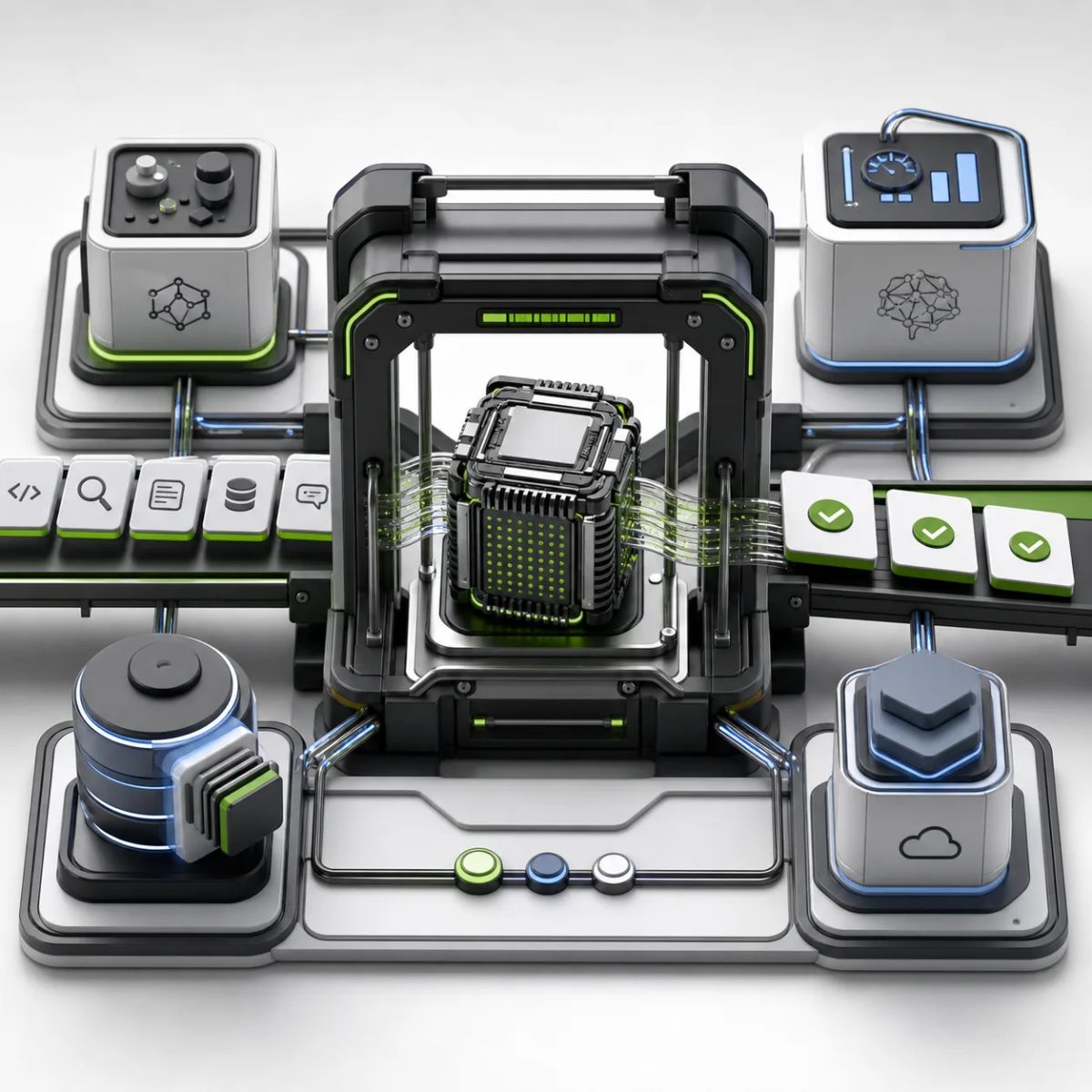
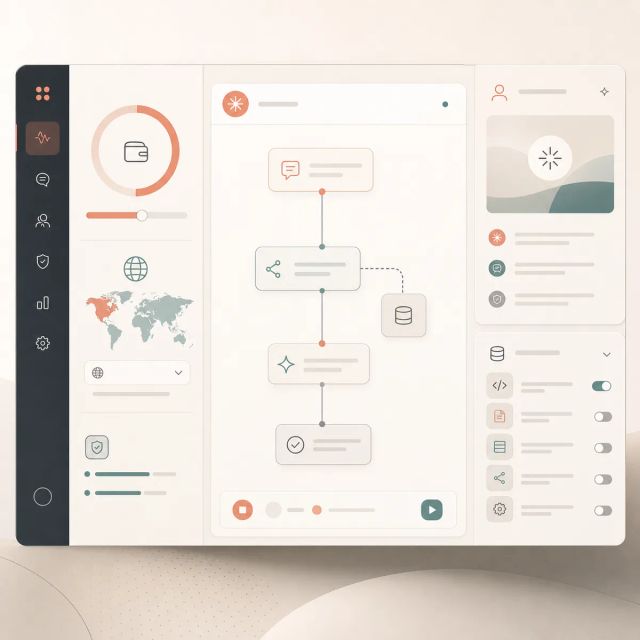
A modular agent harness surrounds a compact model core connected to tools, memory, evaluation, and runtime modules
+ Large Language Models News

NVIDIA says harness tuning lifts Nemotron 3 Ultra in LangChain agents

NVIDIA says tuning the LangChain Deep Agents harness for Nemotron 3 Ultra improved open-stack agent performance without retraining the model.

NVIDIA says LangChain tuned its Deep Agents harness for Nemotron 3 Ultra and reached leading open-model performance without retraining the model.

The July 8 post says the work came from engineering the environment around the model: system prompts, tool descriptions, middleware, memory, tool use, evaluation, and model behavior. NVIDIA frames the result as an open stack that enterprises can run, customize, and control.

NVIDIA also says the tuned setup completed more tasks at higher throughput and ran at 10x lower inference cost per run than leading closed models on LangChain’s Deep Agents benchmark.

Those claims come from NVIDIA and LangChain, so they should be read as launch evidence rather than neutral benchmarking. The interesting point is the mechanism: no new base model was required.

Agent work is becoming harness work

The post is a useful correction to model-only thinking.

For agents, the model is only one part of the system. Tool descriptions decide what the model thinks it can do. Middleware decides what happens before and after tool calls. Memory decides what context survives across steps. The runtime decides which actions are safe to execute.

If a tuned harness can materially improve results without retraining the model, enterprises have another lever besides buying a bigger model. They can tune the system around a model they control.

That is also where governance lives. NVIDIA’s NemoClaw for LangChain Deep Agents combines LangChain Deep Agents code, tuned for Nemotron 3 Ultra, with NVIDIA OpenShell as a secure runtime for executing agent actions.

The open-stack claim is the enterprise pitch

NVIDIA names Abridge, Amdocs, Box, and EY in the launch context. That matters because enterprise agent deployments are less about demo autonomy and more about ownership, audit, security, and repeatability.

An open model, open harness, and secure runtime are easier to inspect and customize than a closed model endpoint alone. The trade-off is operational responsibility: teams have to own evaluation, runtime policy, and deployment quality.

For teams already using LangChain, the immediate test is concrete. Pull the tuned profile, run it against an internal task set, compare it with a closed-model baseline, and measure both accepted task completion and total inference cost.

Sources

The AI Feed Desk

The AI Feed Desk

Editorial desk

The AI Feed Desk tracks AI provider updates, model releases, agent tooling, and enterprise adoption, turning fast-moving announcements into source-linked context for builders and operators.

Noticed a typo, incorrect information, or translation error?

Tell us so we can fix it.

Help Improve This Article

Related Articles

An enterprise agent console shows a spend meter, region selector, advisor lane, and repository skills panel

Anthropic adds budget and residency controls to Claude Managed Agents

Claude Managed Agents now support session budgets, advisor models, inference geography controls, and repository-loaded skills.

The AI Feed Desk

By The AI Feed Desk

8 minutes ago
A comment trigger, reasoning dial, and pull request checkpoint connect through a cloud agent workspace

GitHub gives Copilot cloud agent comment triggers and reasoning controls

GitHub added comment-triggered Copilot automations and per-task reasoning controls for Copilot cloud agent.

The AI Feed Desk

By The AI Feed Desk

A security operations console rotates token keys into a vault beside a dataset processing pipeline

Hugging Face says an autonomous agent breached production infrastructure

Hugging Face disclosed a July 2026 production incident it says was driven by an autonomous AI agent system and recommends token rotation.

The AI Feed Desk

By The AI Feed Desk

A translucent coordinator core routes tasks to several distinct expert model nodes

Sakana Fugu turns model orchestration into one API

Sakana AI is positioning Fugu as a single API that dynamically coordinates expert models for coding, reasoning, and other complex multi-step tasks.

The AI Feed Desk

By The AI Feed Desk

A Claude Opus 5 model control room routes coding, business, and research agent tasks through cost and safety controls

Claude Opus 5 becomes Anthropic's everyday agent model

Anthropic says Claude Opus 5 is available on Claude and the API at Opus 4.8 pricing, with stronger agentic coding and professional-work performance.

The AI Feed Desk

By The AI Feed Desk