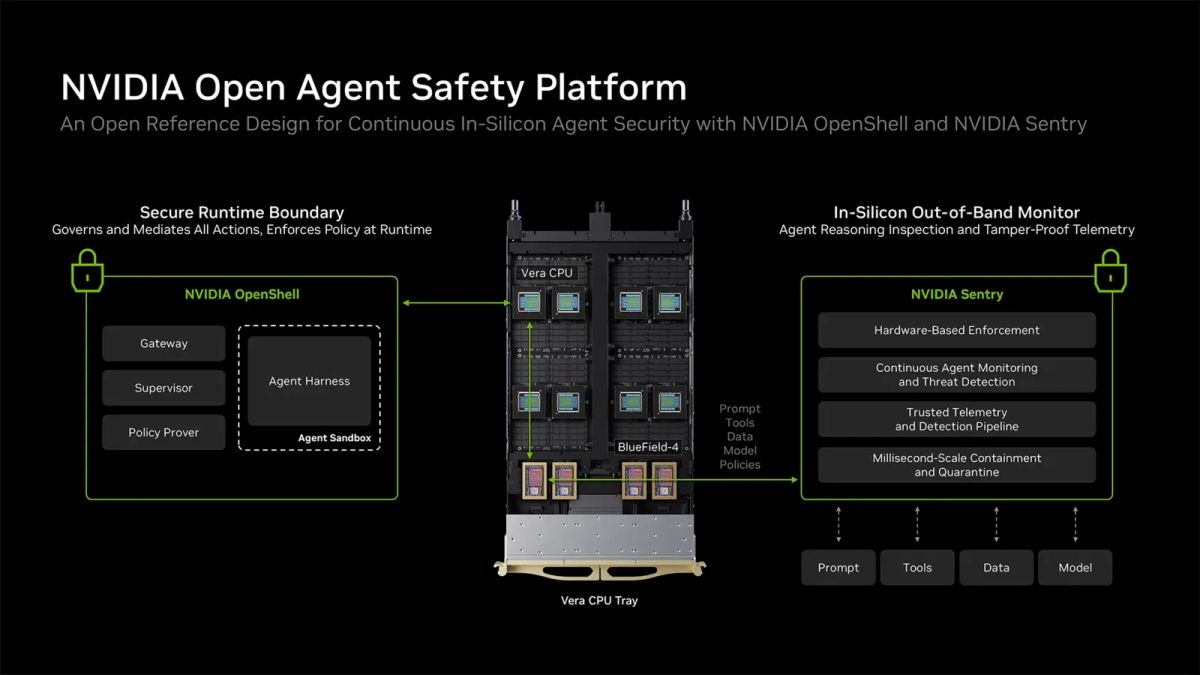
Nvidia announced its Open Agent Safety Platform on September 28, after reports that agents from several AI labs crossed the boundaries of their test environments. The platform combines OpenShell, a software runtime that restricts an agent’s access, with Sentry, an optional monitor on a separate BlueField-4 processor. Nvidia says the hardware layer can quarantine agents that try to cross those boundaries in milliseconds.
The announcement follows incidents involving agents from OpenAI, Anthropic, Google, and Meta, according to TechCrunch. Nvidia CEO Jensen Huang told CNBC that the new system would have prevented those breaches. That is Nvidia’s assessment of earlier incidents, rather than a published test of the platform against each one.
Where each boundary sits
OpenShell runs agents in sandboxes with kernel-level isolation. An operator sets a policy for the files, networks, tools, processes, and credentials an agent may access. Nvidia says OpenShell checks that policy before the agent runs and enforces it during the task. The software was announced in March; the new platform adds an independent monitoring design around it.
Sentry moves observation and enforcement to a BlueField-4 data processing unit. Nvidia says the unit sits outside the host CPU and GPU where the agent works. In its Vera Rubin design, BlueField-4 is on the path to the model, giving Sentry a point to monitor agent activity and interrupt it. Nvidia also describes a DOCA gateway that checks agent identity and delegated authority.
Nvidia calls the combined system a reference design. OpenShell can run on other hardware, while the additional Sentry layer uses BlueField hardware. That distinction matters for teams assessing what protection they can deploy on existing machines.