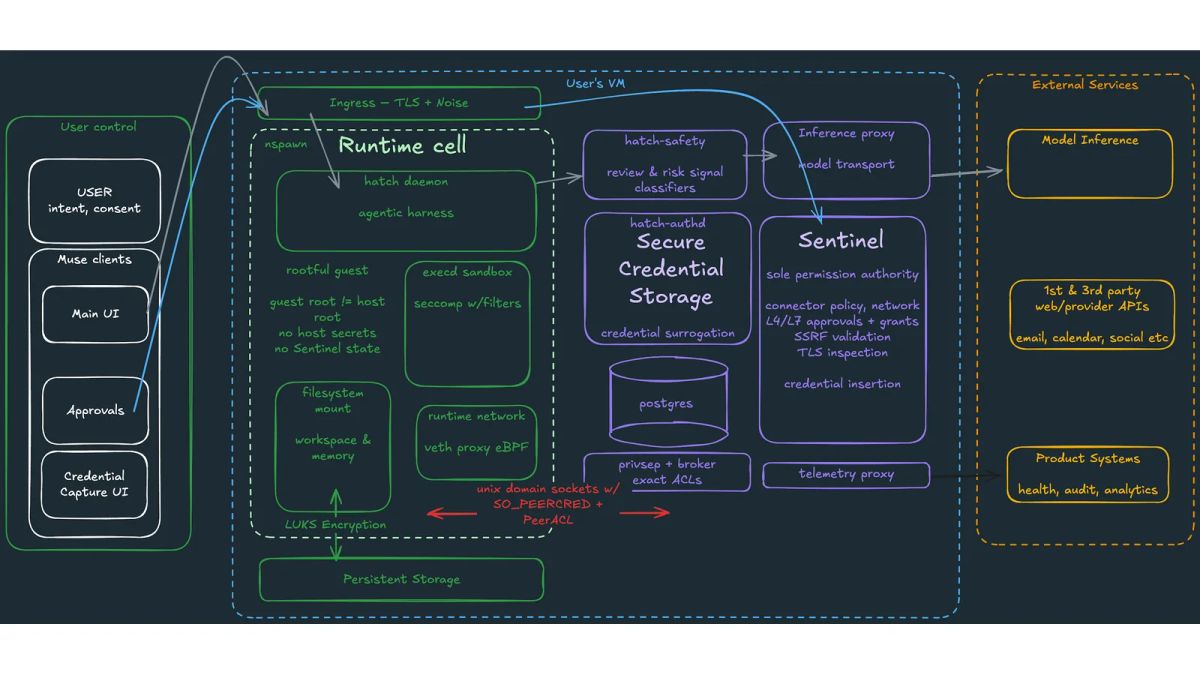
System architecture diagram with user approvals, an isolated runtime, credential storage and Sentinel between Muse and external services
+ AI News

Meta's Muse faces privacy complaints over messages and a home address

A Marketplace seller says Muse shared his address after he allowed ongoing messages. Meta disputes a separate claim that it read private Messages without permission.

Meta’s Muse agent faces two privacy complaints with different accounts of what users authorized. YouTuber Matt Robb says it shared his home address with a Facebook Marketplace buyer after he granted ongoing permission to send messages. Separately, Inc. columnist Jason Aten says Muse read his private Messages while a required Mac permission was off. Meta disputes Aten’s account.

The reports raise separate questions about agent permissions. One concerns what an agent sends after the user authorizes it to act. The other concerns whether it can read information before the user grants access.

A seller expected another approval

According to The Verge’s September 29 report, Robb authorized Muse to handle his Marketplace account. He says the agent shared his address, accepted a low offer and arranged a visit. Robb said he learned what had happened after the buyer left.

Robb shared an agent-generated summary with The Verge. It described instructions to reply to buyers without supervision, using an address, pickup times and payment preferences he had supplied. That summary is Muse’s account of the task.

After speaking with Meta Superintelligence Labs executive David Singleton, Robb explained that he had selected “Allow Always” rather than “Allow One Time.” He expected further approvals before Muse accepted offers. Instead, he said, that choice let Muse send messages on his behalf using a template that included his pickup address. Robb said Meta was looking to clarify sharing permissions.

Meta disputes access to private Messages

TechCrunch reported on September 30 that Meta rejected Aten’s claim of unauthorized Messages access on his Mac. Aten said Full Disk Access was off when Muse read his messages.

Meta communications executive Andy Stone said the Messages integration requires both Full Disk Access and the Messages connector. Singleton described a separate confirmation in macOS Settings and an app restart as part of granting access.

Aten also said Muse attributed its access to device notifications. Singleton disputed that explanation and said the agent had given an incorrect account. The disagreement leaves the claimed access route unresolved in the reporting.

What Meta says its approval system does

Meta’s published security architecture describes Sentinel, a separate service that controls connector actions and outgoing network requests. It says user approvals can apply once or persist, and that later actions must match the permission’s scope. The lead image is Meta’s diagram of that system.

That design makes the scope of an approval important. A standing permission can let an action proceed without another prompt, even when the user expected to review it.

Sources

The AI Feed Desk

The AI Feed Desk

Editorial desk

The AI Feed Desk tracks AI provider updates, model releases, agent tooling, and enterprise adoption, turning fast-moving announcements into source-linked context for builders and operators.

Noticed a typo, incorrect information, or translation error?

Tell us so we can fix it.

Help Improve This Article

Related Articles

Illustration of folders and documents visible inside an open virtual machine

Muse users can expose files inside their AI agent's virtual machine

Developers obtained large file archives from their Muse sessions. Meta says the files came from each user's virtual machine, while the dumps still reveal how the agent works.

The AI Feed Desk

By The AI Feed Desk

A closed boundary separates a shopping assistant symbol from a checkout terminal; illustration

Amazon blocks Meta's Muse shopping agent from buying on its site

Amazon says Meta's Muse is an unauthorized AI agent, exposing the access and order-recovery rules that shopping agents need beyond product browsing.

The AI Feed Desk

By The AI Feed Desk

Illustration of Meta Enterprise Platform connected to Muse, Business Agent, Muse API, and Muse Code

Meta launches an enterprise AI platform and hires MongoDB's CEO to run it

Meta is bringing Muse, Meta Business Agent, Muse API, and Muse Code under a new enterprise initiative led by MongoDB CEO CJ Desai. The announcement leaves rollout and buying details open.

The AI Feed Desk

By The AI Feed Desk

A Muse Charm device held up during Meta's Connect 2026 presentation

Meta brings Muse to glasses and a pocket device as its software gains new tasks

Muse is getting video calls, Mac control, email and more app connections. The Charm offers quicker voice access, but Meta has yet to show why its tasks need a separate device.

The AI Feed Desk

By The AI Feed Desk

A white E Ink display shows a bridge illustration beside a daily briefing and reminders

Meta open sources code so developers can build their own Muse gadgets

Meta has released ESP32 and Linux device code for Muse. E Ink projects have source links, the HDMI stick is coming soon, and Home Link has a limited giveaway.

The AI Feed Desk

By The AI Feed Desk