Musubi announced PolicyLM-1.7B on October 6, an open-weight decision model for content moderation. TechCrunch reports that it applies plain-English policies to messages, with a claimed response time under 50 milliseconds. It adds a moderation-specific option to the decision models we covered from Amazon and Cloudflare.
Strands Decider 2B, released on October 1 and included in that earlier coverage, provides a useful comparison. Both approaches use restricted answers to make decisions. Their examples put those decisions in different places, checking human messages against content rules or checking an agent before it calls a tool.
Musubi targets policies that change
According to TechCrunch, PolicyLM returns a binary judgment about whether content belongs in a category. Musubi says teams can change the policy without retraining the model. That would let policy writers revise moderation rules through text rather than commission a new training run for each revision.
The report describes the model as designed to match conventional moderation classifiers on cost and speed while applying more complex policies. It provides no hardware, input-length or accuracy results for the sub-50-millisecond claim.
Strands shows how a decision can stop a tool call
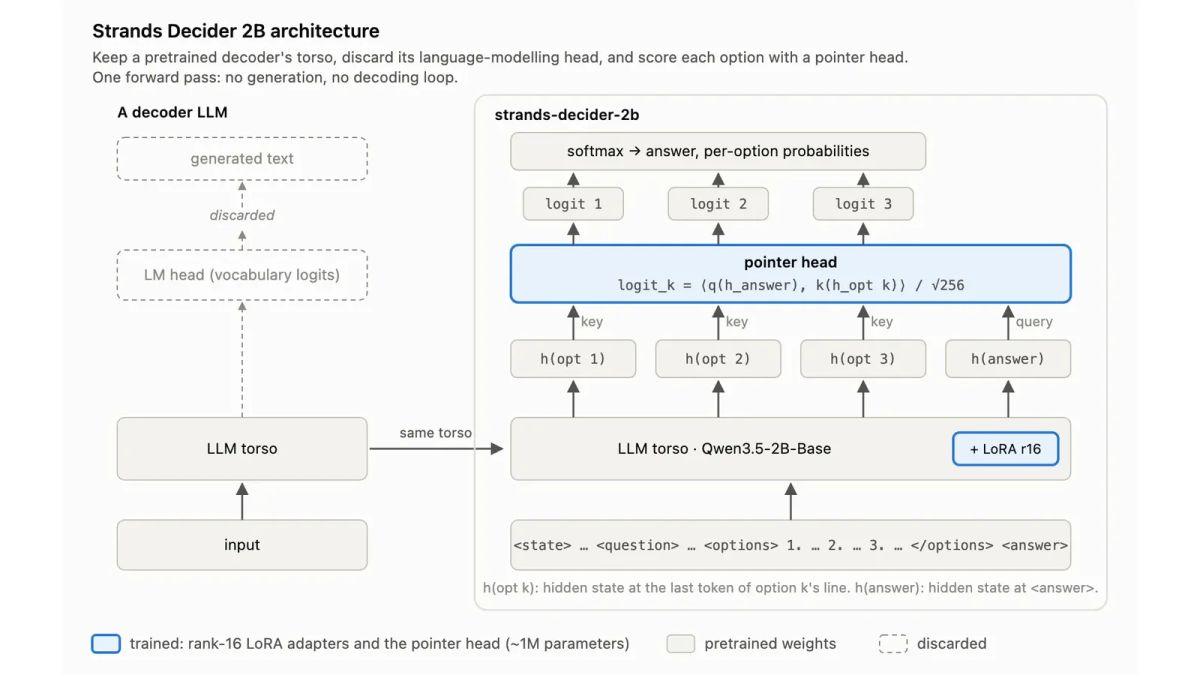
The Strands announcement describes a two-billion-parameter model based on Qwen3.5-2B. It replaces the component that generates text with a pointer head that scores supplied answer options. The lead diagram shows this architecture. Strands says it has released weights, code, training data and training scripts.
Its agent example checks a proposed weather-tool call. When the user asks about the weather without naming a city, the agent guesses one. Decider checks whether the arguments came from the user and whether the call is premature. The surrounding Python code sends the agent back to ask for a city.
Strands explicitly calls this an illustration with hand-picked questions, thresholds and policy. Its intervention handler can let a call proceed, deny it, ask a person for confirmation or return feedback to the agent.
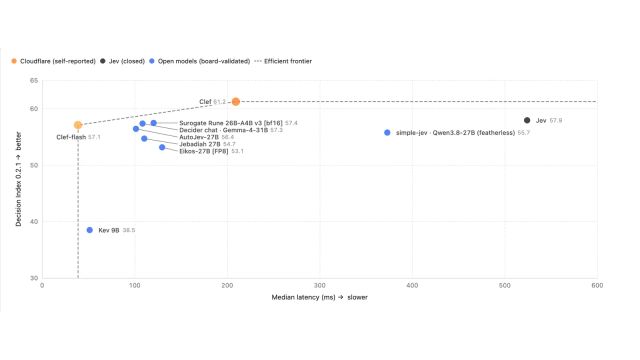
The team reports accuracy and probability calibration on JevBench’s public set. It also reports median local latency around 115 milliseconds on an Nvidia RTX 3090 and around 153 milliseconds for small tasks on an M3 MacBook. The published GPU latency chart measures v18, while the released model is v19. Latency grows with input length.