H Company's Holo4 launch graphic with a wireframe globe and two colored dots
+ AI News

Holo4's desktop results vary sharply by model size

H Company released two open-weight Holo4 agents for computer use. Its own OSWorld 2.0 results put the 27B model at 61.7% and the 35B-A3B model at 30.9%.

H Company has released Holo4, a family of open-weight agents that can work through a graphical interface, code, MCP tools, and APIs. The release includes a 27B dense model, a 35B-A3B mixture-of-experts model, and a smaller Holotron4 Nano. Both main models are available through H Company’s API and as downloadable weights.

The two main models have very different published desktop results. In H Company’s OSWorld 2.0 figures, Holo4 27B completes 61.7% of tasks, while Holo4 35B-A3B completes 30.9%. That is a 30.8 percentage point gap. H Company also lists Claude Opus 5.5 at 81.8% on the benchmark, although it cautions that the releases and testing setups behind comparison points differ.

One agent across several interfaces

H Company says the same Holo4 model can click and type in desktop or mobile apps, run code, and call tools when an API is available. It trained the models on supervised examples and reinforcement learning, including tasks produced by an internal system that generates interactive environments. The company says this system has made about 10,000 tasks across web apps, desktop software, and MCP servers.

The release includes public trajectories for benchmark runs, so developers can inspect the steps behind a score. H Company also shows longer examples in FreeCAD and Godot, but those demonstrations use different tasks and token counts. They are useful examples of what the agent attempts, not a controlled comparison of which model is cheaper to run.

Sources

The AI Feed Desk

The AI Feed Desk

Editorial desk

The AI Feed Desk tracks AI provider updates, model releases, agent tooling, and enterprise adoption, turning fast-moving announcements into source-linked context for builders and operators.

Noticed a typo, incorrect information, or translation error?

Tell us so we can fix it.

Help Improve This Article

Related Articles

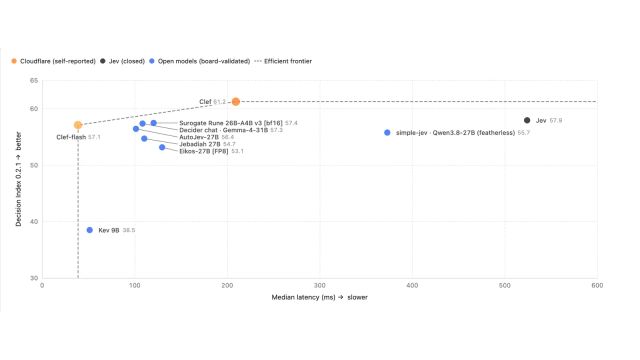
Scatter chart comparing decision index scores and median latency for Clef, Clef-flash, Jev and other decision models

Amazon and Cloudflare release open decision models as the Jev clones multiply

AWS releases Strands Decider 2B. Cloudflare adds Clef and Clef-flash, with open weights and hands-on fine-tuning. Task scores show where speed costs accuracy.

The AI Feed Desk

By The AI Feed Desk

A Gemini-colored cursor moves through a browser window inside a guarded sandbox

Gemini 3.5 Flash gets a Computer Use tool for agent workflows

Google's Gemini API now previews Computer Use with browser, mobile, and desktop environments, making execution safety and logging part of the developer workflow.

The AI Feed Desk

By The AI Feed Desk

Jeff project logo with a smiling robot inside a blue ring above the name Jeff

OpenAI's Decisions API and the Jev clones racing to match it

OpenAI previews a Jev-style decision API. Jeff, Jeeves and Jevstiller offer different local approaches, with trade-offs in speed, reasoning and agreement.

The AI Feed Desk

By The AI Feed Desk

AstaBrief name in green surrounded by outlined research documents on a dark green background

Ai2 open-sources AstaBrief, the fast report-generation model in Asta

Ai2 releases AstaBrief's weights and training data. Fast mode averages 51.1 seconds per report in Asta, with evaluation limits worth checking before adoption.

The AI Feed Desk

By The AI Feed Desk

A closed boundary separates a shopping assistant symbol from a checkout terminal; illustration

Amazon blocks Meta's Muse shopping agent from buying on its site

Amazon says Meta's Muse is an unauthorized AI agent, exposing the access and order-recovery rules that shopping agents need beyond product browsing.

The AI Feed Desk

By The AI Feed Desk