Amazon Web Services and Cloudflare have released open decision models in the same week as OpenAI’s similar offering. AWS’s Strands Decider 2B runs locally. Cloudflare’s Clef and Clef-flash offer downloadable weights and hosted access on Workers AI, plus a hands-on service to fine-tune them for specific jobs.
They give developers more ways to handle a narrow step in an agent workflow. A decision model chooses among predefined options and returns probabilities. Software can use those outputs to route a support ticket, select the next action or send an uncertain case to a person.
AWS starts with a small local model
TechCrunch reports that Strands Decider 2B grew out of distinguished engineer Marc Brooker’s experiments with TypeSafe’s Jev. Amazon engineers prepared the project for release through Strands Labs after it briefly led the Jevbench ranking for models of its size.
The model uses Qwen3.5-2B as its base. It returns calibrated choices instead of generating text, and TechCrunch describes it as fully open source and small enough to run locally. Brooker says AWS customers wanted workflow decisions that cost less and take less time than a full LLM call.
He also identifies a training trade-off. Improving accuracy and probability calibration on decision tasks can weaken the language understanding and knowledge that make a model useful across different jobs. A strong classifier for one workflow still needs testing on the next.
Cloudflare adds vision and hosted access
Cloudflare says Clef and Clef-flash have a vision encoder and a 64,000-token context window. The company compares those capabilities with Jev’s text classification and 32,000-token window. It releases the models on Hugging Face under Apache 2.0 and says their API is compatible with Jev’s.
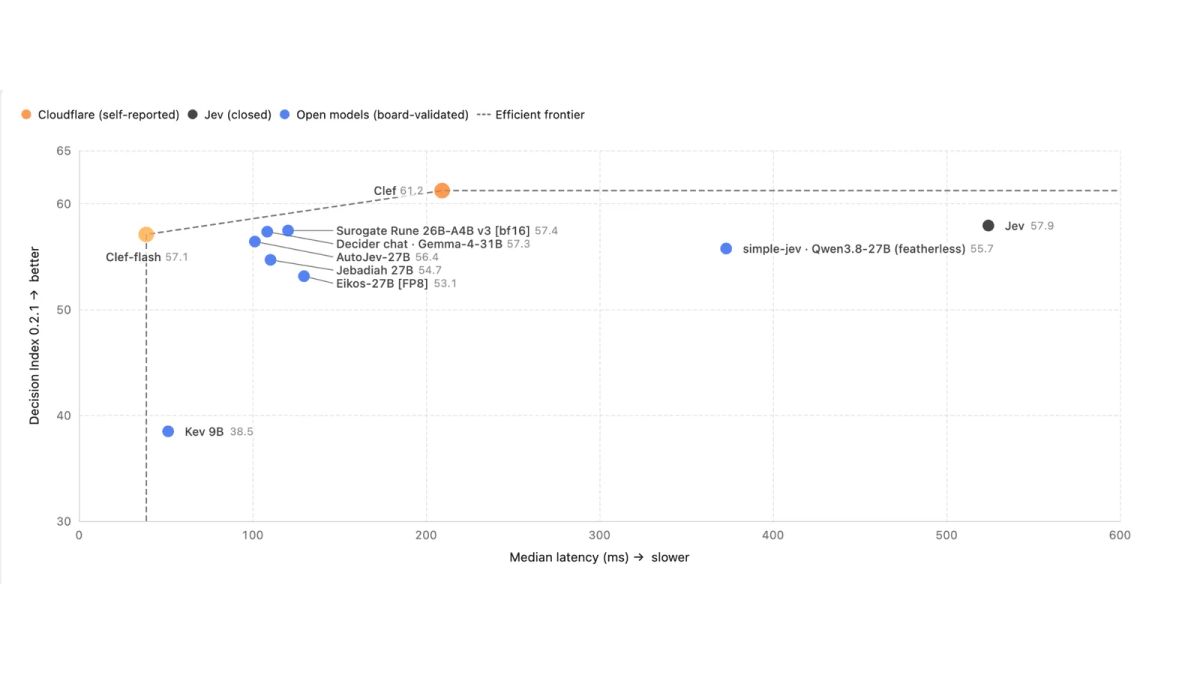
Clef uses Qwen3.8-27B as its base, while Clef-flash uses Qwen3.5-9B. Both score valid choices after processing the input, rather than generating an answer token by token. Cloudflare reports median latencies of 209.3 milliseconds for Clef and 38.8 milliseconds for Clef-flash across 43 evaluations, versus 524.1 milliseconds for Jev.
The lead image is Cloudflare’s published decision-index chart. Its legend marks Cloudflare’s results as self-reported. The announcement’s task tables also show that the ranking changes with the job.
Cloudflare’s website-classification example gives a separate measure of practical latency. Fetching, rendering and classifying a website took Clef 2.2 seconds, compared with 4.7 seconds for gpt-oss-120b in the same workflow. That end-to-end example includes work beyond the decision itself.
Fine-tuning begins as a service
Cloudflare’s reinforcement learning launch starts with its forward-deployed engineers helping customers tune Clef. The company plans to use those engagements to build a self-serve platform for collecting data, training and redeploying models.
Its proposed process combines AI Gateway request data, Workers AI model runs, Containers for scoring actions, a new Trainer to update weights and deployment back to Workers AI. Cloudflare describes parts of that platform as work in progress. Developers can try the released models now, while custom training begins through the hands-on service.