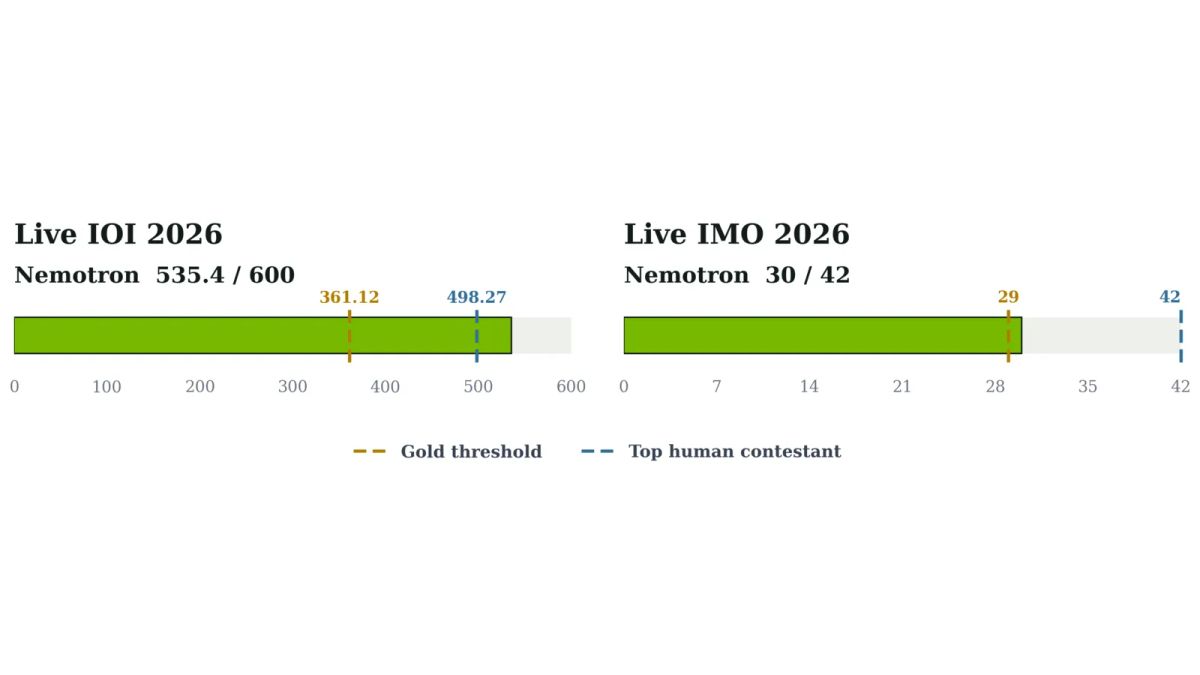
Nvidia says specialist systems built from Nemotron 3 reached gold-medal-level scores at both the 2026 International Olympiad in Informatics and International Mathematical Olympiad. Its programming system scored 535.4 out of 600, above the reported gold threshold of 361.12 and top human score of 498.27. Its mathematics system scored 30 out of 42, one point above the gold threshold.
The October 7 report describes separate specializations of one model family. Each combines domain training with a process that generates answers, checks them and revises promising attempts.
Nvidia says the IOI run took place live under the same time, internet-access and submission constraints as human contestants. It was an unofficial, unsupervised benchmark outside the official ranking. Official IMO graders graded the mathematics system’s submitted proofs.
Programming specialists learned from 22,000 problems
Nvidia curated 22,000 competitive-programming problems and generated synthetic reasoning traces. It used those examples to train Nano-CC, with 30 billion total parameters and 3 billion active parameters, and Ultra-CC, with 550 billion total parameters and 55 billion active parameters.
Nano received supervised fine-tuning, which trains on examples, and reinforcement learning. Ultra received supervised fine-tuning. Nvidia says one training epoch was enough for Ultra to outperform the fully post-trained Nano across IOI, ICPC and LiveCodeBench Pro.
The IOI 2026 system paired Ultra-CC with GenCorrect, Nvidia’s iterative generate-evaluate-refine method. Earlier IOI 2025 experiments show how much that process changed the outcome. Nano rose from 130 points before post-training to 280 after supervised fine-tuning and 291 after reinforcement learning. GenCorrect raised it to 468, above that year’s 438.3 gold threshold. Ultra-CC reached 502 with the same inference strategy.
Mathematics training included criticism and revision
For IMO, Nvidia trained separate supervised and reinforcement-learning specialists from Nemotron 3 Ultra. The supervised corpus held 414,890 filtered examples across 15,818 unique proof problems. Those examples covered proof generation, revision, verification and checks of the verification itself. The reinforcement-learning model trained on 9,597 problems near the limit of its ability.
The supervised specialist performed best in the first search round. The reinforcement-learning specialist delivered the best overall result when using a single checkpoint. Nvidia combined both with the general model for the final system.
The models proposed proofs, scored them, wrote critiques and revised candidates. A separate stage with a high compute budget selected final submissions. The system worked in natural language without a formal prover, external tools or internet access. It earned full credit on four of six problems.
What Nvidia has released
Nvidia says its Hugging Face IMO collection includes both specialist checkpoints, both training datasets and Nemotron-IMO-Bench, a 200-problem benchmark. NeMo-Skills includes the IMO inference pipeline, prompts, submitted proofs and a quickstart. The Ultra-CC programming model is also available on Hugging Face, with IOI evaluation and inference code in NeMo-Skills. The accompanying papers describe the training methods.