Reflection has introduced Beam, a text-only AI model with 501 billion total parameters and 23 billion active parameters. The US startup pitches it as an open-weight option for coding, reasoning, and tasks that require an AI agent to use tools. It claims competitive performance against Chinese open models with lower inference compute.
Beam is still a preview. Reflection says it is completing red-team testing and evaluations, with early access for selected users. It plans to release the weights under Apache 2.0 later in October, alongside a technical report, model card, and software for running, evaluating, and fine-tuning the model.
What the lower-compute claim measures
Beam uses a sparse mixture-of-experts architecture. Reflection pretrained it on 23.8 trillion tokens and extended its context length to one million tokens during midtraining. Its reinforcement-learning campaign used 10,500 Nvidia GB300 GPUs over four weeks and generated more than 100 million training attempts.
Reflection reports reasoning scores comparable to GLM-5.2 with three to four times less inference compute. Its coding results vary by test. Beam scores 65.5 against GLM-5.2’s 62.1 on SWE Bench Pro v1, but 80.1 against 81.0 on Terminal Bench v2.1. Reflection also acknowledges that models such as Kimi K3 remain ahead on raw capability. TechCrunch reports that Reflection’s performance claims have yet to receive independent verification.
The compute comparison estimates operations by multiplying twice the active parameter count by the mean generated tokens per attempt. Those tokens include reasoning and the final answer. Reflection explicitly excludes prompt processing, attention work that depends on context length, and serving overhead. The estimate therefore covers only part of the work a deployment must do.
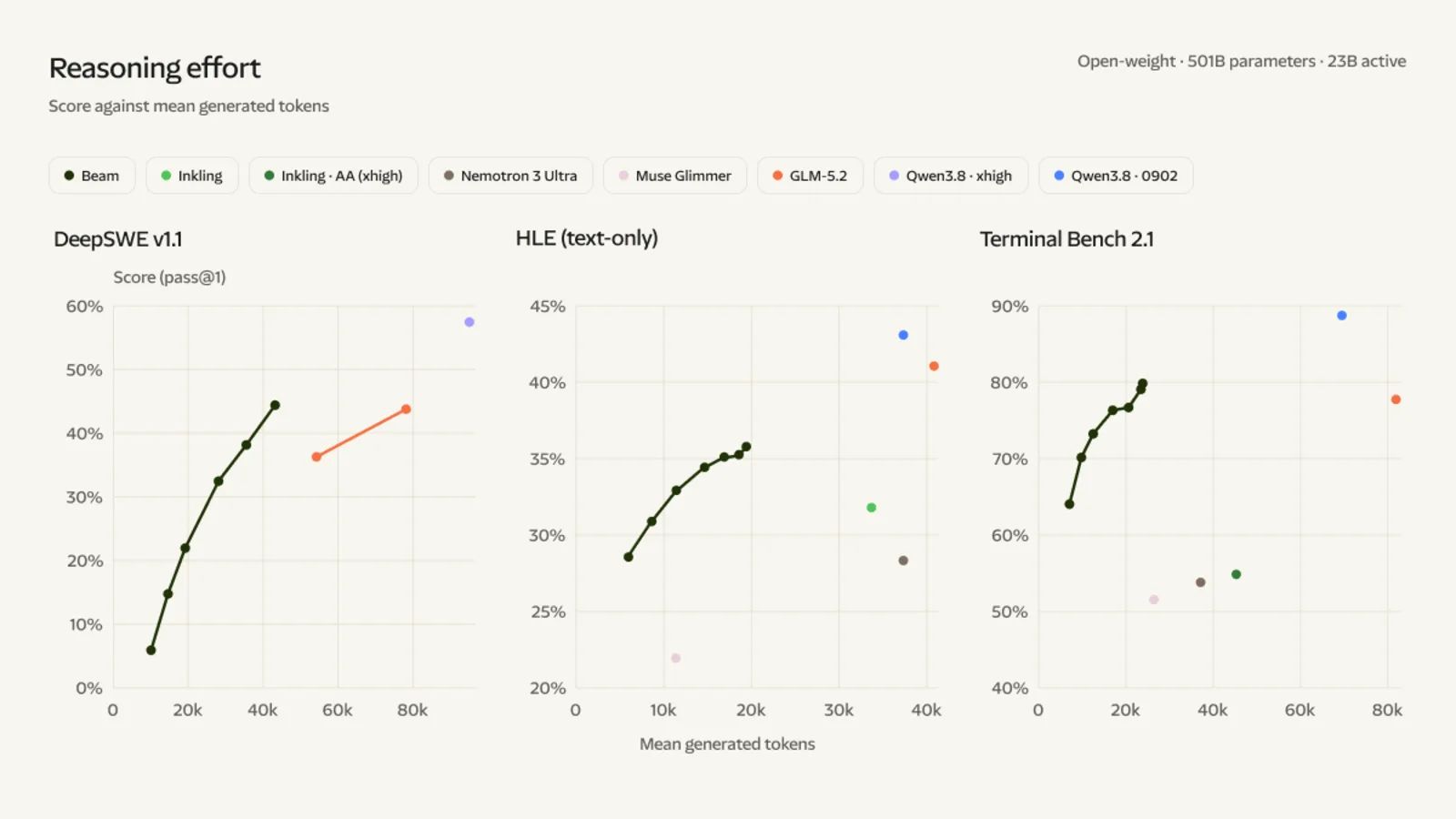
Reflection's chart shows the tradeoff between benchmark scores and generated tokens. Beam's reasoning effort setting lets users vary response length and performance.
Source: Reflection
An enterprise and sovereign AI offer
TechCrunch reports that Reflection wants enterprises and sovereign nations to build customized, local AI systems with its models and their own proprietary data. The company calls these systems “AI factories.” It has begun testing a sovereign AI factory partnership with South Korea’s Shinsegae Group.
The planned weight release would give builders a model they can run and adapt. Reflection also plans distribution partners and integrations with open-source libraries. Those plans accompany a business offer whose appeal depends on both model performance and the customer’s ability to operate a local system.
Sources
- Reflection: Introducing Beam: Reflection’s 501B open-weight model. Lead artwork and benchmark chart credit: Reflection.
- TechCrunch: Reflection debuts Beam, an open-weight AI model to rival Chinese models at lower compute cost