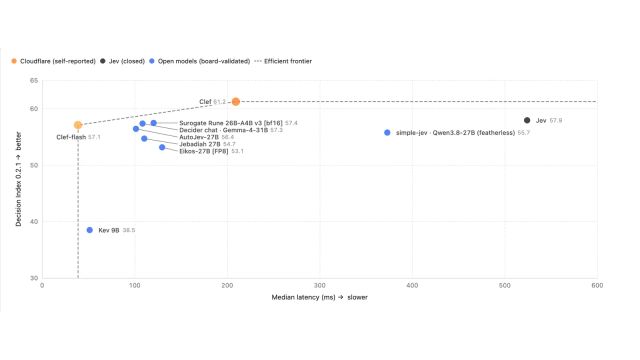
OpenAI has previewed a Decisions API that asks its Luna model to choose among predefined options. TechCrunch describes it as a Jev clone, aimed at the same need for fast, cheap decisions inside software. Builders can already explore that approach locally through Jeff, Jeeves and Jevstiller, but each solves a different part of the problem.
According to TechCrunch’s September 30 report, Sam Altman described image classification and choices between agent behaviors as uses for the API. It remains a limited preview. The report had yet to see developers test it, so a speed or accuracy comparison with the open projects remains premature.
Why small decisions matter for agents
TypeSafe’s Jev takes a situation and a set of options, then returns probabilities. An agent can use those decisions to pick a tool or check whether an action fits its task, while a larger model handles planning and writing.
TechCrunch reports a hackathon demo that used Jev to permit, flag or block agent actions. It put the monitoring cost at $2.94 with Jev versus $372 with a frontier model. Those are the demo’s reported costs. The useful question for builders is whether a cheaper check makes reviewing every action affordable at their own workload.
Jeff makes the small-model case
Jeff offers a 0.8-billion-parameter model that returns option probabilities in one forward pass. Its October 1 community preview includes nine task adapters for jobs such as prompt-injection checks, support triage and tool choice.
The project’s reported speed depends on hardware and measurement conditions. With all nine adapters loaded and a different adapter on each request, its server records a 30 ms median on an NVIDIA RTX PRO 6000. Separate base-model measurements on roughly 200-token inputs report 28 ms on an Apple M4 Max and 463 ms on a 32-thread CPU.
Jeff also reports a comparison against Qwen3.8-27B on an M4 Max. Across eight adapter tasks, the smaller model plus a fallback to the 27B scores 95.3% mean accuracy versus 86.6% for the 27B alone. Mean decision time falls from 8.1 seconds to 0.25 seconds. The comparison uses fixed held-out samples and disables the 27B’s step-by-step reasoning.
That result has a clear scope. Task adapters help Jeff classify familiar kinds of inputs. Its broader benchmark table shows weaker results than Jev on reasoning-heavy tasks, and the published Jev scores use different samples. Jeff currently handles English text. Its v1.2 adapters also require that exact base version, so an upgrade means retraining them.
Jeeves buys reasoning with more time
Jeeves, hosted in PostHog’s GitHub organization, uses a 9-billion-parameter model that can reason before choosing. The repository publishes training code and train, development and test data, along with a Jev-compatible API.
On the 231 public JevBench items, it reports 93.5% accuracy against Jev’s 86.6%. The sealed judge tier is outside that comparison. Its knowledge results trail Jev on MMLU and MMLU-Pro.
The latency cost matters for an agent that must wait before acting. On one H100 with FP8 precision, the project reports about 0.3 seconds per request without thinking. Full thinking has a 3.3-second median and a 17.1-second 90th-percentile latency on its development timing set. Builders can shorten reasoning or skip it above a confidence threshold. A local reasoning model therefore needs a different time budget from Jeff’s small classifier.
Jevstiller reduces calls to the teacher
Jevstiller learns a small local classifier from Jev’s probability outputs. It reports about 15 ms on a CPU for requests it accepts locally, and sends the rest to Jev.
Its example 98% target measures agreement with Jev across all requests. It measures how well the system reproduces its teacher, including the teacher’s mistakes. The statistical bound assumes calibration data represents the traffic the system will receive. A permanent 2% audit sample checks live agreement and can trigger a return to Jev when it detects a breach.
Coverage varies sharply. In the project’s threshold comparison, the bounded router answers 86.5% of AG News requests locally, but only 24% of TweetEval sentiment requests. Jevstiller also offers a setting to preserve Jev’s low-confidence flags, at a further cost in local coverage. Builders who use those flags for human review need to account for that setting.